German Adjectives – Complete Guide with Lists, Endings, and Examples
Contents
Key takeaways
- German adjectives describe people, places, objects, and emotions — they are essential for any level of fluency.
- Predicative adjectives (after sein, werden, bleiben) never change their form.
- Attributive adjectives (before nouns) take endings based on gender, case, and article type.
- Learning adjectives in thematic groups — size, color, emotion, personality — speeds up vocabulary growth.
- Regular exposure to real sentences trains you to use endings naturally without memorizing every rule.
German adjectives unlock a whole new level of expression. Whether you want to describe your apartment, talk about your mood, or understand a German novel, adjectives are the words that bring meaning to life.
This guide covers everything you need: adjective lists by category, the three positions adjectives can take, how endings work in each case, comparison forms, common mistakes to avoid, and real sentence examples throughout.
If you want to practice these words in context with guided support, you can explore the German language course on Promova and build your skills step by step.
What are adjectives in German?
Adjectives in German are words that modify or describe nouns. They tell you about qualities such as size, color, age, mood, or condition. German adjectives appear in three main positions:
- Attributive position — directly before a noun: ein großes Haus (a big house)
- Predicative position — after linking verbs like sein (to be), werden (to become), bleiben (to stay): Das Haus ist groß.
- Adverbial position — describing a verb instead of a noun: Sie singt schön. (She sings beautifully.)
The key difference: only attributive adjectives change form. Predicative and adverbial adjectives always stay in their base form, no matter the noun's gender or case.
Adverbial adjectives: describing verbs, not nouns
In English, most adverbs end in "-ly" — quickly, quietly, happily. German doesn't work that way. Instead, German often uses the plain adjective itself to describe a verb, with no ending added.
- Sie singt schön. — She sings beautifully.
- Der Zug fährt schnell. — The train goes fast.
- Er spricht leise. — He speaks quietly.
These adjectives look exactly like their predicative form. The difference is what they describe: predicative adjectives describe the subject (Der Zug ist schnell — The train is fast), while adverbial adjectives describe the action itself (Der Zug fährt schnell — The train goes fast).
That overlap is good news — once you know an adjective's base form, you already know its adverbial form too.
Why German adjectives matter for communication
Without adjectives, German would feel flat and hard to follow. These words help you describe people and things with precision, express emotions and personal opinions, understand descriptive passages in books and conversations, and make your German sound natural and expressive.
Common German adjectives for daily use
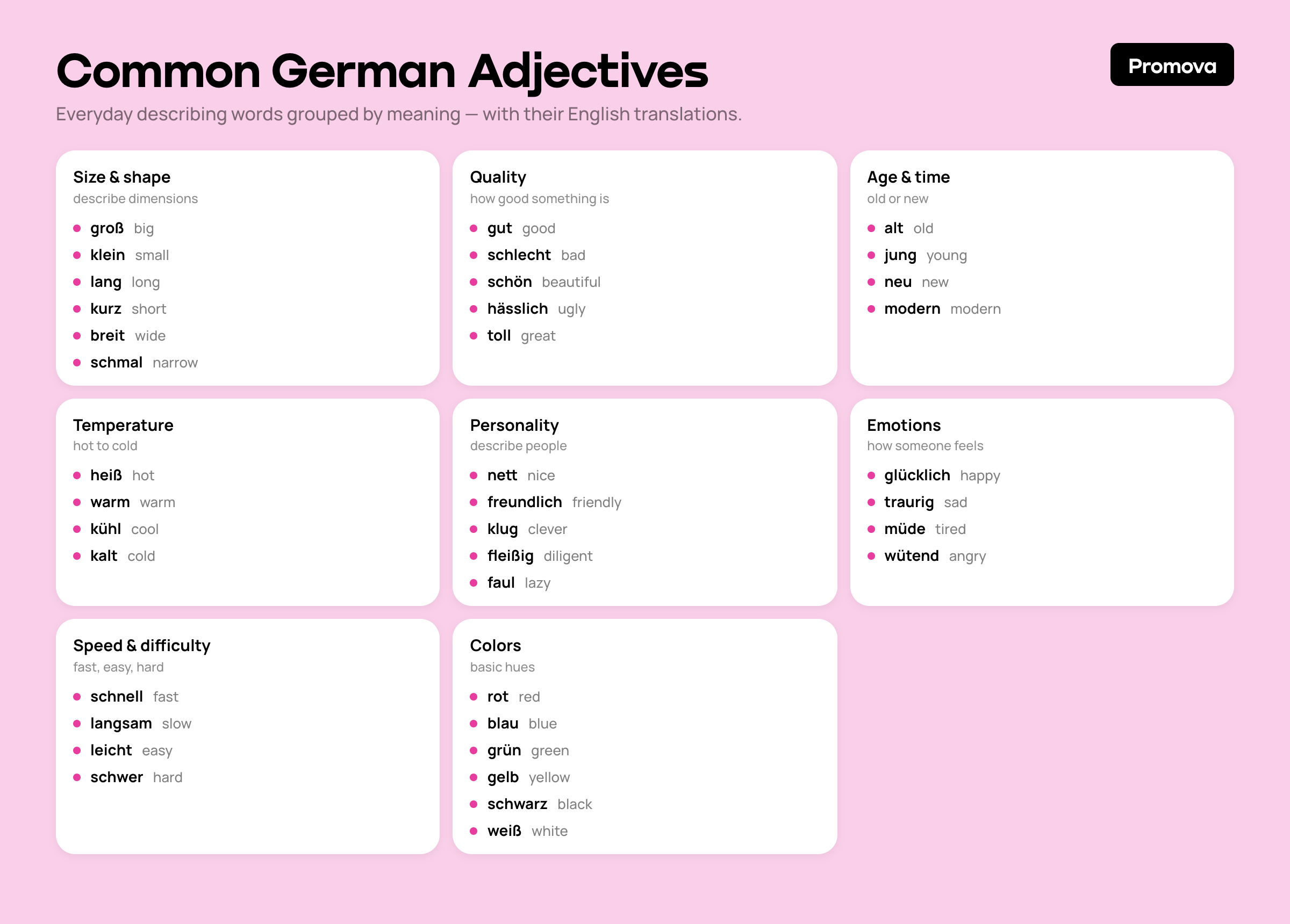
The most useful adjectives are the ones you encounter every day. Here is a core list organized to help you start using them right away.
Size and dimension
- groß — big, tall
- klein — small, short
- lang — long
- kurz — short (length)
- breit — wide
- schmal — narrow
- hoch — high, tall
- tief — deep, low
- dick — thick, fat
- dünn — thin
Quality and condition
- gut — good
- schlecht — bad
- neu — new
- alt — old
- sauber — clean
- schmutzig — dirty
- kaputt — broken
- gesund — healthy
- krank — sick, ill
- voll — full
- leer — empty
Temperature and weather
- kalt — cold
- warm — warm
- heiß — hot
- kühl — cool
- nass — wet
- trocken — dry
- sonnig — sunny
- bewölkt — cloudy
Personality and emotions
- freundlich — friendly
- nett — nice, kind
- lustig — funny
- traurig — sad
- glücklich — happy
- böse — angry, evil
- ruhig — calm, quiet
- laut — loud
- müde — tired
- aufgeregt — excited
- ängstlich — anxious, fearful
- stolz — proud
Difficulty and evaluation
- leicht — easy, light
- schwierig / schwer — difficult, hard
- einfach — simple
- kompliziert — complicated
- interessant — interesting
- langweilig — boring
- wichtig — important
- nützlich — useful
Adjectives in real sentences
- Das Essen ist gut. — The food is good.
- Der Hund ist klein. — The dog is small.
- Die Aufgabe ist schwierig. — The task is difficult.
- Ein schöner Tag beginnt. — A beautiful day is beginning.
- Das Wasser ist kalt. — The water is cold.
- Sie ist sehr freundlich. — She is very friendly.
- Der neue Lehrer ist interessant. — The new teacher is interesting.
- Wir haben ein großes Problem. — We have a big problem.
German adjective endings (basic idea)
When an adjective comes before a noun, it needs an ending. The ending depends on three things: the article type (definite, indefinite, or none), the noun's grammatical case (nominative, accusative, dative, genitive), and the noun's gender and number.
Weak declension — after definite articles (der, die, das)
The definite article already carries full gender and case information, so the adjective ending is mostly -e or -en:
- Nominative: der alte Mann, die alte Frau, das alte Haus, die alten Häuser
- Accusative: den alten Mann, die alte Frau, das alte Haus, die alten Häuser
- Dative: dem alten Mann, der alten Frau, dem alten Haus, den alten Häusern
- Genitive: des alten Mannes, der alten Frau, des alten Hauses, der alten Häuser
Mixed declension — after indefinite articles (ein, eine)
When the article does not fully show gender or case, the adjective carries a stronger ending:
- Nominative: ein alter Mann, eine alte Frau, ein altes Haus
- Accusative: einen alten Mann, eine alte Frau, ein altes Haus
- Dative: einem alten Mann, einer alten Frau, einem alten Haus
- Genitive: eines alten Mannes, einer alten Frau, eines alten Hauses
Strong declension — without an article
When there is no article, the adjective must show full gender and case information on its own:
- Nominative: kalter Kaffee, frische Luft, gutes Brot
- Accusative: kalten Kaffee, frische Luft, gutes Brot
- Dative: kaltem Kaffee, frischer Luft, gutem Brot
- Genitive: kalten Kaffees, frischer Luft, guten Brotes
When adjectives do not change
Predicative adjectives — placed after verbs like sein, werden, or bleiben — always stay in their base form:
- Der Kaffee ist heiß. — The coffee is hot.
- Die Blumen sind schön. — The flowers are beautiful.
- Das Kind bleibt ruhig. — The child stays calm.
- Die Aufgaben werden leichter. — The tasks are getting easier.
The same rule applies to adverbial adjectives, since they never take endings either:
- Sie spricht langsam. — She speaks slowly.
German adjectives list for steady vocabulary growth
Expand your vocabulary with these useful groups organized by theme.
Colors
- rot — red | blau — blue | grün — green | gelb — yellow
- schwarz — black | weiß — white | grau — gray | braun — brown
- orange — orange | lila / violett — purple, violet
Speed and movement
- schnell — fast | langsam — slow | plötzlich — sudden | regelmäßig — regular
Value and price
- teuer — expensive | billig / günstig — cheap, affordable
- kostenlos — free (no cost) | wertvoll — valuable
Intelligence and character
- klug / intelligent — smart | dumm — stupid | fleißig — hardworking | faul — lazy
- ehrlich — honest | höflich — polite | selbstbewusst — confident | schüchtern — shy
- stark — strong | schwach — weak
Safety and certainty
- sicher — safe, certain | gefährlich — dangerous
- möglich — possible | unmöglich — impossible | wahr — true | falsch — wrong, false
Why adjective practice helps learners
Adjectives are not just vocabulary — they are building blocks of meaning. Consistent practice helps you follow descriptions in stories and articles, talk about experiences and opinions, write accurate sentences, and understand compliments and evaluations in everyday German.
German adjective comparison: positive, comparative, superlative
German adjectives have three degrees of comparison. Most adjectives form the comparative by adding -er and the superlative with -(e)st. Many common adjectives also add an Umlaut:
- groß → größer → am größten
- alt → älter → am ältesten
- jung → jünger → am jüngsten
- warm → wärmer → am wärmsten
Irregular forms to memorize:
- gut → besser → am besten (good → better → best)
- viel → mehr → am meisten (much → more → most)
- gern → lieber → am liebsten (gladly → preferably → most preferably)
Real examples:
- Dieses Buch ist besser als das andere. — This book is better than the other one.
- Sie ist die klügste Studentin in der Klasse. — She is the smartest student in the class.
- Der Sommer ist wärmer als der Frühling. — Summer is warmer than spring.
Word order and emphasis with German adjectives
German adjective order usually matches English: the adjective sits right before the noun it describes, or right after the linking verb.
| Type | English | German |
| Attributive | The little boat floated. | Das kleine Boot trieb. |
| Predicative | The ocean is deep. | Der Ozean ist tief. |
| Adverbial | The shark circled slowly. | Der Hai kreiste langsam. |
German word order is more flexible than English, though. You can move a predicative or adverbial adjective to the front of a sentence to add emphasis:
- Tief ist der Ozean. — Deep is the ocean.
- Langsam kreiste der Hai. — Slowly circled the shark.
You can also strengthen an adjective by adding a word like sehr (very), wirklich (really), or echt (truly) right before it:
- Der Kaffee ist sehr heiß. — The coffee is very hot.
- Das war wirklich einfach. — That was really easy.
These small words are an easy way to sound more natural and expressive without learning new grammar rules.
Common mistakes with German adjectives
Even confident learners trip up on a few patterns. Here's what to watch for.
The first mix-up happens right after the definite article, where a strong ending sneaks in where it doesn't belong:
correct (green) and incorrect (red) A strong ending after der/die/das is a common slip. Definite articles already show gender and case, so the adjective takes the weak ending -e.Declension after der/die/das
Indefinite articles cause the opposite problem — the ending gets dropped entirely:
correct (green) and incorrect (red) "ein" doesn't always show gender clearly, so the adjective has to carry that information. The neuter nominative/accusative slot needs the strong ending -es.Ending after ein or eine
A third pattern goes the other direction: adding an ending where the adjective should stay untouched.
correct (green) and incorrect (red) Predicative and adverbial adjectives never take endings. The base form stays unchanged after "sein."Predicative and adverbial adjectives
And finally, comparatives bring their own trap — a missing umlaut that changes how natural the sentence sounds:
correct (green) and incorrect (red) Words with a, o, or u often need an umlaut in the comparative. The umlaut is part of the comparative form, not optional.Umlaut in comparative forms
Mixing up "schwer" and "schwierig." Both can mean "difficult," but schwer also means "heavy," while schwierig only works for difficulty. Die Tasche ist schwer (The bag is heavy) makes sense — Die Tasche ist schwierig doesn't.
Once you recognize these patterns, you'll start catching your own mistakes before they become habits.
Tips for learning German adjectives
These strategies make adjective learning stick faster:
- Learn in opposites. Pairing antonyms (groß/klein, gut/schlecht, schnell/langsam) doubles your vocabulary with half the effort.
- Learn with articles from day one. Instead of just alt, practice ein altes Haus, die alte Frau — so endings become part of the word automatically.
- Use color-coded declension charts. Visual patterns make the tables much easier to absorb.
- Describe things around you in German. Look at objects and situations in your day and try to attach German adjectives to them.
- Read short German texts. Children's books, news summaries, and simple articles expose you to adjectives in natural context.
- Practice speaking slowly. Say full phrases aloud — even just ein kleines, rotes Auto — to build muscle memory for endings.
Learn German adjectives with support on Promova
Promova offers a structured, supportive environment for exploring German adjectives at your own pace. Guided lessons walk you through vocabulary by theme, adjective endings by case, and sentence-building exercises that reinforce everything in context. Conversation tools let you practice speaking naturally, so adjective forms become second nature over time.
With consistent practice, adjectives stop being something you look up — they become part of how you think and communicate in German.
Final thoughts on German adjectives
German adjectives are one of the most rewarding parts of the language to master. Once you know the three positions — attributive, predicative, and adverbial — understand how endings change with gender and case, and start recognizing your own common mistakes, your German becomes significantly richer.
The key is gradual exposure: learn adjectives in thematic groups, use them in real sentences, and practice regularly so the endings feel natural instead of memorized. Progress here isn't about getting every ending right immediately — it's about noticing patterns until they become automatic.
FAQ
What are basic German adjectives for beginners?
Start with high-frequency words like gut (good), schlecht (bad), groß (big), klein (small), neu (new), alt (old), schön (beautiful), kalt (cold), warm (warm), and freundlich (friendly). These appear constantly in daily German and give you an immediate foundation for describing the world around you.
Do German adjectives always change endings?
Only attributive adjectives — placed directly before a noun — change their endings depending on gender, case, and article type. Predicative adjectives after verbs like sein, werden, or bleiben always remain in their base form. This makes sentences like Der Kaffee ist heiß simple, with no ending changes needed.
How can I remember German adjective endings?
The most effective approach is to learn full noun phrases rather than isolated tables. Practice forms like ein kalter Tag, die schöne Stadt, dem alten Mann until the combinations feel natural. Color-coded charts help visually, and reading short texts reinforces patterns in real context.
What is the easiest way to practice adjectives in German?
Begin with predicative adjectives in simple sentences — no endings to worry about. Then move to attributive adjectives after der/die/das, which mostly use -e or -en. Describe your surroundings in German, use flashcards with full noun phrases, and read beginner texts regularly. Speaking practice is especially effective because you internalize endings through sound and rhythm.
Do German adjectives change in the plural?
Yes. Attributive adjectives take a plural ending no matter the noun's original gender — usually -en after die (die kleinen Kinder — the small children) or -e with no article (kleine Kinder — small children). Predicative and adverbial adjectives stay the same in the plural, just like in the singular: Die Kinder sind klein.
Make your next step to fluency with Promova
More helpful articles:
German Adjective Endings – Complete Guide with Charts and ExamplesGerman Prepositions – Complete Guide with Case Rules, Lists, and ExamplesGerman Plurals – Complete Guide to All Plural Forms with Rules and ExamplesGerman Capitalization Rules – Learn What Words Are Capitalized in GermanGerman Sentences: How Sentence Structure Works English


Comments