How Does Learning a Second Language Help with Jobs?

Contents
Key Takeaways
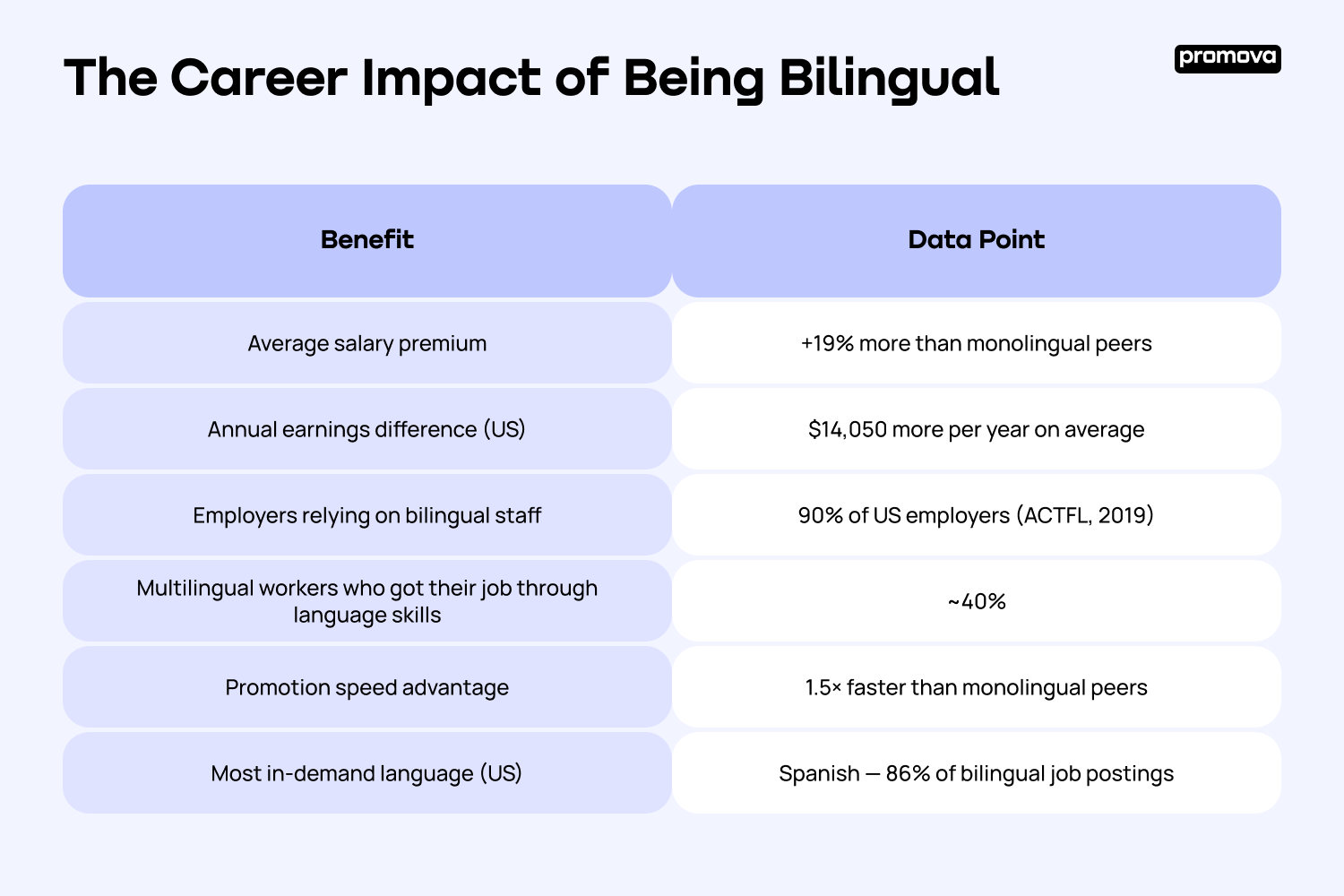
- Bilingual employees earn an average of 19% more than their monolingual colleagues — that's up to $14,050 more per year in the US alone, according to bilingual salary research by Language Trainers.
- 90% of US employers rely on workers who speak languages other than English, and 56% expect their demand for multilingual staff to grow in the coming years (ACTFL, 2019). Employers increasingly seek candidates who know other languages to communicate with clients and partners in other countries, making multilingual skills highly valuable.
- Language skills help at every stage of a career: getting hired, negotiating salary, earning promotions, and accessing job opportunities across many industries, including education, healthcare, automotive, and international business.
- A second language signals more than communication ability — it demonstrates adaptability, cultural intelligence, and cognitive flexibility that employers actively value. Learning a second language also improves memory, problem-solving skills, and critical thinking abilities, contributing to personal growth and adaptability.
- The most in-demand language for US bilingual jobs is Spanish, but Portuguese and Mandarin command the highest hourly rates.
- You don't need to be perfectly fluent to see career benefits — intermediate proficiency opens doors, and advanced fluency unlocks premium-level opportunities.
You're applying for a job. You and another candidate have almost identical qualifications — same education, similar experience, comparable references. The difference? They speak two languages. You speak one.
In that moment, the bilingual candidate has an edge that your resume can't compensate for. And that edge comes with a price tag — literally. Bilingual employees consistently earn more, get promoted more often, and have access to a broader range of roles than their monolingual peers. It's one of the clearest, most documented career advantages you can build.
This article explains exactly how learning a second language helps with jobs — from the salary numbers to the cognitive advantages to the specific industries where language skills matter most.
The salary difference is real — and significant
Multilingual employees earn an average of 19% more than their monolingual counterparts. In the United States specifically, bilingual professionals earn an average of $14,050 more per year than colleagues who only speak one language, according to bilingual salary research published by Language Trainers. Over a 20-year career, that premium compounds into hundreds of thousands of dollars in additional lifetime earnings.
The range across industries and locations is wide. Research consistently shows bilingual workers earn 5% to 20% more per hour depending on the field, the specific language, and how often they use it at work. In cities like San Francisco and New York, multilingual professionals in tech, healthcare, and finance command salaries at the top of those ranges. According to Workforce Essentials research on bilingual career benefits, bilingual employees may also receive bonuses on top of their base salary when their role involves frequent translation or communication with non-English-speaking clients.
A 2024 study by Pearson found that 80% of respondents across five countries believe English proficiency is directly linked to earning potential — with advanced English speakers reporting salary increases of up to 80% compared to beginners. And bilingual MBA graduates in the US earn 22% more at entry level than monolingual peers with the same degree, according to Language Trainers research.
1
Why employers are actively looking for bilingual workers
The demand side of this equation is just as clear as the salary data.
A 2019 survey of 1,200 senior managers and HR executives by the American Council on the Teaching of Foreign Languages (ACTFL) found that 9 out of 10 US employers rely on employees who speak languages other than English. More telling: 56% of those employers said their need for bilingual and multilingual staff will increase over the next five years. The demand for bilingual employees doubled in the five years prior to the pandemic — a trend that has continued as global remote work expanded the pool of international clients and partners companies need to communicate with.
The same survey found that a quarter of employers have lost business specifically because their workforce lacked sufficient foreign language skills. That's not a soft concern about culture — it's a direct revenue impact. Employers who've experienced that loss are actively trying to hire their way out of the problem.
Industries with the fastest-growing demand for multilingual workers include:
- Healthcare — patient communication, medical interpretation, and culturally sensitive care
- Finance and banking — international clients, regulatory compliance across markets
- Technology — global product teams, international user research, cross-border partnerships
- Education — bilingual instruction, ESL support, international program coordination
- Trade and logistics — supplier negotiations, cross-border coordination, international contracts
- Customer service — supporting diverse customer bases in their preferred language
Language skills help you get hired — even for jobs that don't require them
Here's something many people don't realize: a second language helps your job prospects even for roles where it isn't listed as a requirement.
When interviewers compare two equally qualified candidates, the bilingual candidate consistently gets more interest. This isn't irrational. A second language tells an employer several things beyond "this person speaks another language":
- They've committed to something difficult and followed through over months or years
- They're comfortable working outside their comfort zone
- They're likely better at adapting to unfamiliar contexts and problem-solving under uncertainty
- They demonstrate two qualities essential for success: motivation and adaptability
Your first language plays a key role in how you learn additional languages, shaping your understanding, cultural awareness, and adaptability in new environments.
These are transferable signals. A hiring manager for a marketing role, a product job, or an operations position isn't necessarily thinking "we need French" — they're thinking "we need someone adaptable, curious, and capable of navigating complexity." A second language is evidence of all three.
Research consistently shows that around 40% of multilingual employees say their language skills helped them get their current job — and that's across all industries, not just roles explicitly requiring bilingual ability.
The most valuable languages for your career right now
Not all languages offer the same career advantage. Which language is worth learning depends heavily on your industry, your location, and your career goals. However, certain languages are particularly advantageous for specific industries and roles, and world languages play a crucial role in cross-cultural communication and global careers. Some patterns are clear across current labor market data.
Spanish is the most in-demand language for bilingual employment in the US by a significant margin — it appears in 86% of bilingual job postings. Healthcare, education, social services, customer support, and local government are particularly strong sectors for Spanish speakers.
Mandarin Chinese is the official language of China and is the most widely spoken among Chinese languages, with over 1.2 billion speakers globally. As one of the most important world languages, Mandarin is highly valued in global business, particularly for roles involving Asia-Pacific operations, supply chain management, trade, and multinational corporate partnerships. This makes Mandarin a valuable language for securing international employment opportunities.
Portuguese commands the highest average hourly rates in the US bilingual job market, driven by demand related to Brazil's growing economic role and business ties with Portuguese-speaking markets in Africa.
French is valuable in international organizations, diplomatic roles, African business contexts, and throughout Canada. French is one of the official working languages of the United Nations, the European Union, and many international NGOs.
German is sought after in manufacturing, engineering, automotive, and precision industries with strong German corporate presence — particularly in the American Midwest and Southeast where German companies have major operations.
Arabic is one of the world's fastest-growing languages and serves as an official language in 25 countries. It is in high demand in government, intelligence, finance, and international relations, especially for roles with exposure to Gulf-region markets and the Middle East. Arabic proficiency is increasingly sought after in fields such as government and engineering, and there is currently a shortage of Arabic-proficient professionals in North America, leading to high-impact opportunities in government and specialized private sectors.
Engaging with native speakers of these languages is essential for practice, cultural understanding, and professional networking, which can significantly improve language skills and open doors to job prospects.
How to make your language skills count on a resume
Having a second language is one thing. Getting credit for it professionally is another. Many employers highly value second language skills, sometimes even more than a bachelor's degree, especially in roles where communication and cultural awareness are key. Here's how to present it effectively:
Be specific about your level. Vague claims like "some Spanish" don't help employers assess your actual value. Use recognized frameworks: CEFR levels (A1 to C2), official test scores (JLPT for Japanese, DELF for French, DELE for Spanish), or honest descriptions like "conversational," "business-proficient," or "fluent."
Tie the skill to outcomes. Instead of just listing "bilingual: English/Spanish," add context: "Used Spanish daily in client-facing roles to serve a bilingual customer base of 2,000+." That makes the skill concrete and credible.
Mention it in your cover letter. If the role involves any international dimension, or if the company has multilingual clients or teams, address your second language skills directly — not as a footnote, but as a relevant capability. Students who highlight their language skills on resumes and cover letters stand out to employers.
Keep growing it. Language skills that you've stopped using deteriorate. Regular practice — even 15 to 20 minutes a day — maintains and builds on what you have. Immersing yourself in real-world situations helps you learn faster and move from B1 to B2, or B2 to C1, which can meaningfully increase the roles available to you.
How to start building career-ready language skills
The most important thing is to start — and to practice consistently rather than intensively. Research on language acquisition is clear: daily short sessions outperform occasional long ones for vocabulary retention and fluency development.
Fifteen to twenty minutes of daily practice compounds over months into real, measurable progress. For tips on building that habit effectively, Promova's guide on how to learn a new language covers the methods and mindset that make the difference between slow progress and genuine momentum.
Promova is a language learning platform built for busy adults who want to build real-world language skills without restructuring their schedules. Bite-sized lessons cover practical vocabulary for real situations — including business contexts, professional communication, and everyday conversation. The AI Tutor lets you practice speaking at any hour with instant feedback and no fear of judgment, which makes it especially effective for building the speaking confidence that professional settings demand.
Conclusion
A second language is one of the most practical investments you can make in your career, especially in today's business world and global economy. Knowing more than one language gives you a competitive edge, opening doors to international industries and cross-border opportunities. The salary data is clear — a 19% average premium, up to $14,050 more per year in the US, and a compounding advantage over a career's lifetime. The demand from employers is clear — 90% rely on multilingual staff and that need is growing. And the cognitive benefits are real — better problem-solving, stronger adaptability, and sharper executive function are direct outputs of becoming bilingual.
For employers, the benefits of learning a second language are significant: bilingual or multilingual employees are highly valued for their adaptability, cultural awareness, and enhanced communication skills, especially in roles that require international communication or customer service.
You don't have to be fluent before the advantages start showing up. Intermediate proficiency opens doors. Advanced fluency unlocks premium opportunities. And every level of progress along the way builds skills and signals qualities that employers actively look for.
FAQ
Does learning a second language actually help you get a job?
Yes, significantly. Research shows around 40% of multilingual employees say their language skills helped them get their current job. Even for roles that don't explicitly require a second language, bilingual candidates stand out — language skills signal adaptability, commitment, and cross-cultural competence that employers value across many industries.
How much more do bilingual workers earn?
Bilingual employees earn an average of 19% more than monolingual peers. In the US, that translates to an average of $14,050 more per year. The range across industries and languages is 5% to 20% more per hour, with Portuguese, Russian, and Mandarin among the highest-paying languages in the US market.
What is the most in-demand language for jobs in the US?
Spanish accounts for 86% of bilingual job postings in the US, making it the most in-demand by far. Healthcare, education, customer service, and social services have the strongest need for Spanish speakers. For the highest hourly rates, Portuguese, Russian, and Mandarin currently command the top pay in the bilingual job market. However, proficiency in world languages and the ability to communicate in multiple languages are valuable assets for global careers and cross-cultural communication.
How fluent do I need to be for language skills to help my career?
You don't need to be fluent for language skills to start opening doors. Intermediate proficiency (B1–B2 on the CEFR scale) is sufficient for many roles and demonstrates meaningful ability to employers. Advanced fluency (C1–C2) unlocks the highest-value opportunities — professional translation, senior international roles, and positions requiring native-level precision. Starting learning a language with Promova is a practical way to build toward these levels consistently.



 English


Comments