Americans Are Googling "Foreign Language Anxiety" More Than Ever. We Surveyed 1,000 of Them to Find Out Why.
Contents
Google searches for "foreign language anxiety" hit an all-time high in the United States in 2026. Promova surveyed 1,046 U.S. residents to understand what's really going on — and here's what we discovered.
Travel anxiety in the United States has been building for a while — and the reasons aren't hard to find. The geopolitical situation has raised real questions about where it's safe to go on vacations or business trips. At the same time, record numbers of Americans are moving abroad or seriously considering it: by November 2025, one in five told Gallup they'd like to leave permanently¹ — driven by economic pressure, quality-of-life concerns, and geopolitical uncertainty.
Foreign language anxiety has been rising alongside it.
Foreign language anxiety — the specific fear or nervousness people feel when speaking, listening to, or being exposed to a language they haven't mastered — was formally described by researchers Horwitz, Horwitz, and Cope in 1986. Today, it affects the vast majority of language learners worldwide.
Google searches for the term were near zero from 2022 through most of 2025. By spring 2026, search interest hit a score of 100 — the highest point ever recorded.
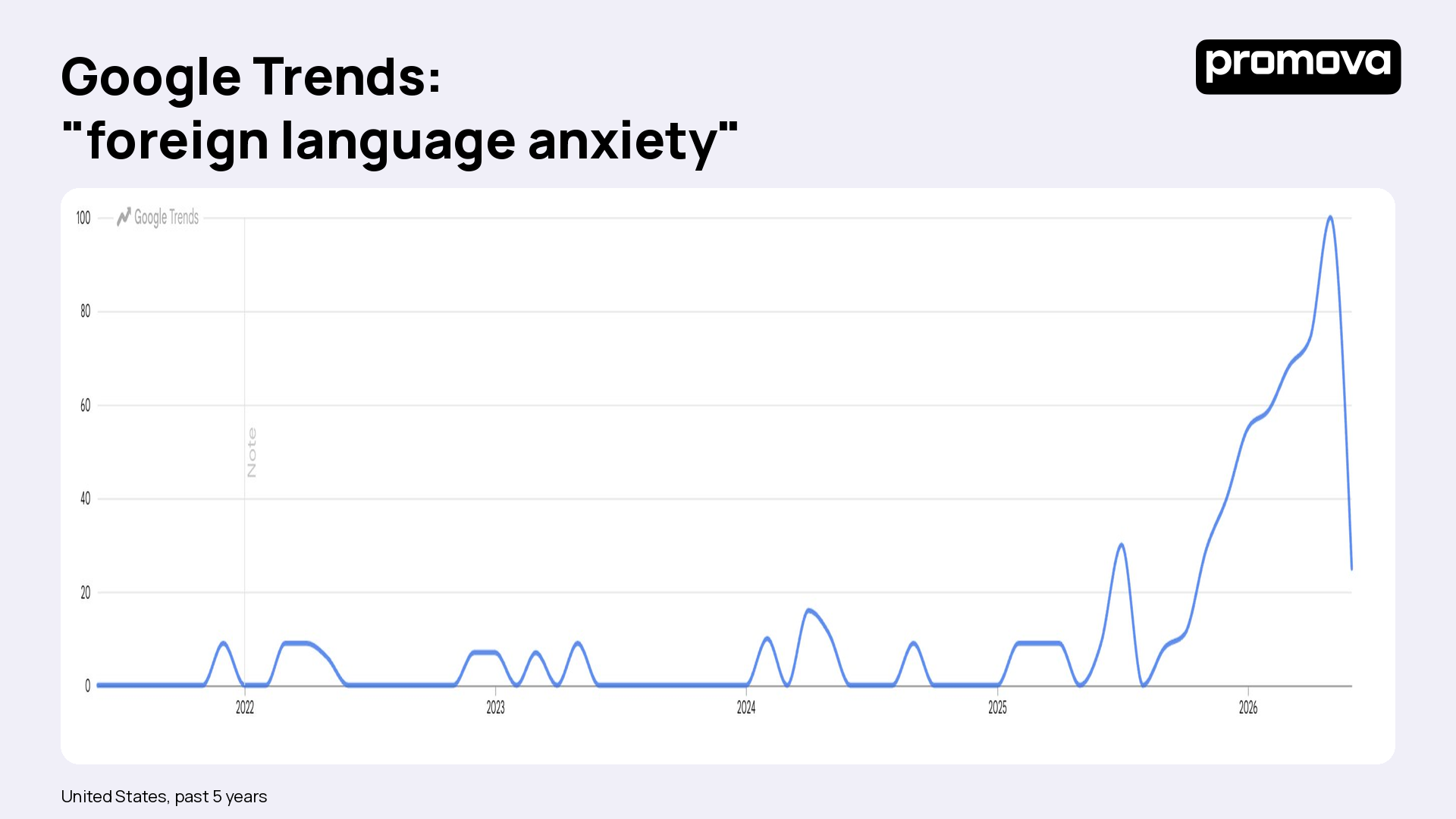
To better understand the reasons behind it, Promova surveyed 1,046 U.S. residents in June 2026 — and here's what we discovered.
Disclosure: This research was commissioned and conducted by Promova, a language learning app for today’s minds. The expert quoted in this article, Nataliia Afonina, is a Promova employee
Key Findings
- 42.1% of Americans feel more anxious about speaking a foreign language now than they did a year ago
- 77.2% have experienced foreign language anxiety at some point — only 22.8% say they've never felt it
- 59.4% believe their anxiety will decrease over the next year — because they plan to practice more
- Social media is the #1 driver: 44.5% say watching others speak fluently online makes their own anxiety worse
- 31.3% link their increased anxiety to global instability and geopolitical tensions
- 52.3% have secretly hoped a non-English speaker would give up and switch to English
- 48.9% have spoken English more slowly and more loudly to someone who didn't speak it
Why 2026 Is the Year Everyone Started Googling This
Foreign language anxiety isn't new — researchers have studied it for decades. A large-scale meta-analysis covering 97 studies confirmed that the more anxious you feel, the worse you perform. And a 2024 study also found that simply being exposed to a language more often measurably reduces the fear of being judged for speaking it.
But a few things converged in 2025–2026 to push it into the mainstream:
Americans are moving. By November 2025, one in five Americans told Gallup they want to move abroad permanently — driven by economic pressure, quality-of-life concerns, and geopolitical uncertainty.
Travel anxiety spiked first — and foreign language anxiety followed. Three things made international travel feel more stressful in 2025–2026. First, geopolitical tensions: when the U.S. State Department issues a worldwide travel caution advisory warning Americans abroad, and flagging potential airspace closures that could disrupt flights, there is no way you won’t become nervous about future trips. Second, more Americans become hesitant about international travels because they are “worried about how they'd be received as an American while traveling abroad”, with 51% in 2026 compared to 47% in 2025. Third, rising costs of travelling, with many travelers rethinking how far they go and how often.
Social media made everyone else look fluent. TikTok, Instagram, and YouTube are full of polished, effortless multilingual content — watching it creates a comparison gap that makes even serious learners feel permanently unprepared, with 44,5% of surveyed Promova users citing it as a main anxiety factor.
What the Numbers Actually Show
42.1% of Americans feel more anxious about speaking a foreign language than a year ago. 35.1% say they've made real progress. 22.8% have never felt anxious about it at all.
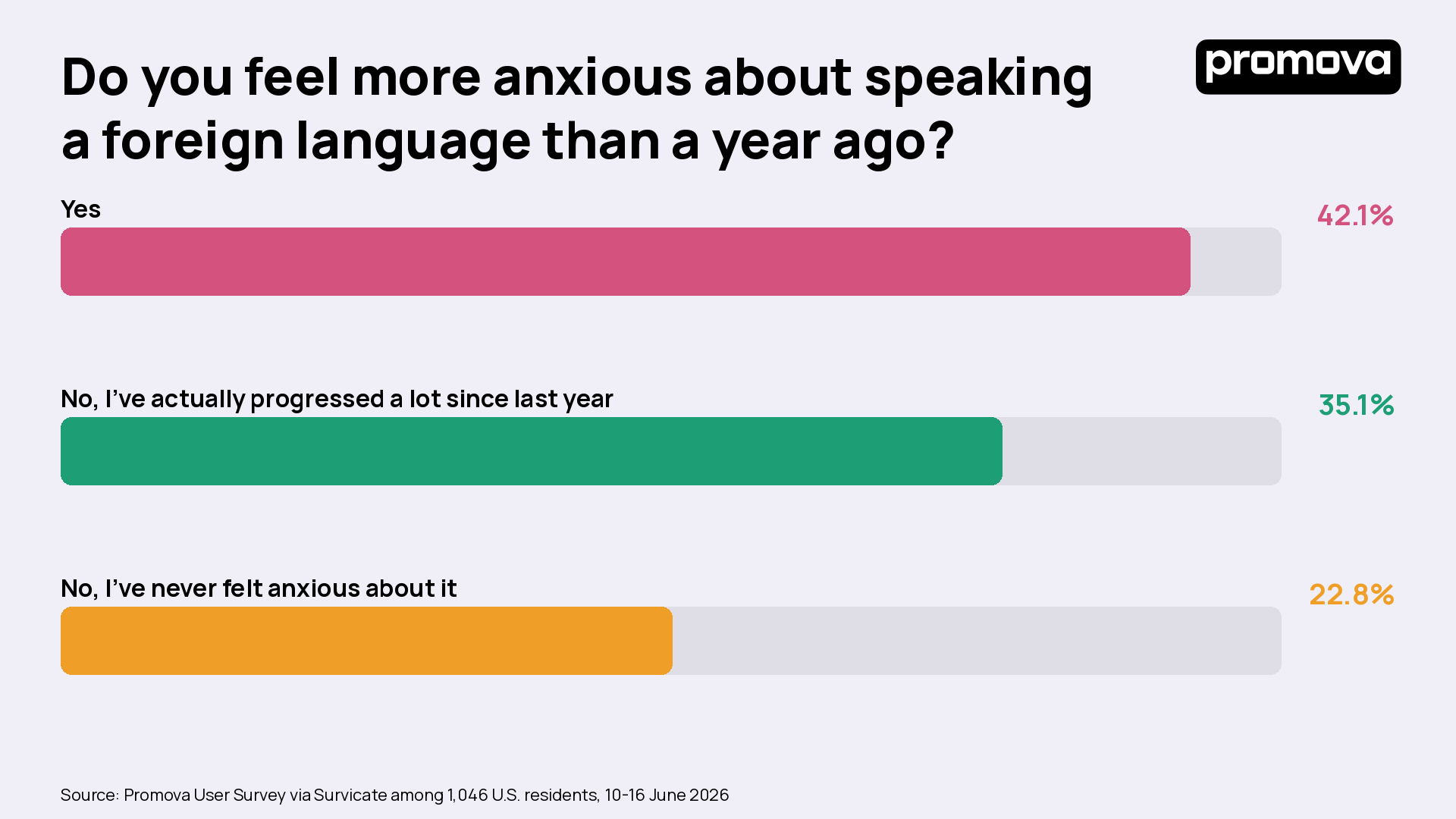
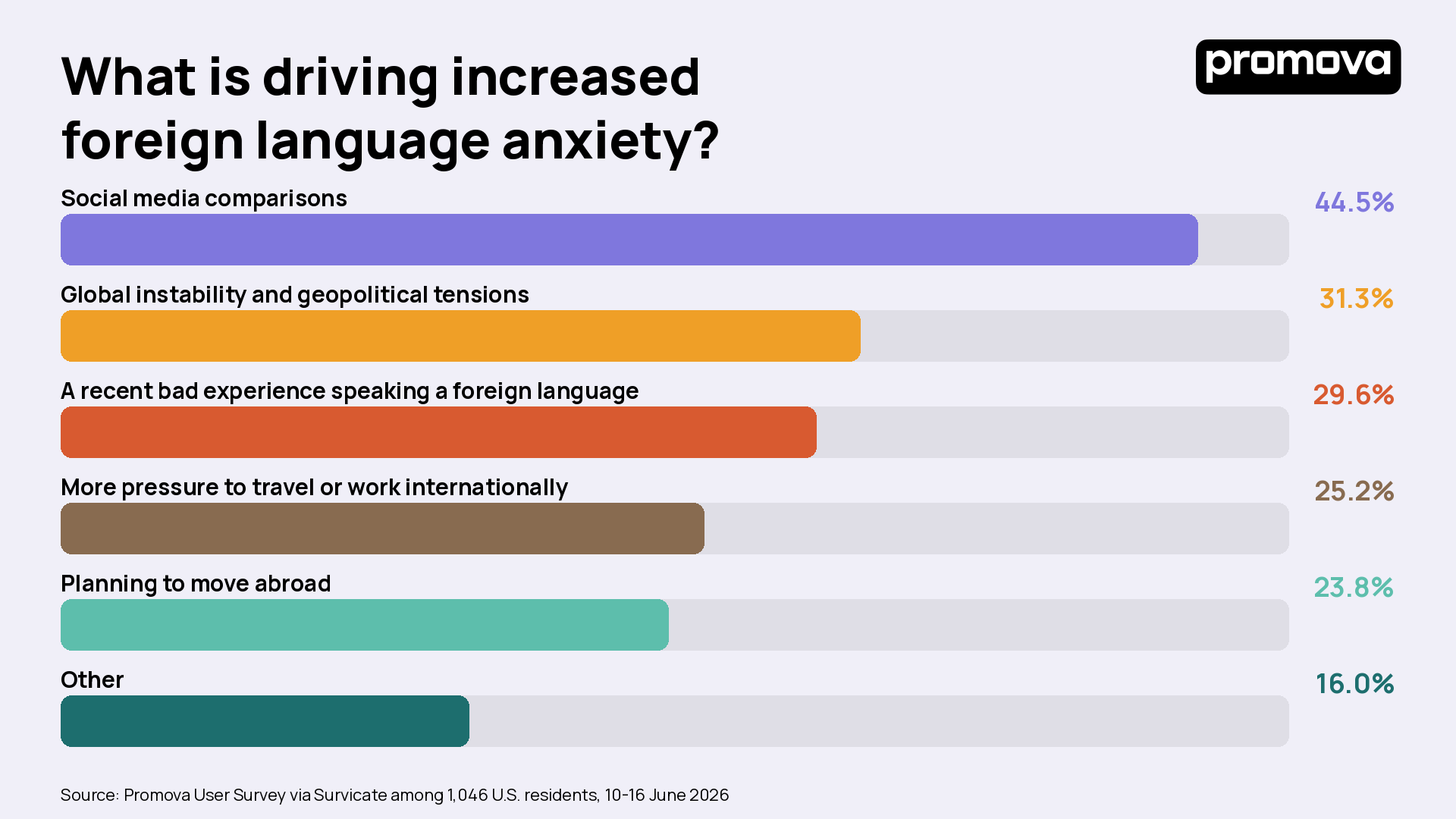
The top drivers behind the increase:
- Social media comparisons: 44.5%
- Global instability and geopolitical tensions: 31.3%
- A recent bad experience speaking a foreign language: 29.6%
- More pressure to travel or work internationally: 25.2%
- Planning to move abroad: 23.8%
"One of the reasons for travel anxiety is the fear of interaction with another culture: accidentally causing offense or misreading a social cue, feeling vulnerable in a communication situation, or not being able to ask for help in a foreign language — along with the shame of being misjudged or considered not clever enough," — Nataliia Afonina, Language Learning Specialist at Promova and an MA degree in Psychology holder.
One in Six Americans Expects Their Anxiety to Get Worse
Only 6.1% of respondents feel genuinely confident about their level of a foreign language. 42.4% describe themselves as people who try, but are a nervous wreck about it. 30.8% feel mild discomfort and push through anyway. 20.7% avoid foreign language situations entirely — not a challenge they're managing, a situation they simply don't enter.
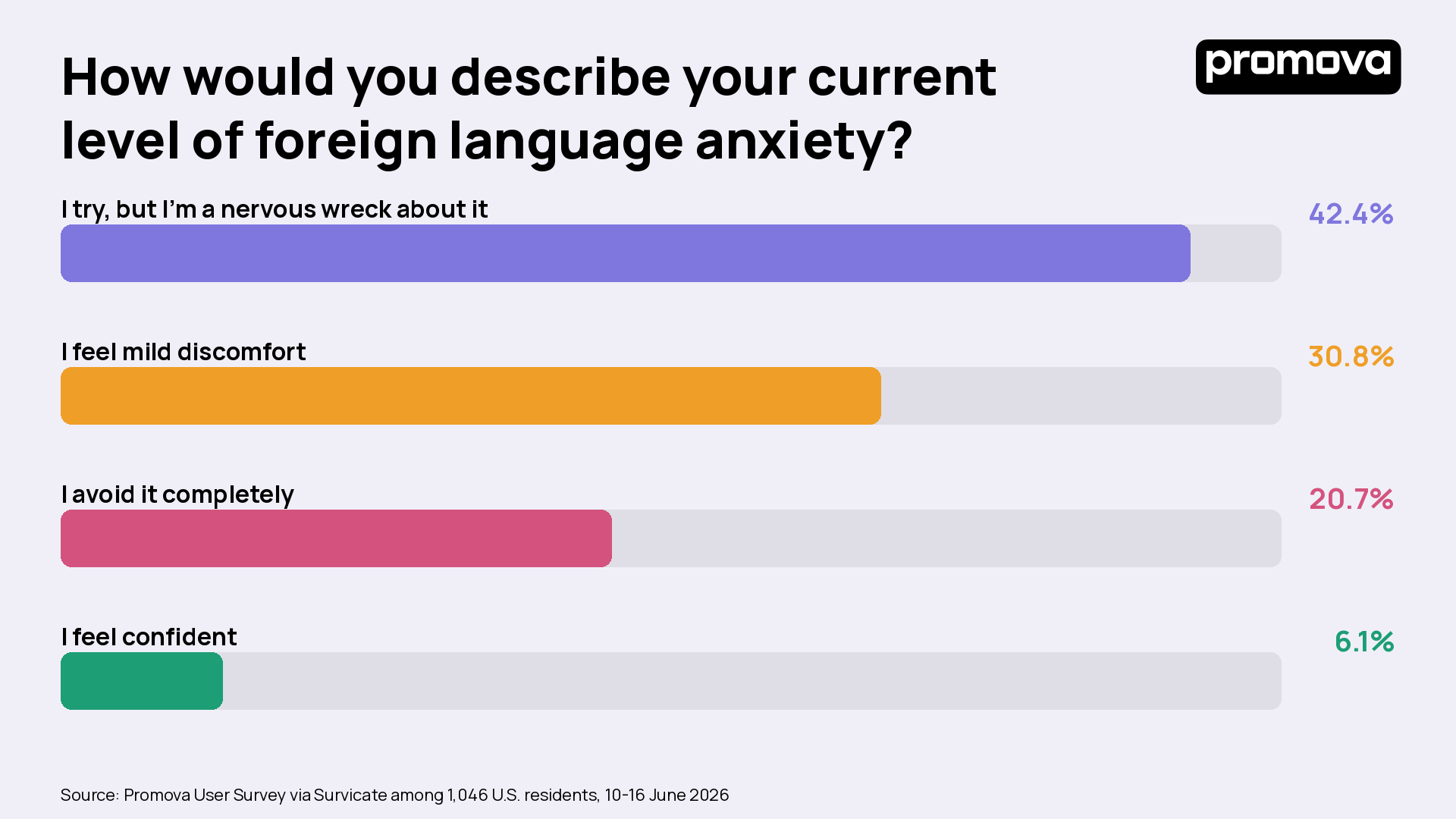
59.4% say their anxiety will decrease over the next year — because they're planning to practice more. But 16.1% expect it to get worse, citing a world that feels too uncertain to predict.
What People Actually Do When They Don't Understand a Word
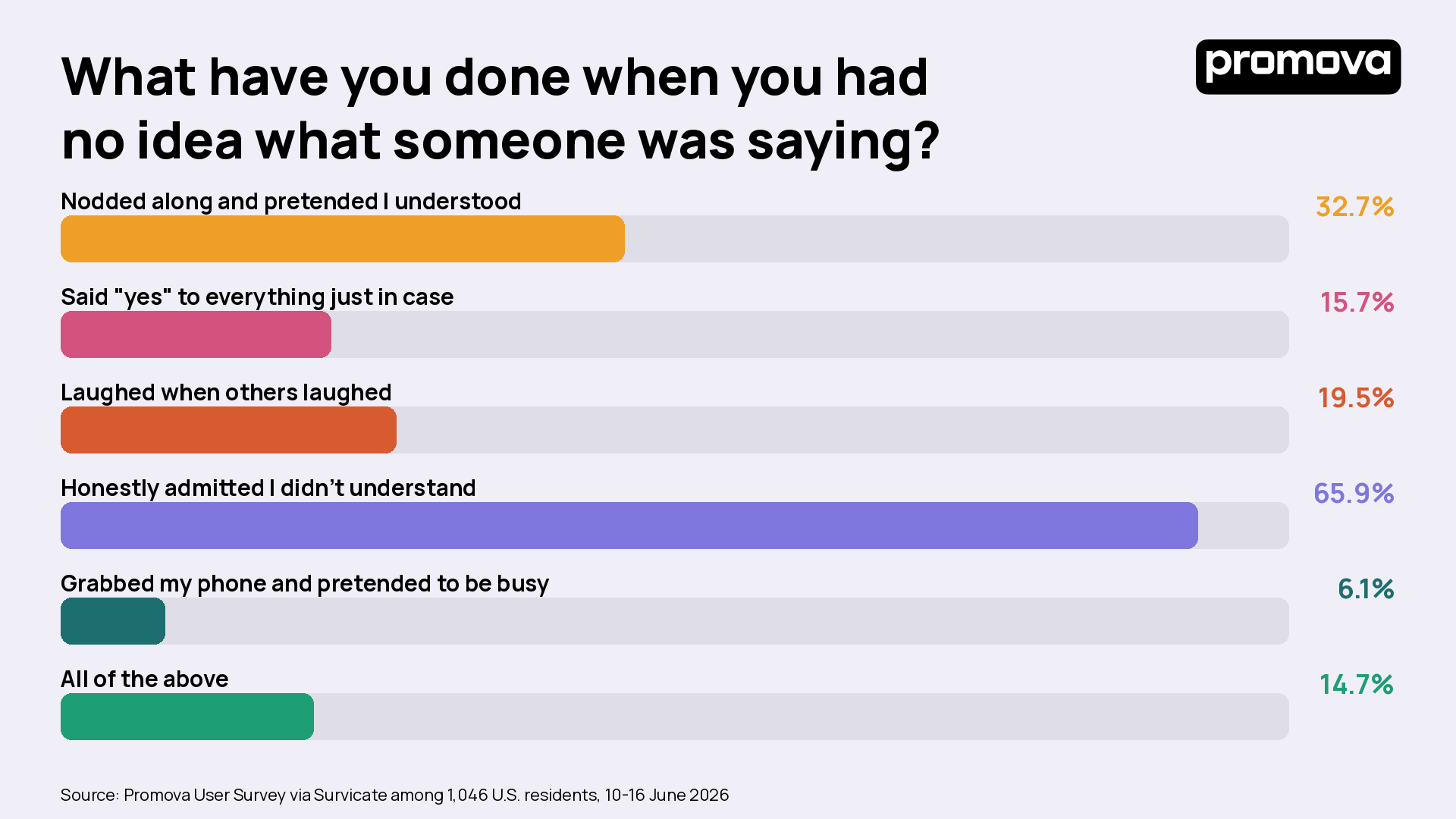
While 65.9% of respondents say they honestly admit when they don't understand something, most people have also built their own set of workarounds.
2
The Nod-and-Smile Method
65,9% of respondents were honest about not being able to understand, but for the rest it became a challenge. 32.7% have nodded along and pretended to understand something they absolutely didn't. 19.5% have laughed when others laughed — just to be safe. 15.7% have said "yes" to everything, just in case. And 14.7% have deployed every single one of these tactics at once.
The Disappearing Act
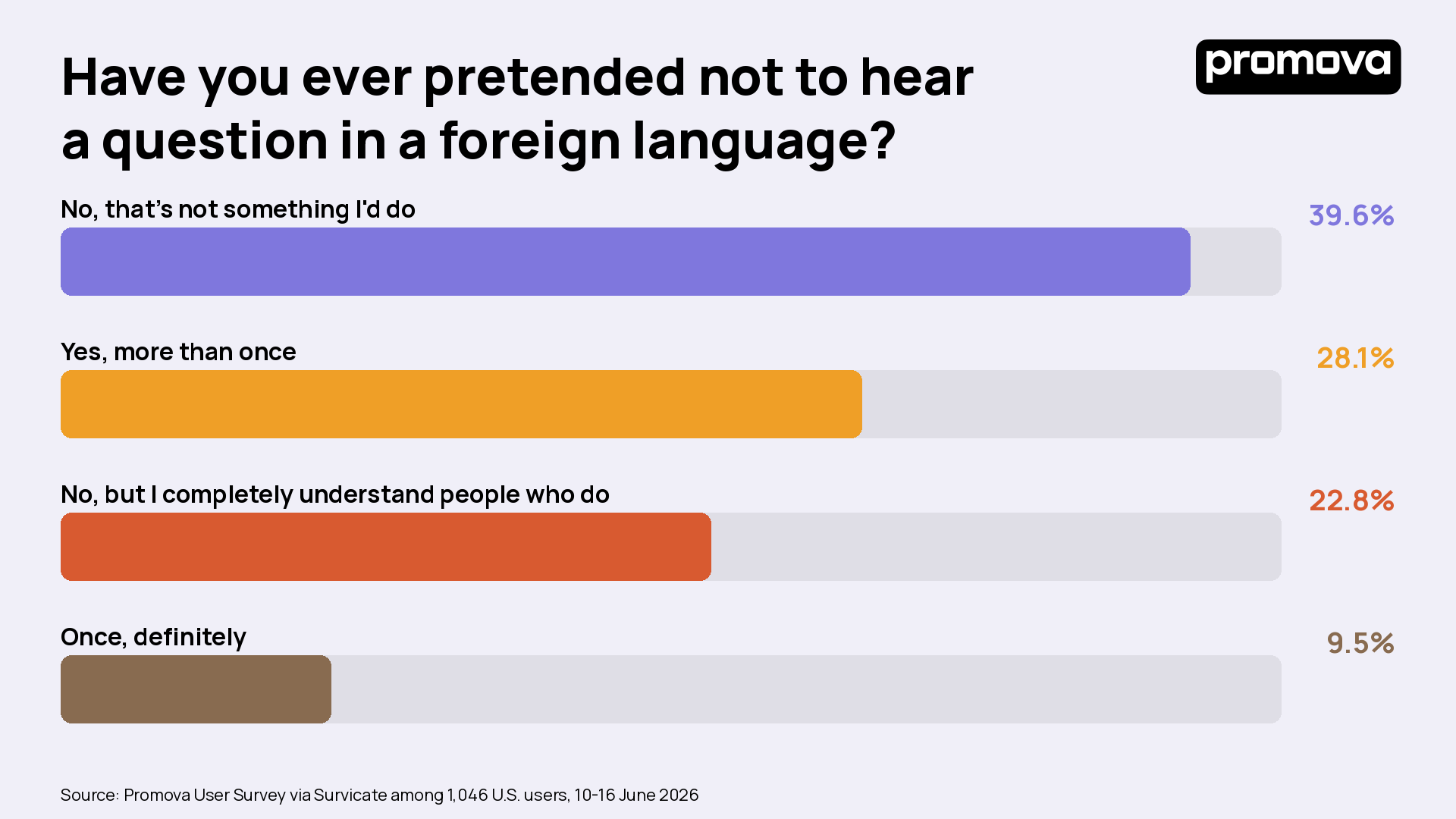
37.6% have pretended not to hear a question in a foreign language to avoid having to answer it — 28.1% have done it more than once. A further 22.8% say they wouldn't personally do it, but they completely understand people who do.
The Slow-and-Loud English Tactic
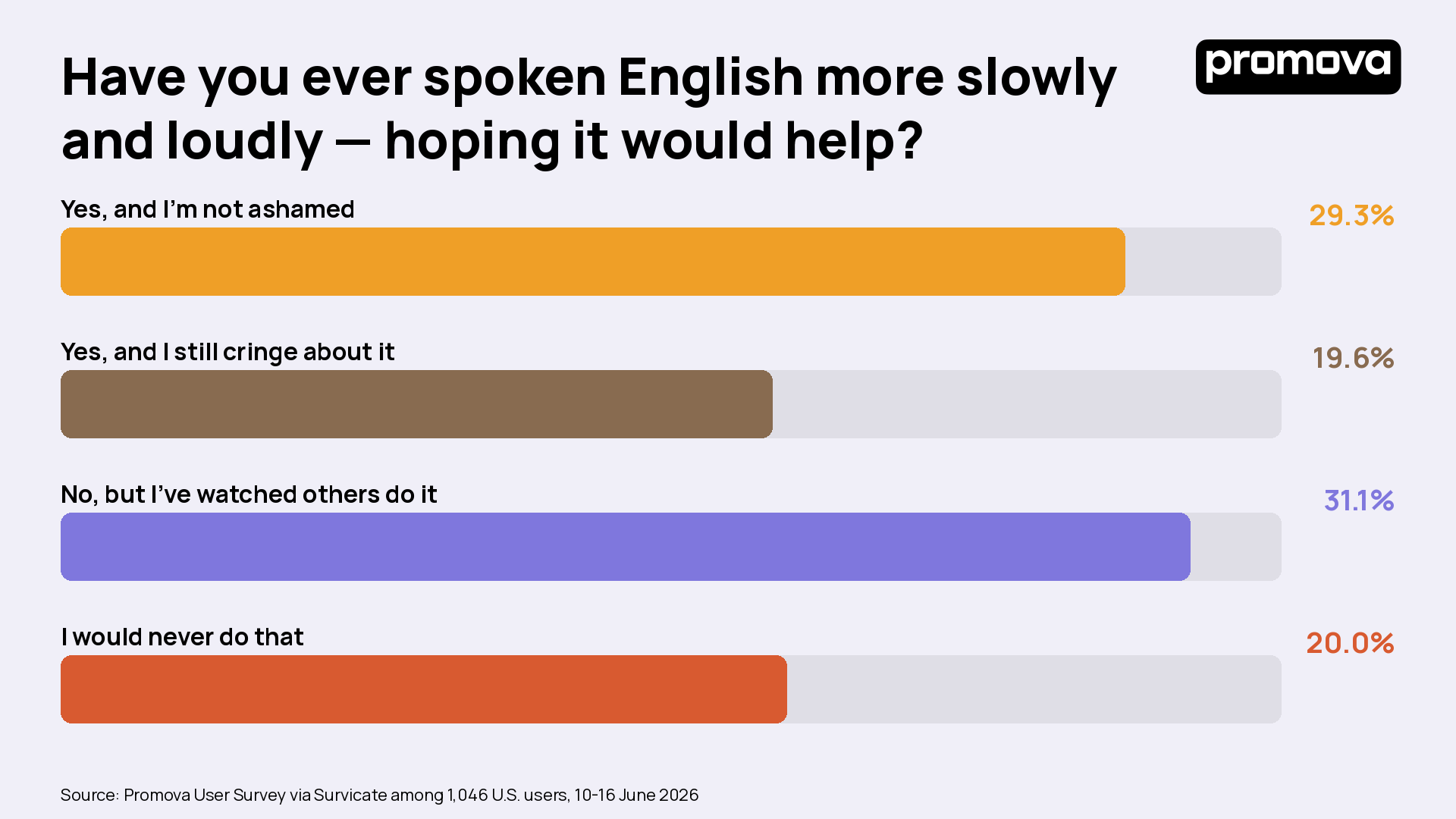
Nearly half of Americans (48.9%) have spoken English more slowly and more loudly to someone who didn't speak it. 29.3% have done it and feel no shame. 19.6% have done it and still cringe about it. 31.1% have never done it themselves — but have watched someone nearby do it and felt the secondhand embarrassment in real time.
The Secret English Hope
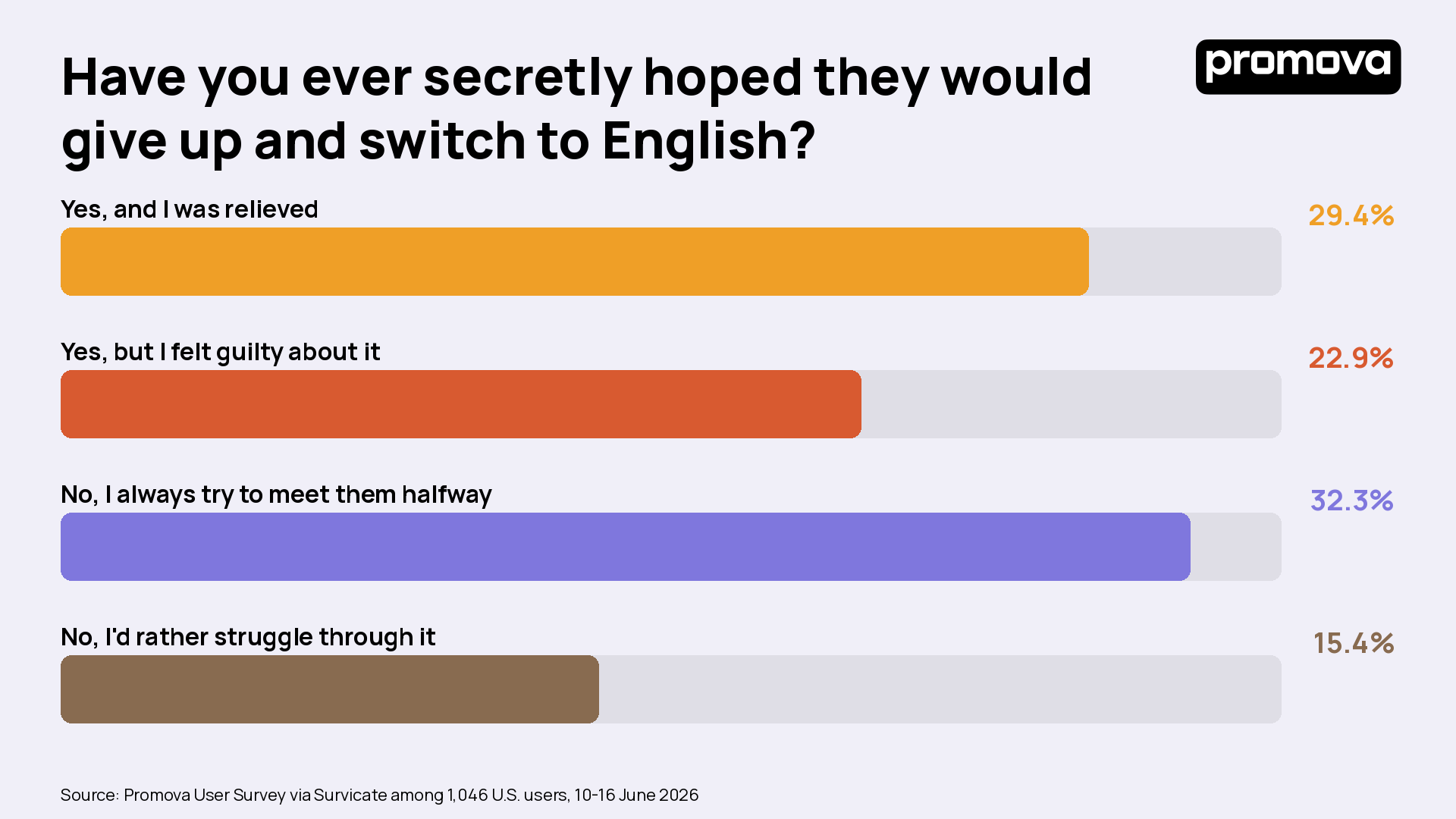
52.3% have secretly hoped that a non-English speaker would give up on the conversation and switch to English. 29.4% felt genuine relief every time it happened. 22.9% felt guilty about wanting it — but wanted it anyway.
What Can Help You Feel More Confident
"When you first engage in a face-to-face conversation with someone in a foreign language, your brain may treat it as a high-stakes survival situation. To overcome this, we encourage our learners to change their goal. When you're just starting out, perfection isn't the point — communication is. Say it anyway, and credit yourself for making the effort." — said Nataliia Afonina. “And keep in mind that most native speakers are incredibly welcoming to foreigners who make an effort. They're usually just happy you're trying to engage with their culture.”
Here is a linguistic toolkit Nataliia recommends to reduce anxiety and feel more prepared for any communication situation abroad:
Before You Travel
Lock down three core phrases until they're automatic: a politeness pair ("please" and "thank you"), a distress signal ("could you repeat that more slowly?"), and a backup plan ("do you happen to speak English?"). These three cover the vast majority of high-anxiety moments travelers describe.
Run mental rehearsals. Visualize the specific interactions you're most nervous about — ordering a coffee, checking into accommodation, asking for directions. Write out a short version of how that exchange might realistically go, then say it out loud a few times. When the real moment arrives, your brain recognizes it as familiar rather than threatening.
Know your communication context. Some cultures are "low-context" — people say precisely what they mean (think the U.S. or Germany). Others are "high-context," where tone, relationships, and reading between the lines carry most of the meaning (think Japan or Italy). Knowing which one you're walking into helps you calibrate expectations before anxiety sets in.
On the Ground
"Don't dive into the deep end immediately. Build your communication tolerance step by step," Nataliia advises.
Start with zero-follow-up interactions. Say goodbye to a shopkeeper. Acknowledge a neighbor who nods at you. These micro-interactions cost almost nothing if they go imperfectly — but they prime your brain for larger conversations.
Use your environment as a prop. When ordering at a bakery or market, point to the item while attempting to say its name. The visual context guarantees the transaction works regardless. This isn't a workaround — it's how communication actually functions in real life.
Give yourself 10 minutes before you speak. When you arrive somewhere unfamiliar, spend a few minutes watching before you interact. How do people order here? How do they pay? How do they get someone's attention? Mirroring what you observe is one of the fastest ways to feel less exposed.
The Mindset Changes Everything
"Every awkward exchange or mispronounced word actually helps your brain map the language better. In linguistics, we treat errors as essential stepping stones, not defeats. The goal isn't to avoid mistakes — it's to make them in the service of progress," Nataliia added.
Methodology
Promova conducted an online survey of 1,046 U.S. residents between June 10–16, 2026. The survey was distributed via Survicate. Respondents were verified as U.S. residents via an initial qualifying question. Questions covered foreign language anxiety levels, perceived drivers of increased anxiety, avoidance behaviors, and language survival strategies used in foreign-language situations while traveling abroad. Percentages for multi-select questions reflect the share of respondents who selected each option; totals for those questions may exceed 100%.
FAQ
What is foreign language anxiety?
Foreign language anxiety, also known as xenoglossophobia, is the feeling of unease, worry, nervousness and apprehension experienced in learning or using a second or foreign language. This effect was first described by Horwitz, Horwitz, and Cope, prominent researchers in the field of second language acquisition, whose theories on language anxiety have had a significant influence on language research.
How many Americans experience foreign language anxiety?
According to Promova's June 2026 survey of 1,046 U.S. residents, 77.2% have experienced foreign language anxiety at some point. Only 22.8% say they've never felt it.
Why is foreign language anxiety increasing in 2026?
Three main factors converged: social media comparisons (cited by 44.5% of respondents), global instability and geopolitical tensions (31.3%), and increased pressure to travel or relocate internationally (25.2%).



 English


Comments