Growth of AI Usage in the Education Sphere

Contents
In the last five years, AI in education has shifted from experimental to widely used. Market signals across EdTech show that it's now a key part of how education is delivered and experienced. Since 2020, we've witnessed the rapid adoption of AI, thanks to advances in generative technologies, increased investment, and broader use across institutions.
A clear sign of this change is that 86% of education organizations now use generative AI, the highest rate among all industries. Student and teacher use has also grown each year, showing a major change in how learning happens worldwide.
By 2030, the AI education market is expected to keep growing, with a projected annual growth rate of 36%. This growth comes from both new technology and changes in education systems around the world.
This article examines how AI tools for learning have evolved, highlights key market trends, and explains how AI is transforming education across various domains.
Key Numbers at a Glance
To truly understand EdTech growth, it helps to look at key data. These numbers show how widely AI is now used in education.
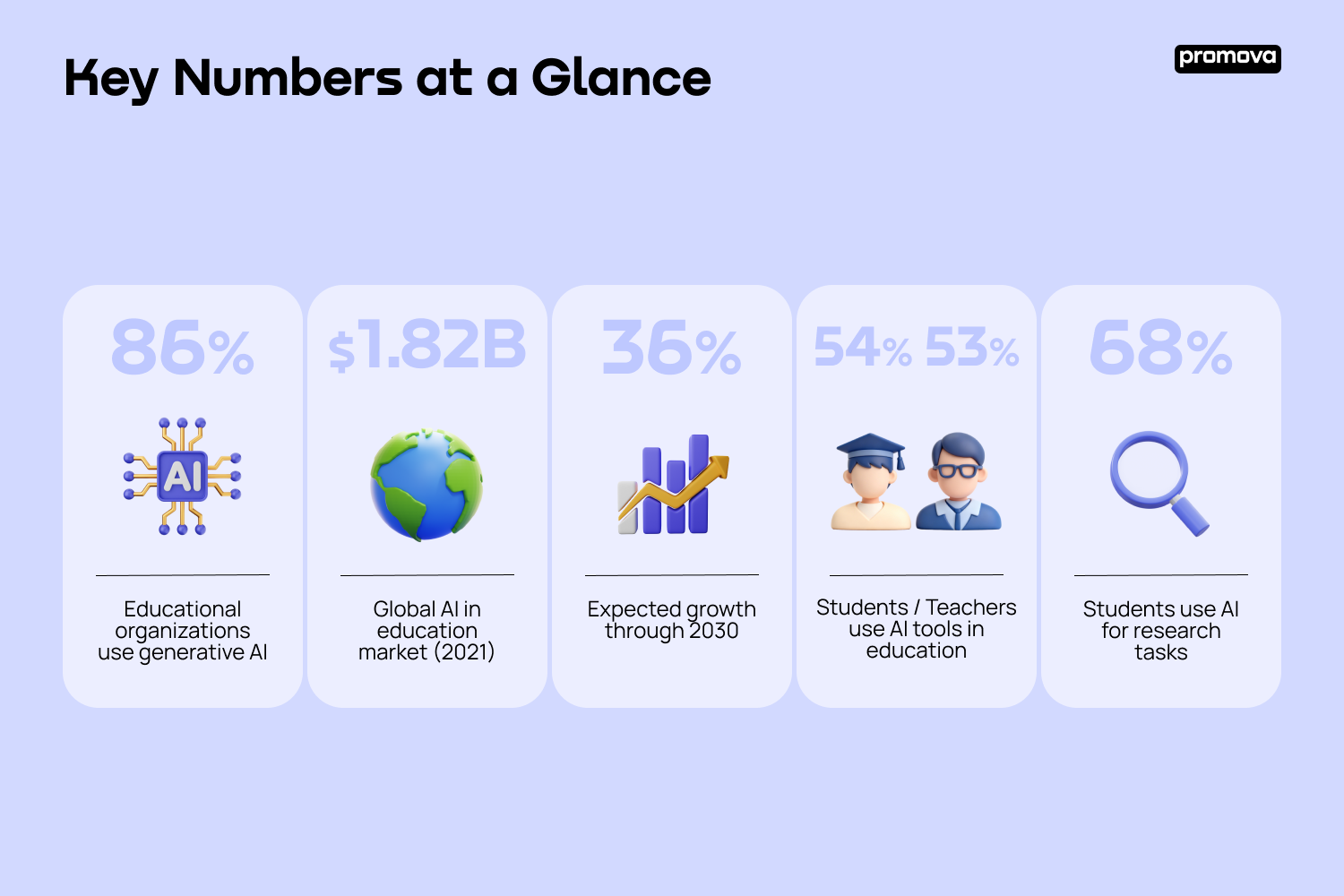
- 86% of educational organizations use generative AI
- Global AI in education market valued at $1.82 billion in 2021
- Expected CAGR of 36% through 2030
- 54% of students and 53% of teachers use AI tools in education
- 68% of students use AI for research tasks
Key Insight: AI use in education has moved from early adoption to widespread integration.
How AI Adoption in Education Has Grown Over 2020–2026
Over the past six years, AI in education has gone from being used in a few areas to being common in many institutions. In the early 2020s, AI tools mostly handled grammar checks, scheduling, and simple adaptive systems. After 2022, this changed quickly.
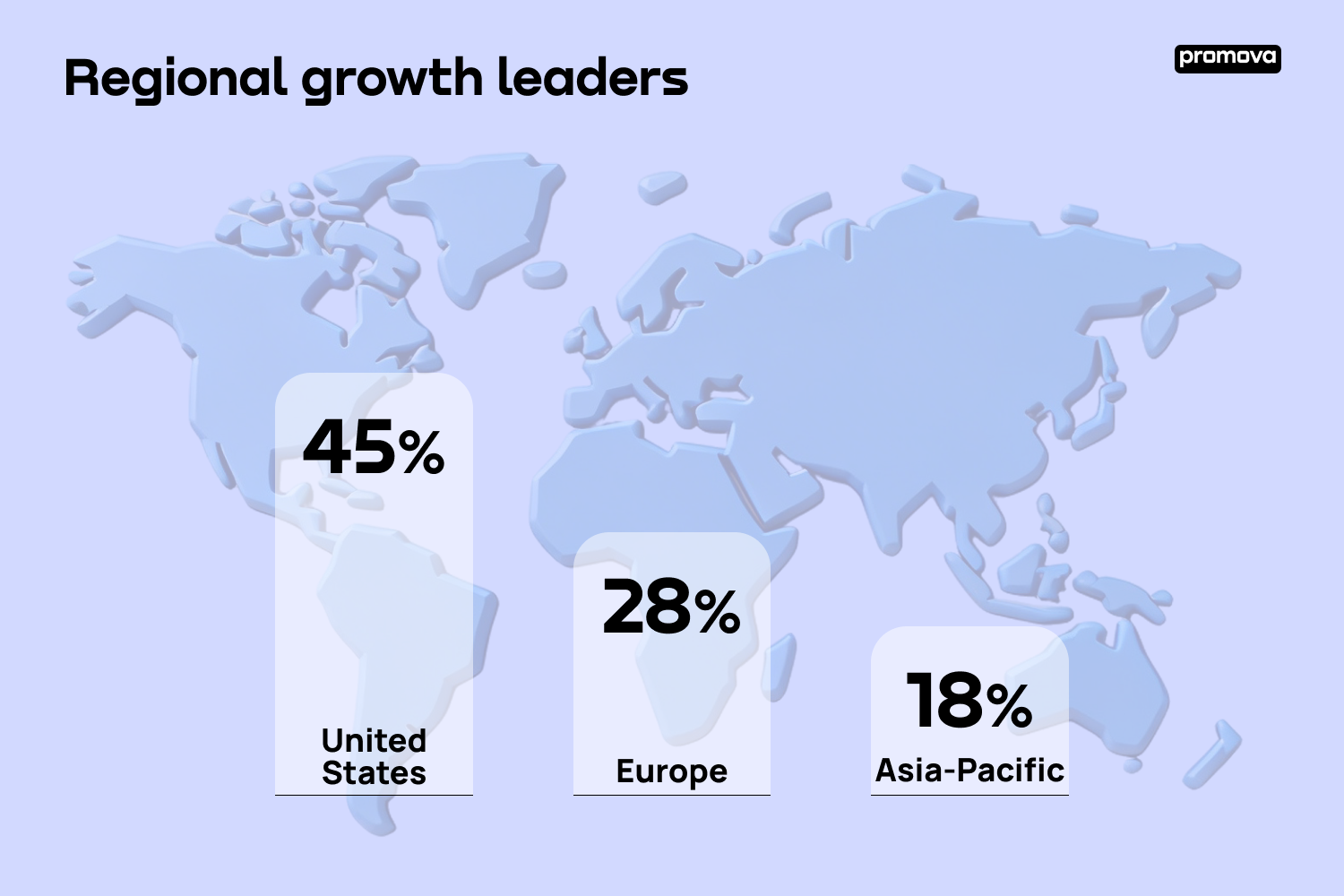
Regional growth leaders (US, EU, Asia-Pacific)
Due to strong investment demand, the AI education market has increased steadily. Worth $1.82 billion in 2021, it’s now expected to grow quickly through 2030 at a 36% annual rate.
Around the world, we’re seeing different growth rates and for different reasons:
- United States: Strong innovation and venture capital funding
- Europe: Regulatory-driven adoption and ethical frameworks
- Asia-Pacific: Rapid expansion driven by large-scale EdTech ecosystems
Specifically, China’s EdTech market alone reached $133.9 billion in 2023, demonstrating the scale of regional investment.
AI education market growth forecast (2025–2030)
The arrival of generative AI tools was a major turning point in all sectors, not just education. AI systems started to offer far more support and innovative features, including:
- Real-time tutoring
- Content generation
- Automated feedback
- Conversational interfaces
This change made AI tools much easier to use. Students and teachers no longer needed technical skills to benefit, which helped adoption grow quickly. One study found that the number of students who used AI tools often went up by 26 percentage points each year, with teachers reporting a 21-point increase.
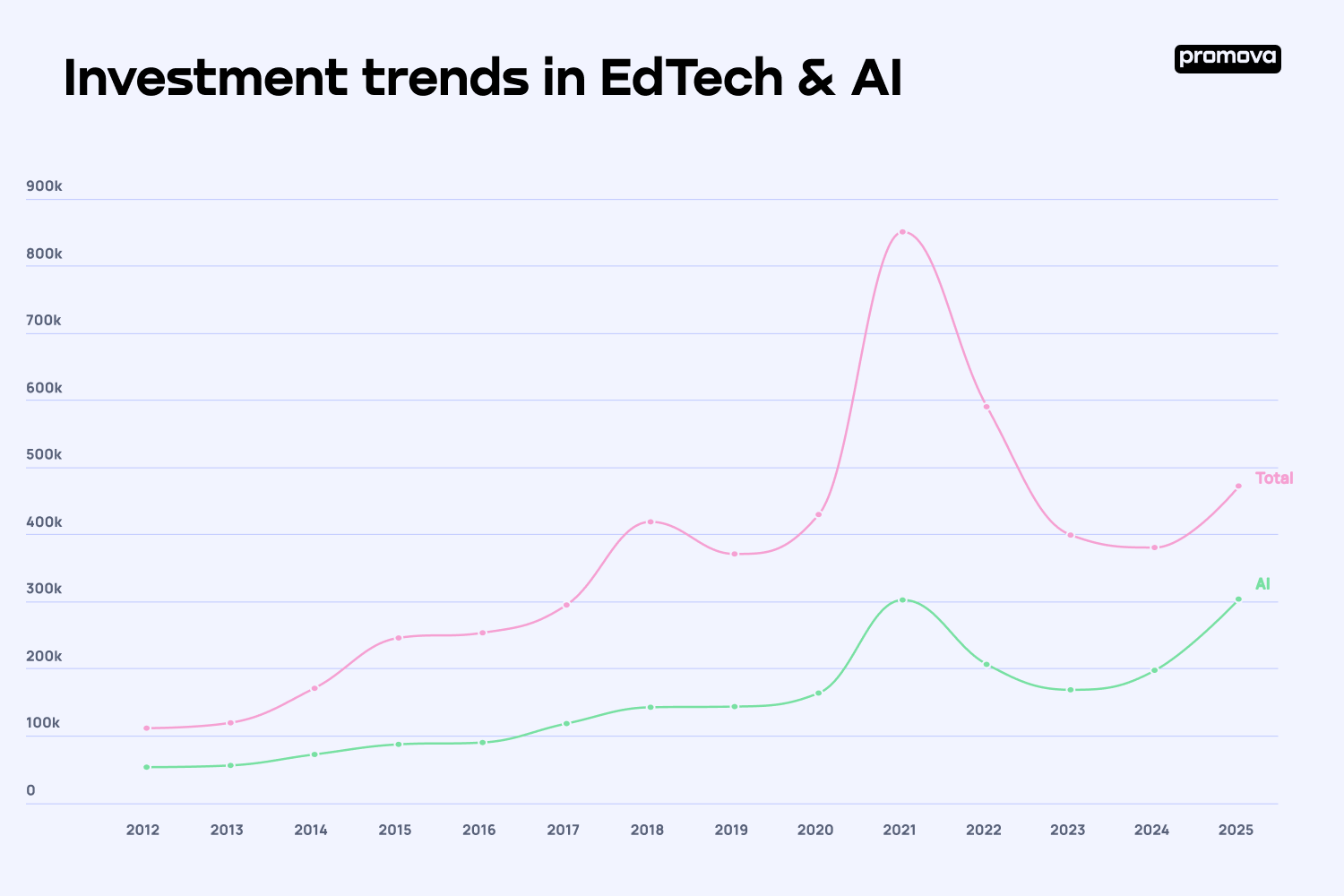
Investment trends in EdTech & AI
Forecasts show that growth will keep speeding up. As AI becomes a regular part of education, growth will be driven by increased adoption in institutions, evolving AI-powered platforms, and a greater demand for personalised learning.
Investment in AI-driven education is now more focused and strategic, following larger trends in global venture capital. In 2025, AI startups made up over 61% of all global VC investment, totaling about $258.7 billion. This shows how dominant AI has become across many industries, including education.
Key Insight: Generative AI has transformed AI from just a support tool into an active part of learning.
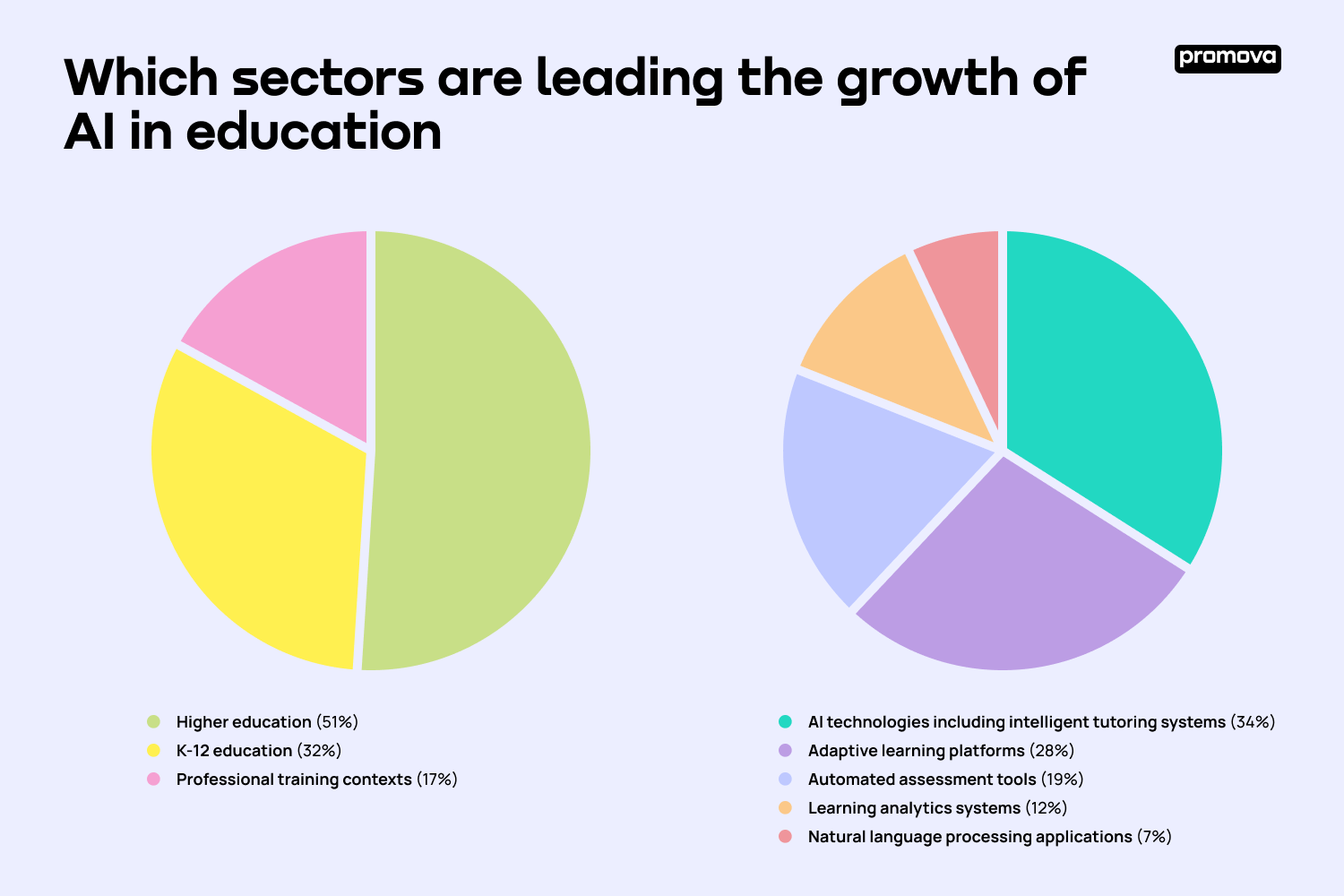
Which sectors are leading the growth of AI in education?
Not all sectors have adopted AI tools at the same pace. Some areas use AI more quickly because they have clearer advantages and needs. Others are taking a wait-and-see approach. Here's how each educational group is adopting AI, and what it says about future trends.
K–12 education adoption rates
K–12 schools have seen a big increase, with 60% of teachers using AI tools in the 2024–25 school year. However, its use depends on policies, available training, and ethical concerns.
Right now, AI is primarily used for:
- Personalised learning platforms
- Automated feedback
- Administrative tasks
Higher education AI integration
About 43% of college students use AI tools regularly, and 50% of instructors have added them to their teaching. This shows that AI is becoming a common tool for both teaching and learning.
Universities have adopted AI for:
- Research assistance
- Learning analytics
- Automated grading
Corporate training & workforce upskilling
Because AI can deliver training at scale, it's become essential for workforce development. In businesses, we're now seeing AI used most for skill assessment, personalized training pathways, and real-time feedback.
Language learning platforms
Language learning is one of the fastest-growing areas for AI in education. People want more speaking practice, instant feedback, and tailored learning, which has led to a faster adoption of AI tools. When there isn't always someone available to practice with, or they don't have access to a tutor, AI is a smart alternative.
Key Insight: Language learning platforms lead innovation because they depend on real-time interaction and feedback.
Most Used AI Tools in Education
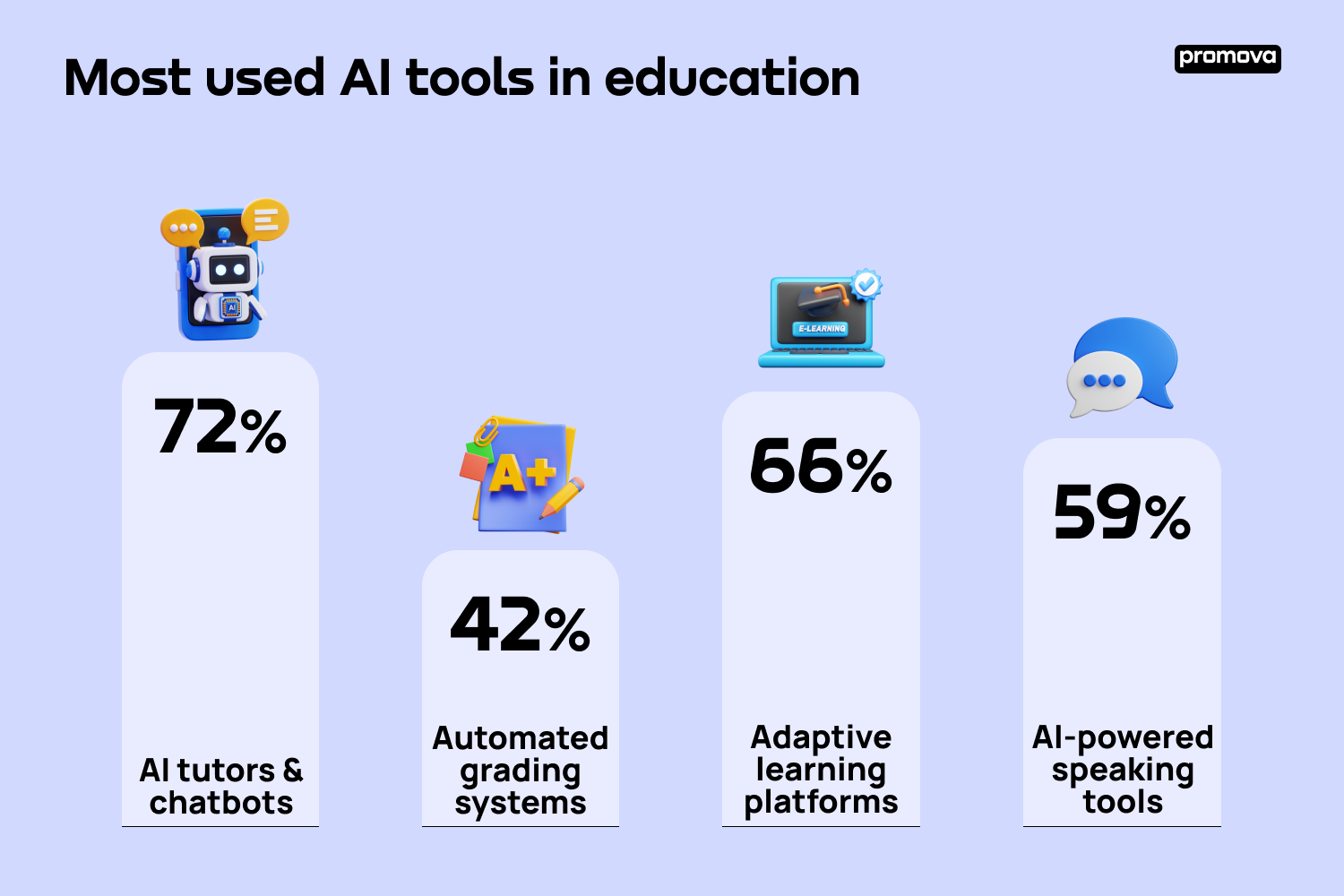
Looking at the most popular AI tools in education, there’s a clear order based on how often they’re used and how practical they are. AI chatbots and tutors are the most common, with 72% of students saying they'd be disappointed if they could no longer use them. Next are AI-powered content generators and research assistants. About 68% of students use AI for research tasks, showing just how important they are for daily academic work.
Adaptive learning platforms and automated grading systems are used somewhat less by students but are widely adopted by schools and teachers. In fact, 42% of educators use AI for grading and assessment. AI speaking and language tools are also growing quickly, as more people want real-time feedback and conversation practice.
Overall, the most popular AI tools are those that fit easily into daily learning with quick, personalized, and accessible support.
AI tutors & chatbots
AI tutors are now among the most popular tools. They give instant answers and detailed explanations, and are always available.
Automated grading systems
AI grading systems cut administrative work by 40% and can improve accuracy by up to 80%. This lets teachers spend more time teaching instead of doing repetitive tasks.
Adaptive learning platforms
Adaptive systems adjust content to fit each student's performance, creating a highly personalized experience. Research shows:
- 62% improvement in test results
- 30% overall performance increase
- 20% reduction in academic anxiety
AI-powered speaking tools
The growth of AI speaking tools shows that people want more interactive learning. Assisting with pronunciation, conversation practice, and real-time corrections, they’re especially helpful when you're trying to master a new language.
Case study: Promova usage data on AI feature adoption and learner demand
AI and education work best together when they take a structured learning approach, rather than operating as a separate tool. Promova is a great example of how AI can be integrated into a language-learning environment, bringing technology and teaching together.
Rather than making AI a separate feature, the platform weaves it into the learning process. This approach supports students' skill development, practice, and feedback throughout the learning cycle.
AI Tutor in Practice: Six Months of Usage Data
Promova is part of the AI-powered language-learning segment within the broader EdTech market. This area focuses on practical communication skills, especially speaking and listening, which need interactive and adaptive learning environments.
Since launching the AI Tutor in August 2025, Promova has tracked something that's hard to fake: what learners actually do. Not what they say they'll do — what they do at 11pm when no one's watching.
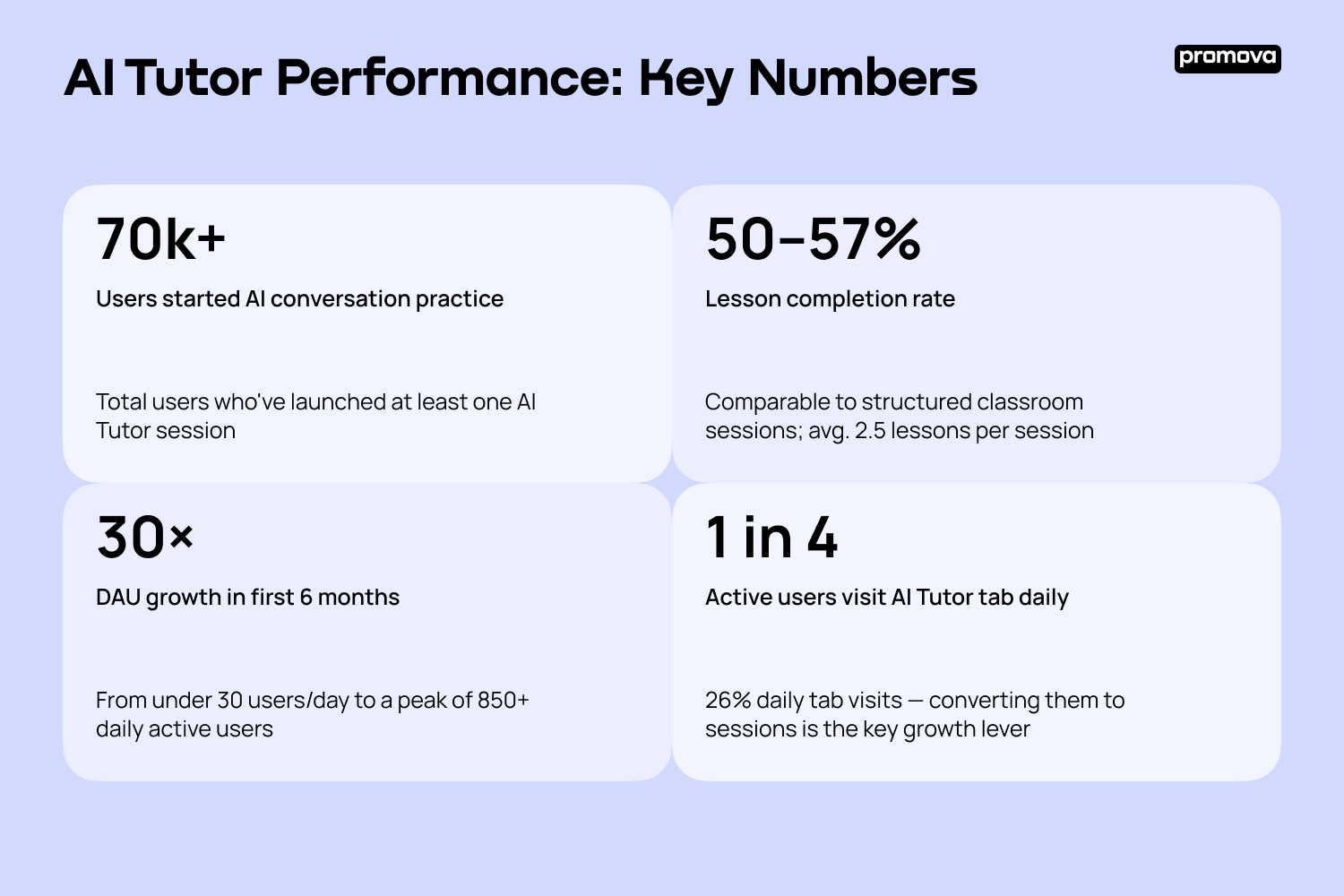
Within the first six months, daily active users practicing with the AI Tutor grew 30x, from a few dozen to a peak of over 850 unique learners per day. To date, more than 70,000 users have started at least one AI conversation session.
What's more telling than the volume is the behavior. Users who open the AI Tutor don't just try it once — they average around 2.5 lessons per sitting. Around More than half complete the full lesson after starting a call (50–57% in early 2026), a completion rate that compares favorably to structured classroom sessions.
About 1 in 4 active Promova users visits the AI Tutor tab on any given day. Most of them don't start a call — yet. But the intent is there, and closing that gap between "browsing" and "speaking" is exactly where the product is focused right now.
Unlike traditional language platforms that rely mostly on static content, Promova is part of the new group of AI-driven learning systems. Using this approach, students get real-time interaction and personalization as they learn.
AI Features and Their Impact on Learning Outcomes
- AI Tutor: Provides explanations and corrections, helping learners understand not only what is incorrect but also why, which supports deeper language learning.
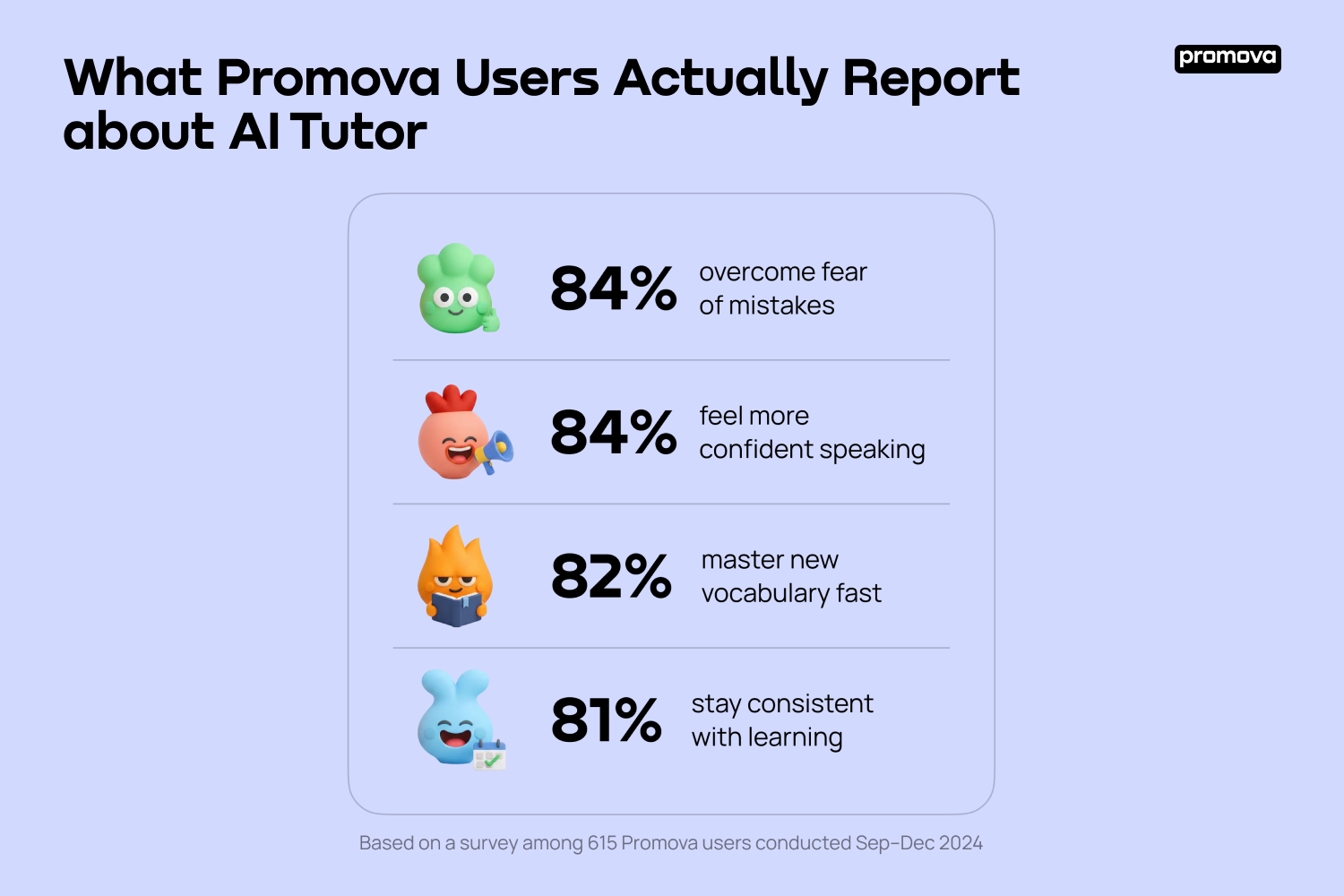
- AI role-play: This feature simulates real-life communication scenarios, so users can practice conversational skills in situations such as meetings or interviews.
- Instant feedback: This mechanism operates across the platform, allowing learners to adjust and improve in real time.
How AI Works Within Methodology (Not Alongside It)
Promova ensures its AI features aren't isolated. Instead, they're part of the learning path. So, AI supports progression, reinforces concepts, and adapts to each user's performance and experience. This structural integration ensures that AI enhances the overall methodology, rather than functioning as a disconnected add-on.
Key Insight: AI works best when it is part of a complete learning system, not used on its own.
How Students and Teachers Actually Use AI
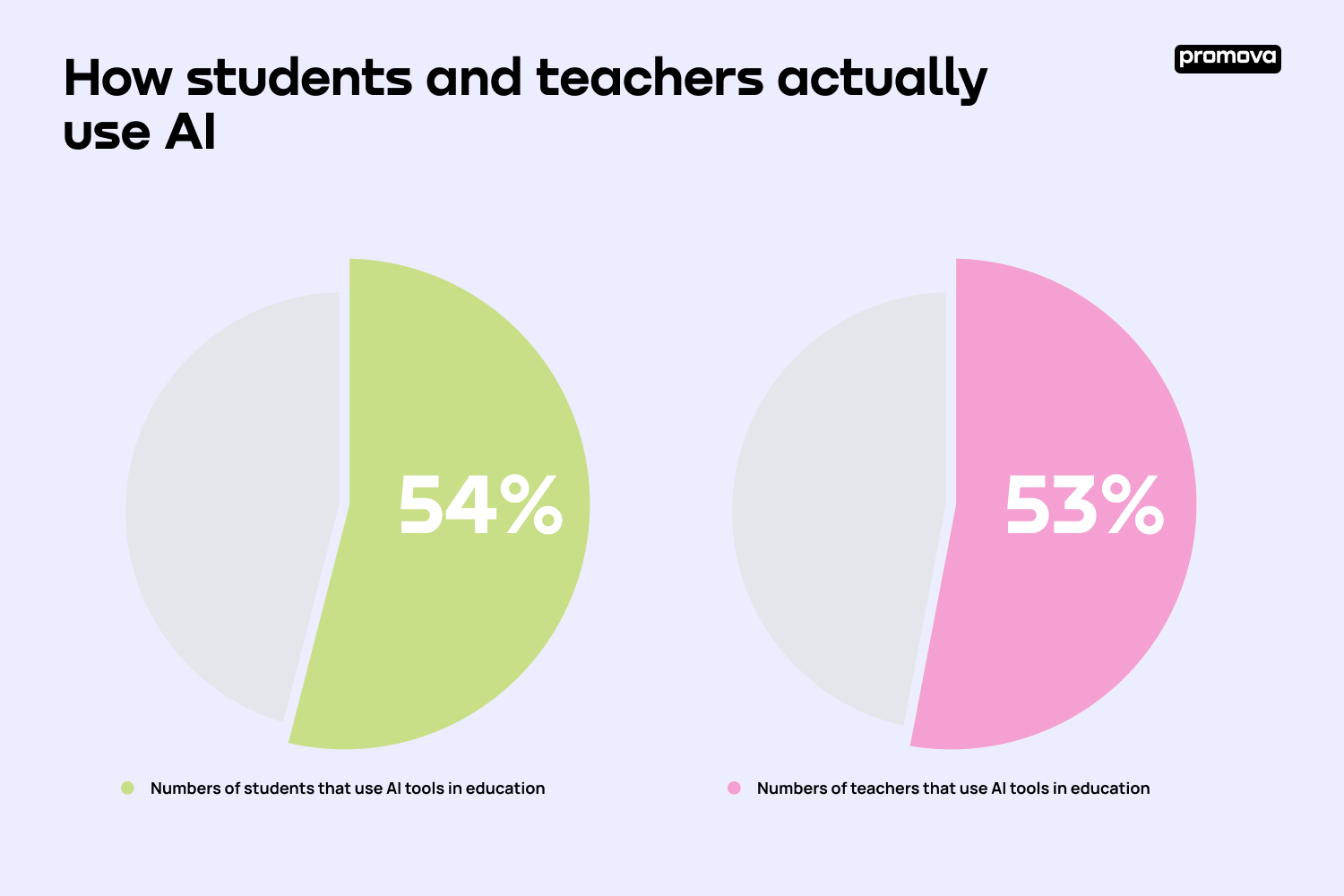
To really see how AI is changing education, we need to look beyond market data and investments and pay attention to how people actually use it in classrooms. Recent data shows that 54% of students and 53% of teachers use AI tools in education, so adoption rates are now about the same. However, they use AI for different reasons and at different frequencies.
How many students use AI weekly
AI adoption is becoming more common among students. As mentioned above, over half of the students are now using these tools. However, they're using them slightly differently than educators. Students report:
- 68% are using AI for research
- 42% are using it to improve their work
How many teachers are integrating AI tools
Teachers are also using AI weekly, but according to surveys, mainly for:
- Administrative tasks
- Lesson planning
- Personalized instruction
As AI becomes more common in classrooms, we might see it start to change what it means to be a teacher.
How AI is changing the role of the teacher
Rather than replacing teachers, AI handles repetitive, time-consuming tasks. As a result, teachers can focus on more important work, including personalized support for students who need it. Notably, 70% of teachers say saving time is the main benefit of using AI in the classroom.
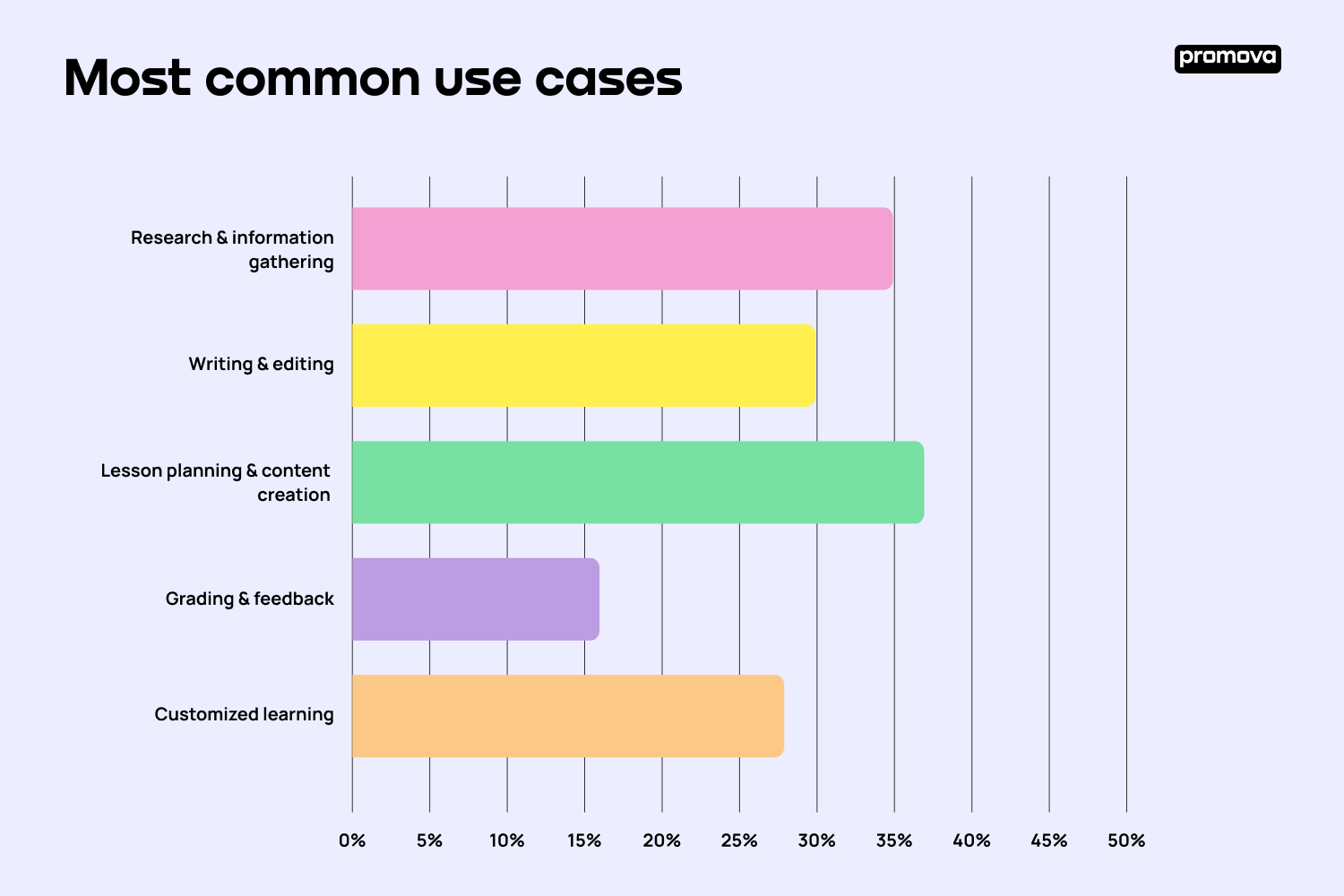
Most common use cases
AI is now used in many ways in education. However, the tools that are easiest to start and give quick benefits are more likely to be adopted first. Currently, the most common use cases include:
- Research and information gathering
- Writing and editing
- Lesson planning and content creation
- Grading and feedback
- Customized learning
Judging by these common use cases, people are more likely to use AI in areas where it saves time and improves accuracy.
Student-teacher adoption gap
Even though students and teachers use AI at similar rates, a closer look shows they use it differently in terms of how often and how independently. Students are more likely to use AI daily or weekly, and independently. On the other hand, teachers use it more selectively. They're also limited by school policies, training, and compliance requirements in how they use it.
A few factors might explain this:
- Autonomy: Students don't need approval to use tools
- Regulation: Teachers must follow institutional policies and guidelines
- Digital skills: There are varying levels of AI literacy among educators
- Academic integrity concerns: Extra caution in formal learning environments
Currently, it seems that students are making AI a regular part of their learning, while schools and educators are still catching up.
2
Benefits driving the growth of AI in education
AI is growing in education because it brings clear benefits that improve learning results and make schools run more efficiently. Whether a K-12 classroom or a higher education institution, it offers a range of advantages:
- Faster feedback for students
- Reduced operational and delivery costs
- Improved learning outcomes
- Increased accessibility for all
All of these factors help students do better and help the market grow. However, they also help teachers spend more time on essential tasks and less on administrative work.
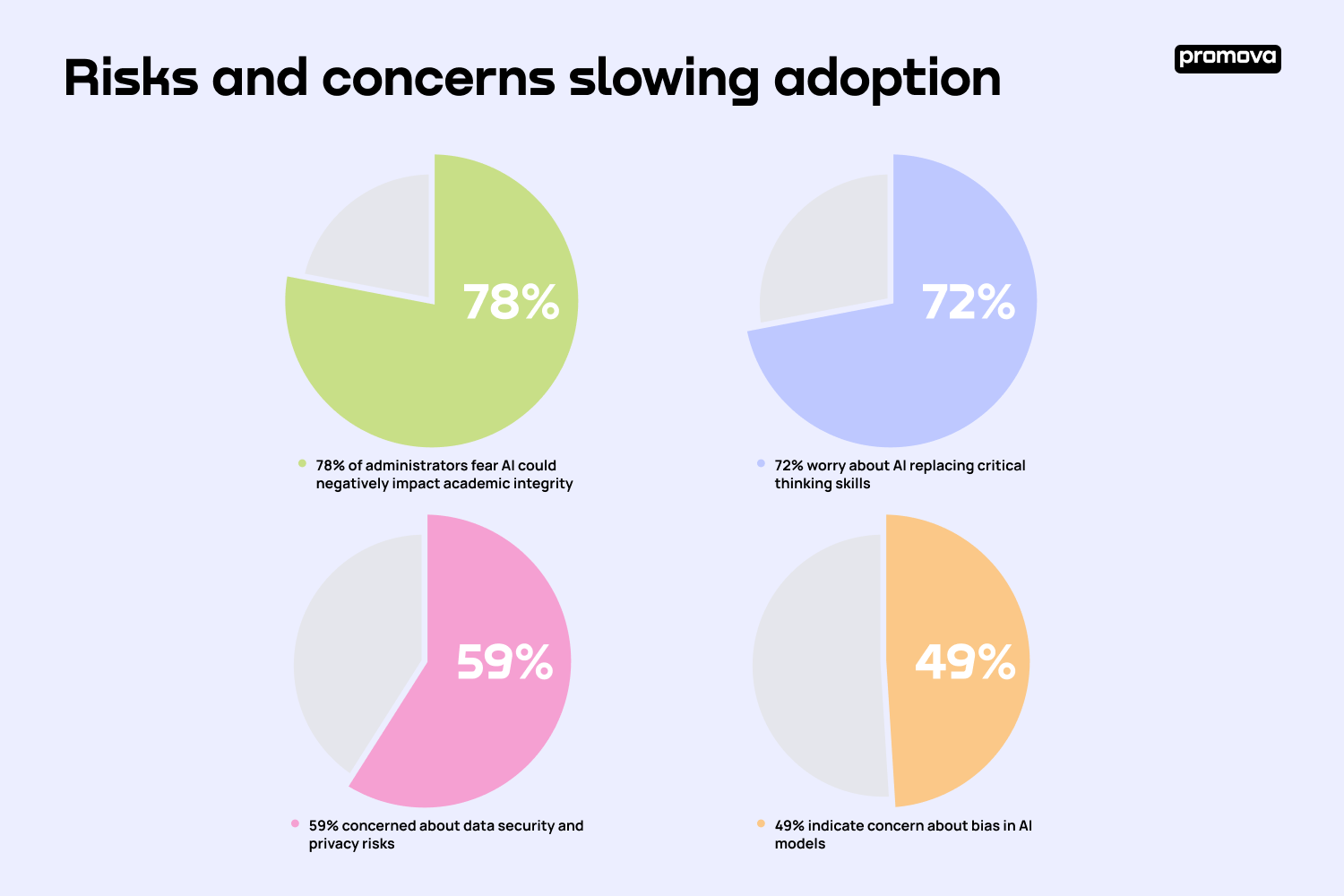
Risks, ethical considerations and concerns slowing adoption
Even with fast growth, there are still challenges. According to a recent study, 61% of educators report concerns about AI-related cheating. Despite this, only 14% of US public schools are currently teaching students about ethical AI use.
Since limited teacher training can slow down adoption, it's likely to become a focus area for many educational institutions. With clear rules and careful planning, we can mitigate some of the risks associated with AI use.
Regulatory and policy landscape
As AI in education continues to grow, we’re now seeing governments and international organisations playing a role in shaping how it is adopted, used, and governed. Their approach is to promote innovation while carefully balancing opportunity and risk by creating frameworks that regulate AI use in learning environments.
Organisations such as UNESCO have introduced guidelines for the ethical implementation of AI in education. Focusing on transparency, data privacy, inclusivity, and the importance of human oversight, they aim to ensure that AI enhances learning without any downsides.
On the other hand, the European Union has adopted a more regulatory approach, specifically through legislation such as the AI Act. Educational AI tools, including those used for assessment and student monitoring, may fall into higher-risk categories and require stricter compliance.
Currently, regulation isn’t limiting AI growth; rather, it's carefully shaping it. By ensuring it remains in education in a safe and ethical way, we’ll continue to see its adoption.
Conclusion
The growth of AI in education is a major change, not just a passing trend. From 2020 to 2026, adoption has sped up in all areas, thanks to new technology and clear benefits.
Looking ahead, AI will continue to evolve from just a tool to a key part of education systems. This is especially clear in personalized learning and language education, where real-time interaction and feedback matter most.
As platforms like Promova show, the future of education depends on how well AI is integrated into teaching methods, not just on its use.
FAQ
How fast is AI growing in education?
AI in education is growing rapidly, with an expected annual growth rate of around 36% through 2030. Adoption has increased significantly since 2020, with most educational organizations now using AI tools in some form.
Why is AI becoming popular in education?
AI is popular because it provides personalized learning, instant feedback, and saves time for both students and teachers. It also improves learning outcomes and makes education more accessible.
What are the most common uses of AI in education?
The most common uses include AI tutors, content generation, research assistance, automated grading, and personalized learning platforms. Many students also use AI for writing and studying support.
What challenges does AI in education face?
The main challenges include concerns about cheating, lack of teacher training, and ethical issues like data privacy. Regulations and guidelines are being developed to address these risks.


 English
 Português
 Español
 Français


Comments