Essential Soccer Vocabulary: Phrases and Terms

Contents
Key Takeaways
- Soccer has its own language — knowing the key terms helps you follow matches, talk about the game, and connect with other fans.
- Player positions, game rules, and kicking techniques each have specific names. Learning them makes sports broadcasts and conversations much easier to understand.
- Common phrases like "He's offside!" or "That's a hat trick!" come up constantly during matches — knowing them helps you react in real time.
- You don't need to memorize everything at once. Start with the basics — positions, scoring terms, and a few phrases — and build from there.
- The best way to lock in new vocabulary is to use it: watch games, join discussions, and practice with friends.
Soccer is one of the most popular sports in the world and an excellent way to connect with others and understand sports broadcasts. This article will teach you essential soccer vocabulary and phrases so you can talk about this sport like a pro.
This guide covers essential soccer vocabulary, common phrases, and tips for using them in real conversations. Knowing these terms will help you follow matches, join discussions, and enjoy soccer more fully.
Why is Soccer Such a Popular Sport?
Soccer is a global phenomenon that unites millions of people. It's more than just a game; it's a form of cultural expression, a source of intense emotions, and a passion that transcends borders. Whether you’re watching the FIFA World Cup, playing with friends, or following your favorite club, soccer brings people together from all walks of life.
Learning soccer vocabulary is helpful because it lets you join conversations about teams, players, and matches. Knowing these terms will help you follow matches, join discussions, and enjoy soccer more fully.
Now that you know why soccer is so popular, let's explore some essential vocabulary to help you join the conversation.
Basic Soccer Terms and Vocabulary
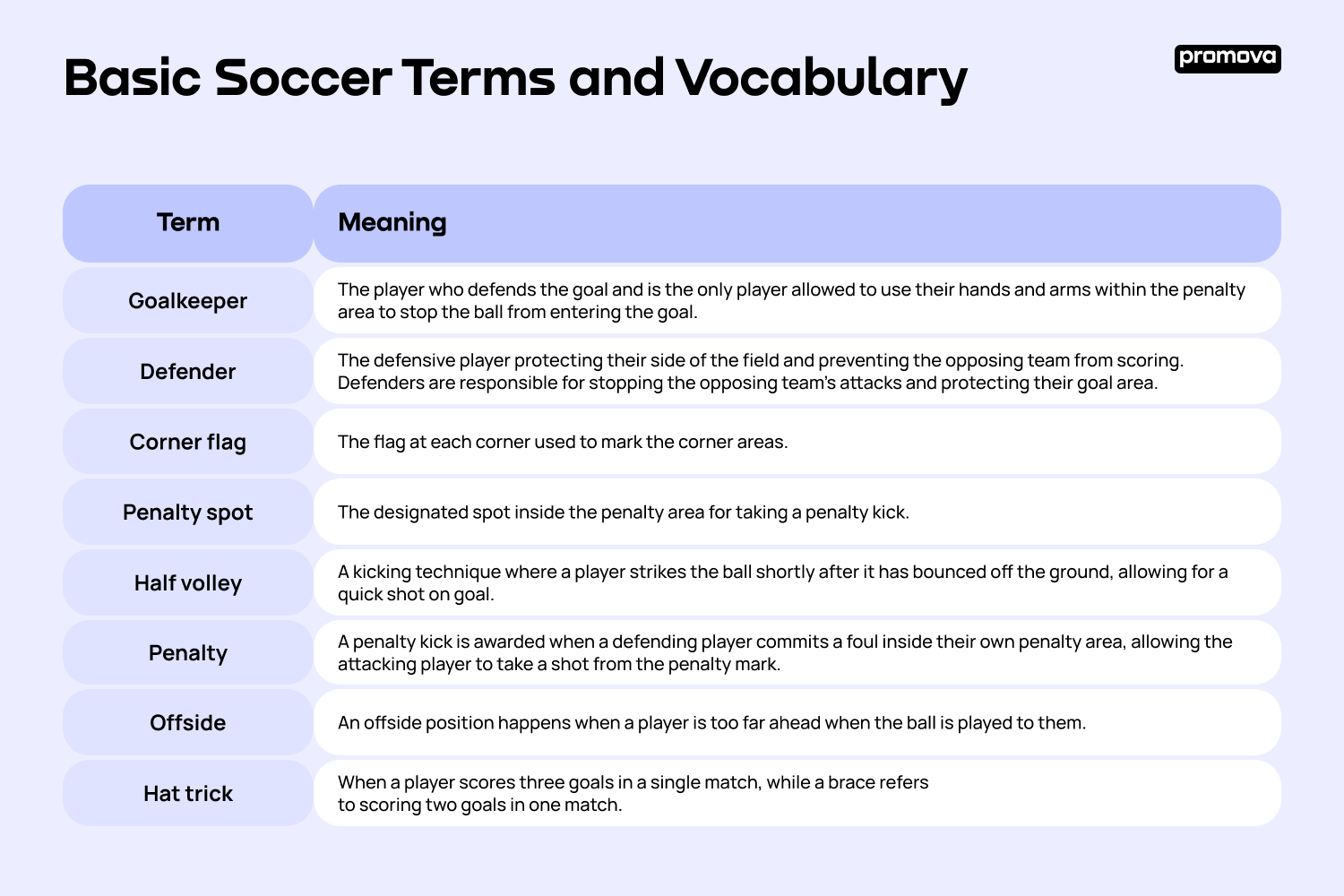
To understand and talk about soccer, it’s useful to know some basic terms and soccer vocabulary. Here’s an organized list by category, with explanations, including key soccer rules and advanced terms.
Player Positions
- Goalkeeper: The player who defends the goal and is the only player allowed to use their hands and arms within the penalty area to stop the ball from entering the goal.
- Defender: The defensive player protecting their side of the field and preventing the opposing team from scoring. Defenders are responsible for stopping the opposing team's attacks and protecting their goal area.
- Midfielder: The player connecting defense with offense, often controlling the middle of the field. Midfielders play in the center of the field and are responsible for linking the defense and the attack, often participating in both defensive and offensive plays.
- Forward: The player focused on scoring goals in the opponent's goal. Forwards, also known as strikers, are primarily responsible for scoring goals and are positioned closest to the opponent's goal.
- Sweeper: A defensive player who plays behind the main line of defenders, clearing the ball and covering defensive gaps without marking a specific opponent.
- Substitute: A player who enters the match to replace another player.
Game Elements and Player Kicks
- Ball: The spherical soccer ball used to play the game.
- Field: The soccer field where the game is played, with the halfway line dividing it into two halves.
- Corner flag: The flag at each corner used to mark the corner areas.
- Penalty mark: The marked point on the field from which penalty kicks are taken.
- Penalty spot: The designated spot inside the penalty area for taking a penalty kick.
- Goalpost: The structure defining where goals are scored.
- Six yard box: The small area in front of the goal used for goal kicks and goalkeeper play.
- Goal: When the ball fully crosses the goal line.
- Net: The net where the ball lands as two teams try to score.
- Whistle: The whistle used by the referee to signal plays.
Advanced Kicking Techniques
- Bicycle kick: An advanced kicking technique where a player performs a backflip to kick the ball backward in midair, often used to score goals in spectacular fashion.
- Half volley: A kicking technique where a player strikes the ball shortly after it has bounced off the ground, allowing for a quick shot on goal.
- Chip shot: A technique used to lift the ball over defenders or the goalkeeper, typically executed with a gentle kick that sends the ball high into the air. A chip shot is a high, lofted shot meant to go over defenders or the goalkeeper and into the net.
- Volley: A technique where a player strikes the ball while it's in the air, usually with their foot or head, without attempting to gain control of it.
Rules and Situations
- Referee: The person responsible for enforcing the rules of the game.
- Penalty: A penalty kick is awarded when a defending player commits a foul inside their own penalty area, allowing the attacking player to take a shot from the penalty mark.
- Free kick: A restart awarded after a foul.
- Direct free kick: A direct free kick is awarded for physical contact fouls, allowing the kicker to attempt to score directly without the ball touching another player first.
- Indirect free kick: A restart for less serious fouls where the ball must touch another player before a goal counts.
- Throw in: The restart when the ball crosses the sideline.
- Corner kick: A restart when the attacking side is awarded a kick from the corner.
- Goal kick: A restart when the attacking team last touches the ball before it crosses the goal line.
- Drop ball: A referee restart after a stoppage not caused by the ball going out.
- Offside: An offside position happens when a player is too far ahead when the ball is played to them.
- Dead ball: Any moment when the ball is out of play before a restart.
- Yellow card: A yellow card is shown to a player as a warning for a minor offense.
- Red card: A red card results in the player's ejection from the game for serious infractions.
- Extra time: Additional time played to break a tie, especially in knockout competitions, and some matches are then decided by a penalty shootout.
- Soccer match duration: A soccer match lasts 90 minutes, divided into two 45-minute halves, with stoppage time added for delays.
Advanced Soccer Terms
- Hat trick: When a player scores three goals in a single match, while a brace refers to scoring two goals in one match.
- Own goal: When a player accidentally scores in their own net, benefiting the opposing team.
- Nutmeg: A technique used to pass the ball through an opponent's legs, allowing the player to continue their attack.
- Give-and-go: A quick passing play where a player passes to a teammate and then moves forward to receive the ball back, also known as a wall pass.
- Cross: A pass from the sideline toward the center of the field to create a scoring opportunity.
- Assist: A pass by a player that directly leads to a goal, typically credited to the last player to touch the ball before the scorer.
With these terms in mind, you're ready to use them in real conversations. Here are some useful soccer phrases to get you started.
1
Useful Soccer Phrases
General Conversation
- What’s your favorite team?
- Who’s your favorite player?
- They’re playing really well today.
- He’s on the bench.
- Start using these phrases today to show your love for soccer!
During the Match
- Kick the ball!
- Shoot at the opposing team's goal!
- He’s offside!
- That was a foul!
- He got a red card.
- They’re in the penalty area.
- What a great save!
- Extra time is starting.
- They score goals!
Scoring and Results
- It’s a tie!
- That’s a hat trick!
- The player scores again!
- Three goals in the same game!
- Two goals by the same player!
- It’s an own goal!
Tips for Enjoying Soccer and Youth Soccer Programs
Soccer is not just an exciting sport but also a social and cultural experience. Here are some tips to make the most of it:
Watching and Listening
- Watch games: Tune in to broadcasts to familiarize yourself with vocabulary and common phrases, especially during the FIFA World Cup. Pay attention to the commentators and assistant referees, who often use exciting expressions like “What an amazing goal!” or “He’s unstoppable!”.
- Follow soccer accounts on social media: Many teams, players, and commentators share interesting content about soccer. Reading their posts is another great way to increase your vocabulary.
- Learn chants and songs: Many teams have cheers and songs sung in stadiums. Learning them helps expand your vocabulary and connect with the soccer community.
Participating and Practicing
- Join online discussions: Participate in forums, social media groups, or virtual communities where soccer is discussed. Share opinions about your favorite players or teams and match results to engage with fellow soccer fans.
- Play soccer video games: Games like FIFA can be a fun way to learn vocabulary while enjoying time with friends, and you may also come across terms related to major league soccer.
- Attend local matches: If possible, go to a game in your city and observe how people talk about the game. This provides practical context for using what you’ve learned.
- Practice phrases with friends: Use phrases like “What a great match!” or “They deserved to win” in conversations with friends who are also soccer fans.
- Play soccer: Of course, another great way to practice vocabulary is by playing the game and improving your ball control. Gather some friends and use real-world references to apply the terms you’ve learned today, such as when players move the ball forward in attack, play the ball backward to keep possession, or create scoring opportunities for teammates; you may also hear defensive terms like slide tackle.
This essential vocabulary and these phrases will help you engage in interesting conversations, enjoy matches, and connect with others who share your passion for the sport.
Complement your learning with daily lessons on the Promova app to maximize your skills.
Until next time, see you in the field!
FAQ
What’s the difference between “football” and “soccer”?
In English, football refers to soccer in British English, while soccer is commonly used in American English. Both mean the same thing, but the term varies by region.
What are the main soccer positions, and how are they said in Spanish?
The basic positions are:
- Portero (Goalkeeper)
- Defensa (Defender)
- Mediocampista (Midfielder)
- Delantero (Forward)
What’s the difference between “match” and “game”?
They are both synonyms, but “match” is more commonly used in British English, while “game” is preferred in American English.
What can I do if I don’t understand a phrase during a match?
Take note of the phrases you don’t understand and look them up later in a dictionary. You can also use subtitles while watching matches to improve comprehension.
How can I practice these phrases and words if I don’t play soccer?
You can practice by watching matches, joining soccer forums, playing soccer video games, or simply discussing the sport with friends.
 English
 Français
 Português
 Español


Comments