Promova vs Rosetta Stone: Which Language Learning App Is Right for You?

Contents
Editorial disclosure: This article was written by the Promova team. We've done our best to represent Rosetta Stone's features accurately based on publicly available information, but as Promova's publisher, we have an inherent interest in the comparison. We encourage you to check both platforms directly before deciding. Rosetta Stone data verified as of May 2026.
Key Takeaways
- Promova and Rosetta Stone are two established language learning apps that take structurally different approaches: Promova focuses on AI-powered speaking practice and short daily lessons; Rosetta Stone uses a visual immersion method that teaches entirely in the target language.
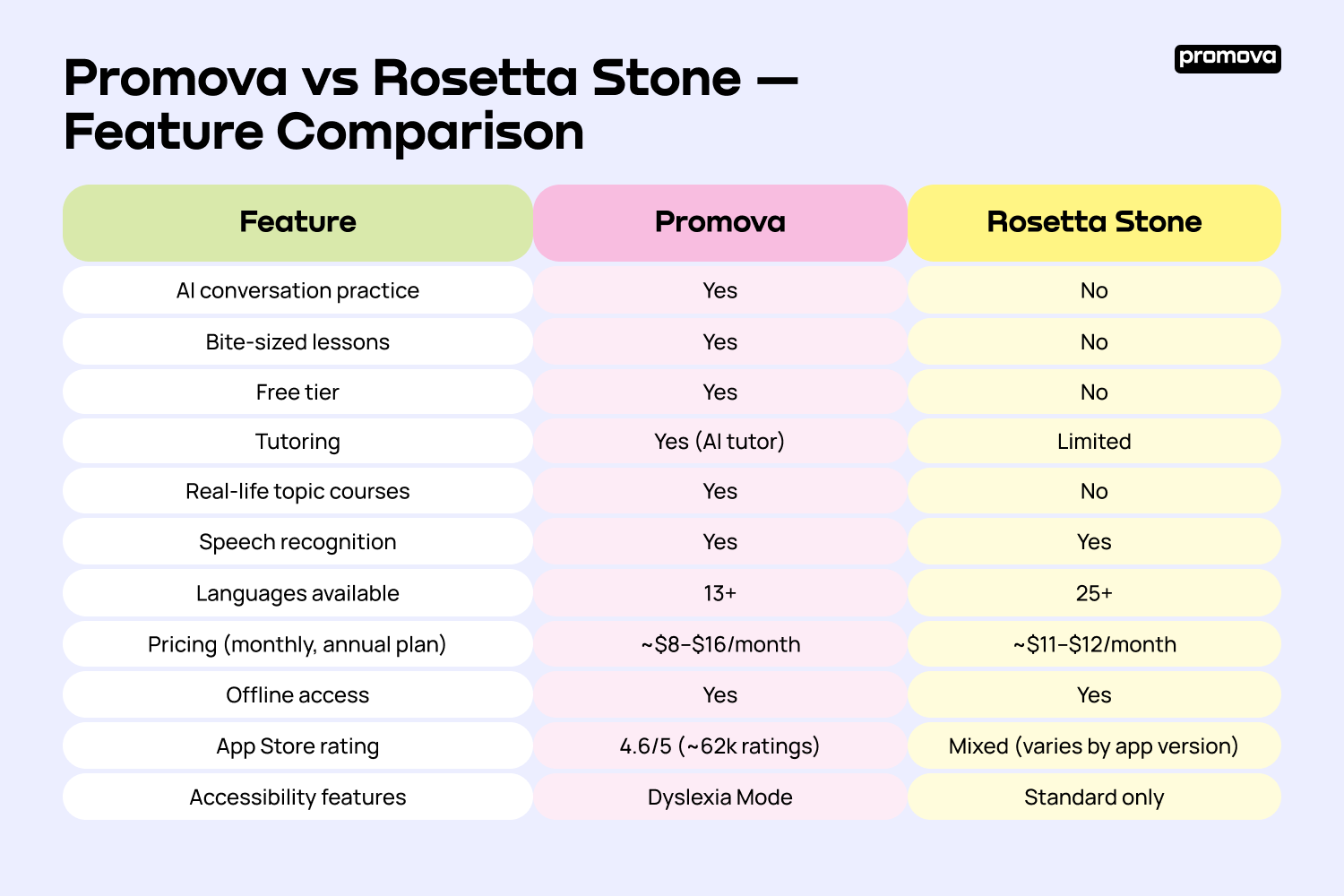
- Promova offers a free tier and plans from around $8–$16/month; Rosetta Stone starts at approximately $11–$12/month on an annual plan with no free tier.
- Rosetta Stone supports 25+ languages — more than Promova's current core set. If breadth of language options is your priority, Rosetta Stone has the advantage.
- Promova is better suited to adults who want AI-guided speaking practice, real-life conversation scenarios, and flexible short lessons. Rosetta Stone suits learners who prefer immersive, visual, translation-free methods.
- Neither app will make you fluent on its own — consistent daily practice is what drives results regardless of which platform you choose.
What are Promova and Rosetta Stone?
Promova is an AI-powered language learning platform designed for adults who want to fit learning into a busy schedule. It combines structured courses, bite-sized lessons, AI conversation practice, and an AI tutor in one place. The goal is to help you speak confidently in real situations, not just understand grammar rules on paper.
Rosetta Stone is one of the oldest and most recognized names in language learning, founded in 1992. It uses a method called Dynamic Immersion — you learn words and phrases through images and repetition, entirely in the target language, with no translation involved. It's designed to help your brain make direct associations between words and meaning.
Both platforms support independent study. But the experience — and what you get out of it — is quite different.
How does the learning method compare?
Promova structures learning around real-life outcomes. You get courses organized by level (A1 to C1), with lessons that mix vocabulary, grammar, pronunciation, and speaking practice. Lessons use microlearning — short five- to fifteen-minute segments that make consistent practice easier during a lunch break or morning commute.
The platform's AI role-play feature lets you practice real conversations before you have them in real life. You pick a scenario — ordering food, talking to HR, a job interview, online shopping — and practice with an AI that gives instant feedback, supporting conversational practice, listening comprehension, and speaking exercises across more than 50 real-life situations.
Rosetta Stone takes a different approach. It removes your first language completely. Instead of explaining what a word means in English, it shows you a picture and expects your brain to make the connection. This works well for visual learners and for building intuitive associations early on. However, it can feel slow for learners who are already at an intermediate level, and the no-translation method offers limited grammar explanation, which some learners find frustrating when they want to understand the rules behind what they're saying.
One honest note on Promova: our platform covers a narrower range of languages than Rosetta Stone. If you need to learn a less common language — Hebrew, Tagalog, Farsi, or Latin, for example — Rosetta Stone is more likely to have it.
Which app is better for speaking practice?
Promova is the stronger option for conversational speaking practice. The AI Tutor lets you practice speaking with voice input, get instant pronunciation feedback, and try again without judgment. This matters a lot for adult learners who feel anxious about making mistakes in front of another person.
Rosetta Stone includes TruAccent, a speech recognition tool that compares your pronunciation to native speakers. It's useful for early-stage pronunciation work. But it's designed for repetition and matching, not open dialogue — you're repeating words and phrases, not having an actual back-and-forth conversation.
If building real conversation confidence is your main goal, Promova offers more structured practice in that direction. If accurate early-stage pronunciation is your focus, Rosetta Stone's TruAccent is a solid tool.
What do you get with each platform?
With Promova, learners get:
- Bite-sized lessons (A1 to C1 level) across multiple languages
- AI role-play and AI Tutor with voice input and real-time feedback
- Special courses on business English, travel, small talk, slang, and English with TV series
- Grammar comics (a series called Grammar Series featuring a character named Luise)
- Video lessons, vocabulary practice, and reading exercises
- Dyslexia Mode with specialized support for neurodivergent learners
With Rosetta Stone, learners get:
- Core language courses in 25+ languages (one of the broadest selections available)
- Visual immersion lessons with no translation, covering all major skill areas
- TruAccent speech recognition for pronunciation scoring
- A limited number of live tutoring sessions depending on the plan
- Offline access on mobile
- A 30-day money-back guarantee on all plans
App ratings
Both apps are well-reviewed, with differences worth noting:
Promova holds a 4.6/5 rating on the App Store (~62,000 ratings) and a 4.6/5 on Google Play (129,000+ ratings), according to data from the Promova review page and YourAppLand's independent overview.
Rosetta Stone's consumer app ratings vary by version and platform and have been more mixed in recent years, with some users citing UI issues and a preference for more explicit grammar instruction. Independent reviewers at Test Prep Insight (May 2026) rate it as a solid option for visual learners, particularly beginners.
Who is Promova best for?
Promova works well for:
- Adults with limited time who need short, focused lessons that fit a daily routine
- Learners who feel nervous about speaking and want a low-pressure practice space
- People with specific goals: job interviews, travel, business communication, or social confidence
- Learners who want both self-study and ai teacher support in one platform
- Learners who need accessibility features (Dyslexia Mode)
1
Who is Rosetta Stone best for?
Rosetta Stone works well for:
- Learners who prefer visual, picture-based learning with no translation
- People who need access to a wide range of languages — 25+, including less common options
- Learners who enjoy immersive methods and have patience for longer-form study sessions
- Those who want offline access and a one-time lifetime payment option
- Learners whose primary goal is pronunciation accuracy at the early stages
What about price?
Promova has a free tier — new learners can access starter lessons without paying, and the free weekly Conversation Club is open to everyone. Promova Premium removes lesson limits and ads. Promova Fluent, the top tier, unlocks AI role-play and all special courses. Depending on subscription length, Promova plans generally work out to about $8–$16 per month.
Rosetta Stone does not have a free plan. Access to full content requires a paid subscription from day one, though a 30-day money-back guarantee is available on all plans. Based on publicly available pricing (rosettastone.com, verified May 2026):
- 3-month plan: approximately $13–20/month
- 12-month plan (annual): approximately $11–12/month (~$130–145/year for one language)
- Lifetime plan: approximately $179–399 depending on promotions (covers 25+ languages)
For learners on a budget or anyone who wants to try before committing, Promova is the more accessible entry point. For learners who want lifetime access to many languages in a single payment, Rosetta Stone's Lifetime plan offers long-term value.
Promova vs Rosetta Stone: the bottom line
Both platforms can help you learn a language. The difference is in approach, flexibility, and what stage of learning you're at.
Rosetta Stone is built around one method — immersive, visual, translation-free. That consistency works well for certain learners, particularly visual learners and absolute beginners who want to build intuitive associations without leaning on their native language. It also offers the widest language selection of the two.
Promova gives you more tools to fit learning into your actual life: short lessons, AI-powered speaking practice, live tutors, a free community, and courses built around real-life topics. It's more flexible in method, and its free tier makes it easier to test before paying.
A 2012 study published in the journal Language Learning & Technology found that self-directed digital language tools showed meaningful gains for learners who used them consistently, but that the quality of speaking practice opportunities had the largest impact on spoken fluency development. This is one reason speaking-focused practice, rather than vocabulary repetition alone, tends to produce faster conversational results.
If you've ever thought "language learning just doesn't work for me," it's worth trying both — many learners discover that the method matters as much as the effort.
FAQ
Is Promova better than Rosetta Stone for beginners?
Both apps work for beginners. Promova gives beginners more explanatory support — the structured A1 courses cover vocabulary, grammar, and pronunciation step by step, and the AI Tutor lets beginners practice speaking without the fear of embarrassing themselves in front of another person. Rosetta Stone's no-translation method can feel confusing for total beginners who need more context to understand what they're learning — though it works well for visual learners who are comfortable with discovery-based learning.
Can I use Promova for free?
Yes. Promova has a free version that gives you access to a set of starter lessons. Premium and Fluent subscriptions unlock additional content, AI role-play, and all special courses.
Does Rosetta Stone use AI?
Rosetta Stone uses TruAccent, a speech recognition technology that scores your pronunciation against native speaker models. It is not conversational AI — it doesn't respond to you in dialogue or give contextual feedback the way Promova's AI Tutor does. Rosetta Stone also provides less explicit grammar instruction, which may not suit learners who want clear rule-based explanations.
Which app helps more with speaking confidence?
Promova is designed specifically around this goal. The AI role-play feature lets you practice speaking in real-life scenarios and get feedback without fear. This is one of the main differentiators between Promova and most other language apps, including Rosetta Stone.
Do language skills help with career advancement?
Yes — and it goes beyond getting hired. According to research by the American Council on the Teaching of Foreign Languages (ACTFL), 90% of US employers rely on employees who speak a language other than English, and bilingual employees earn an average of 19% more than monolingual peers. Multilingual workers also report receiving promotions faster — a career benefit that compounds over time.


 English


Comments