Countries with the Most Official Languages
Contents
Key Takeaways
- Bolivia holds the world record with 37 official languages, including Spanish and 36 indigenous languages recognized in its 2009 Constitution.
- Zimbabwe recognizes 16 official languages, including Sign Language — making it one of the most inclusive multilingual countries globally.
- India has 22 scheduled languages in its Constitution, alongside thousands of regional dialects.
- South Africa has 12 official languages as of 2023, after South African Sign Language was elevated to official status alongside the original 11.
- Countries with many official languages often do so to protect indigenous cultures and promote national unity.
- Learning even one of these widely spoken languages — like Spanish, English, or Hindi — opens doors across many of these multilingual nations at once.
Which country has the most official languages? The answer is Bolivia — with 37. That's not a typo. Thirty-seven languages, all recognized in the country's national constitution.
Most people assume that countries work with one or two official languages. The reality is far more interesting. Around the world, some nations have made a deliberate choice to recognize dozens of languages — to protect cultural heritage, include indigenous communities, and reflect the true diversity of their people.
According to Ethnologue, the most comprehensive database of global languages, there are 7,168 known living languages spoken around the world today. Most are spoken by very small communities. But in some countries, governments have taken extraordinary steps to give those languages official standing. This article walks you through the countries with the most official languages, why they made that choice, and what it means for language learners everywhere.
What Is an Official Language?
An official language is a language that has formal legal status in a country. It’s used by the government, in courts, in schools, and in official documents.
A country can have a single official language, while others recognize more than one language or several languages for official use. The decision usually reflects history, culture, politics, and the makeup of a country’s population. Some also rely on a de facto official language or recognize languages differently at the national level and regional level.
Official languages are different from the languages people actually speak at home. A country might have one official language but hundreds of regional dialects in everyday use.
1
Countries with the Most Official Languages
The following list covers countries with the highest number of constitutionally recognized official languages, based on data from Ethnologue and official national constitutions and language policies.
1. Bolivia — 37 official languages
Bolivia holds the Guinness World Record for the most official languages of any country. When Bolivia adopted its new constitution in 2009, it elevated Spanish alongside 36 indigenous languages to official status. These include Quechua, Aymara, Guaraní, Chiquitano, and dozens of others tied to the country’s native communities.
It’s worth knowing that 23 of these languages are spoken by fewer than 1,000 people, and two are considered extinct. Bolivian Sign Language is also among the 37 officially recognized languages.
In practice, Spanish dominates government and public life. As the predominant language used across public institutions and many government services, it is often prioritized for official communication, which can leave speakers of other officially recognized languages feeling excluded despite that formal recognition. But the recognition of indigenous languages is a meaningful commitment to cultural inclusion — and a recognition that language preservation matters.
What this means for learners: Spanish is the most practical language for Bolivia. With over 480 million native speakers worldwide, learning Spanish connects you to an enormous, vibrant community far beyond South America.
2. Zimbabwe — 16 official languages
Zimbabwe recognizes 16 official languages under its 2013 Constitution. These include Shona, Ndebele, English, Chewa, Chibarwe, Kalanga, Koisan, Nambya, Ndau, Shangani, Sotho, Tonga, Tswana, Venda, Xhosa, and Sign Language.
Zimbabwe is one of the few countries in the world to give Sign Language full official status alongside spoken languages — a strong statement about inclusivity that helps communication across different communities.
English is used mainly in government, media, and business. Shona and Ndebele are the most widely spoken first language options among different groups in Zimbabwe.
3. India — 22 scheduled languages
India is a linguistic mosaic. The Eighth Schedule of the Indian Constitution recognizes 22 scheduled languages, including Hindi, Bengali, Telugu, Marathi, Tamil, Urdu, Gujarati, Kannada, and others.
Hindi and English serve as the primary languages at the federal level, while many other languages carry official and everyday importance in different regions. But across those different regions, different languages shape how people communicate, create, and express identity — and the country is home to an estimated 19,500 dialects, according to India’s linguistic surveys and the 1961 Census of India.
India’s linguistic diversity isn’t just a fact on paper. It’s something you feel in conversations, in films, in music, and in the sheer variety of written scripts used across the country.
4. Mali — 13 official languages
Mali officially recognizes 13 languages, reflecting the ethnic and cultural diversity of West Africa. These include Bambara, Fula, Songhay, Tamasheq, Soninke, Maninke, and others.
Bambara is the most widely spoken language in everyday life. French remains the language of government and formal education — a legacy of colonial history.
5. South Africa — 12 official languages
South Africa's official languages are a direct response to its history. After the end of apartheid, the country championed linguistic diversity as a cornerstone of its new national identity. The Constitution initially recognized 11 languages: Zulu, Xhosa, Afrikaans, English, Northern Sotho (Sepedi), Sotho, Tswana, Tsonga, Swazi, Venda, and Ndebele.
In 2023, South African Sign Language was elevated to official status, bringing the total to 12 official languages.
Zulu, Xhosa, and Afrikaans are the most widely spoken first languages, while English is the most common second language.
6. Switzerland — 4 national languages
Switzerland recognizes four national languages: German, French, Italian, and Romansh. While three official languages are spoken by large populations, Switzerland recognizes four official languages and manages their coexistence through strict regionalism, with language use tied to specific areas and Romansh retaining official recognition in its own context.
This small country shows that official multilingualism doesn’t require a large population. It requires political will and respect for communities.
7. Singapore — 4 official languages
Singapore recognizes four official languages: English, Malay, Mandarin, and Tamil. These four languages come from different language families. English is the primary language of government, business, and education. Malay holds special status as the national language.
Singapore is also known for Singlish — a vibrant creole blend of English with Malay, Hokkien, and Tamil elements that locals use in daily conversation. This multilingual approach reflects the cultural importance of its native languages and other languages used by its multilingual population.
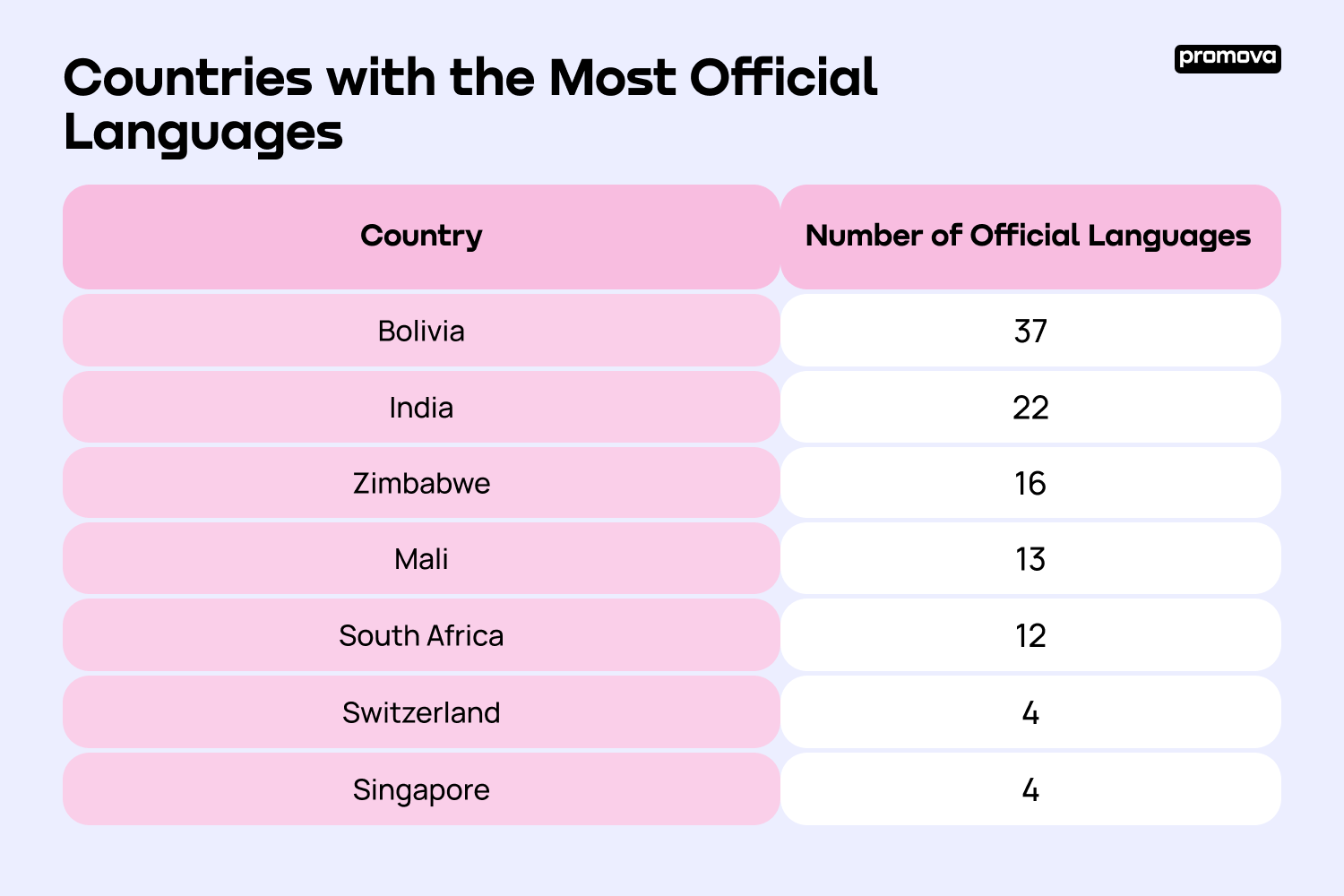
Quick Reference: Countries with the Most Official Languages
| Country | Official Languages | Region |
| Bolivia | 37 | South America |
| India | 22 (scheduled) | Asia |
| Zimbabwe | 16 | Africa |
| Mali | 13 | Africa |
| South Africa | 12 | Africa |
| Switzerland | 4 | Europe |
| Singapore | 4 | Asia |
Why Do Countries Have So Many Official Languages?
There are three main reasons a country chooses to recognize multiple official languages. In many multilingual nations, governments rely on territoriality and personality systems to decide when and where each language is used.
1. To protect indigenous communities. Bolivia and India both elevated indigenous and regional languages to official status to preserve cultures that were at risk of disappearing. According to the United Nations, one indigenous language dies every two weeks. Language is closely tied to identity — when a language disappears, so does a part of a community’s history. In practice, coexistence often depends on public education, localized governance, and sometimes a neutral lingua franca, not just official encouragement.
2. To reflect colonial history. Many African countries use European languages (English, French, Portuguese) as official languages alongside indigenous ones. These languages became embedded in government and education systems during colonization and stayed long after independence.
3. To promote national unity. South Africa made linguistic richness a deliberate policy choice to signal inclusion after decades of apartheid. Recognizing multiple languages says: every community belongs here. Without translation or interpretation, speakers of minority languages can be shut out of legal, medical, or educational support.
What Does This Mean for Language Learners?
Here’s a practical takeaway. Learning Spanish, English, Hindi, or French gives you access to a remarkable number of these multilingual countries all at once.
Spanish alone is the official language in 21 countries. English appears as an official or working language across dozens of nations. Hindi connects you to one of the world’s most linguistically rich regions. According to ALTA Language Services, these are some of the most strategically valuable languages to learn for anyone interested in global communication. People in a multilingual population often show greater cognitive flexibility, stronger problem-solving ability, and more empathy. Check out our overview of the most spoken languages in the world to see how they all stack up.
At the same time, stories like Bolivia’s remind us that smaller languages matter too. Every language carries a worldview, a history, and a way of seeing things that no other language quite captures, especially in places where two languages, three languages, or even more are used in daily life.
How to Start Learning One of These Languages
If you want to explore Spanish, English, or Hindi — or any other widely spoken language — Promova makes it easy to start, even with a busy schedule.
You get bite-sized lessons that fit into your day, structured courses from A1 to C1, and AI-powered speaking practice that lets you build confidence at your own pace. Our guide to the best languages to learn breaks down the most useful options for travel, career, and personal growth.
You don't need to move to Bolivia or Singapore to become multilingual. You just need a consistent habit and the right support.
Final Thoughts
The countries with the most official languages aren’t just linguistic curiosities. While most countries rely on one dominant official language in practice, some recognize multiple official languages to better reflect different communities. They reflect something important: the belief that a language spoken by even a small community deserves a place in public life.
Bolivia’s 37 official languages, Zimbabwe’s 16, India’s 22 — these are political and cultural choices. They say that belonging matters, that history matters, and that no community should have to abandon its language to be part of a nation, while acknowledging the cultural importance of native languages and other languages spoken by different groups.
For language learners, the takeaway is simple. The world is richer, more varied, and more surprising than it looks on a map. And every language you learn is another window into that world.

 English


Comments