How to Write Korean Letters: A Beginner's Guide to Hangul

Contents
Key Takeaways
- Korean letters are called Hangul (한글) — a writing system created in 1443 by King Sejong the Great, specifically designed to be easy to learn.
- Hangul has 14 basic consonants and 10 basic vowels. Combined, they form syllable blocks — not single letters in a row.
- Each Korean syllable block contains at least one consonant and one vowel, arranged in a specific pattern.
- Before Hangul, Koreans primarily used Chinese characters (Hanja), which were complex and difficult for the general population to learn, leading to widespread illiteracy.
- Unlike Chinese or Japanese, Hangul is not based on symbols or meaning — each character represents a sound, making it phonetic and logical.
- Most beginners can learn to read basic Hangul in 1–2 weeks with consistent daily practice.
- With the right resources and motivation, learning the Korean writing system, Hangul, can be achieved in just a few hours.
Korean may look intimidating at first. The characters seem like shapes from another world. But here’s the thing — the Korean alphabet is one of the most logical writing systems ever created. Once you understand how it works, you’ll be reading signs, menus, and song lyrics faster than you’d expect.
This guide walks you through how to write Korean letters from scratch. No prior knowledge needed.
What Is Hangul? The Korean Writing System Explained
Hangul (한글) is the official writing system of the Korean language. It was created in 1443 by King Sejong the Great and a team of scholars during the Joseon Dynasty. The goal was clear: make literacy accessible to all Koreans, not just the educated elite who could read Classical Chinese. Before Hangul, Koreans used Chinese characters (Hanja), which were complex and inaccessible to most people.
According to the National Institute of Korean Language, Hangul was designed with a scientific approach — each consonant shape was modeled after the position of the mouth and tongue when making that sound. That’s not a coincidence. It’s intentional, elegant design. The introduction of Hangul in 1446 marked a significant cultural shift, allowing Koreans to write their own language without relying on borrowed Chinese characters.
Hangul is an alphabet, not a set of pictograms. Each character represents a sound. Combined into syllable blocks, those sounds form words. That structure is what makes it learnable in a way that Chinese or Japanese scripts are not — at least not in the same timeframe. Hangul became a symbol of national identity and pride in the late 19th century, leading to various Hangul reform movements that aimed to promote its use.
Korean Consonants: The Building Blocks
Hangul has 14 basic consonants (자음, ja-eum), each represented by a unique consonant shape that reflects the position of the mouth or speech organs when producing the sound. Korean consonants are represented by these 14 basic shapes, including ㄱ (giyeok), ㄴ (nieun), and ㅁ (mieum), which can be modified to create tense or aspirated versions. These Korean alphabet letters, or Hangul characters, are the building blocks of every Korean word, and learning both consonants and vowels is essential for reading and writing Korean.
Here are the 14 basic consonants with their approximate English equivalents:
| Letter | Name | Sound |
| ㄱ | 기역 (gi-yeok) | g / k |
| ㄴ | 니은 (ni-eun) | n |
| ㄷ | 디귿 (di-geut) | d / t |
| ㄹ | 리을 (ri-eul) | r / l |
| ㅁ | 미음 (mi-eum) | m |
| ㅂ | 비읍 (bi-eup) | b / p |
| ㅅ | 시옷 (si-ot) | s |
| ㅇ | 이응 (i-eung) | silent (at start) / ng (at end) |
| ㅈ | 지읒 (ji-eut) | j |
| ㅊ | 치읓 (chi-eut) | ch |
| ㅋ | 키읔 (ki-euk) | k |
| ㅌ | 티읕 (ti-eut) | t |
| ㅍ | 피읖 (pi-eup) | p |
| ㅎ | 히읗 (hi-eut) | h |
Each of these Korean characters has a distinct consonant shape, often inspired by the shape of the mouth or tongue when pronouncing the sound. For example, ㄹ, ㅁ, and ㅂ are basic consonants that can be combined or modified to form different sounds. The aspirated consonants ㅋ, ㅌ, ㅍ, and ㅎ are created by adding extra lines to the basic shapes, resulting in a stronger burst of air when pronounced.
A few things to notice. Some consonants — like ㄱ, ㄷ, and ㅂ — have two sounds depending on where they appear in a word. And ㅇ is silent when it appears at the start of a syllable, but sounds like “ng” at the end. More on that when we get to syllable blocks.
Korean also has 5 double consonants (쌍자음, ssang ja-eum): ㄲ, ㄸ, ㅃ, ㅆ, ㅉ. These are tensed, or “harder” versions of ㄱ, ㄷ, ㅂ, ㅅ, and ㅈ. They’re written by doubling the base consonant.
The Korean Hangul system uses both vowels and consonants (Korean symbols) to form syllable blocks, which are the foundation of the hangul alphabet. Mastering these hangul characters is fundamental to understanding Korean writing, pronunciation, and cultural literacy.
1
Korean Vowels: Simple Shapes, Clear Sounds
Hangul has 10 basic vowels (모음, mo-eum), known as hangul vowels. These Korean vowels are primarily made up of three components: vertical lines, horizontal lines, and dots, which can be combined to form additional vowel sounds. Vowels in Hangul are made from combinations of horizontal and vertical lines — clean, minimal, and easy to learn. Mastering both vowels and consonants (the fundamental building blocks of the Korean alphabet letters) is essential for reading, writing, and understanding Korean.
| Letter | Romanization | Sound |
| ㅏ | a | “ah” as in “father” |
| ㅑ | ya | “yah” |
| ㅓ | eo | “uh” as in “gum” |
| ㅕ | yeo | “yuh” |
| ㅗ | o | “oh” as in “go” |
| ㅛ | yo | “yo” |
| ㅜ | u | “oo” as in “moon” |
| ㅠ | yu | “yu” |
| ㅡ | eu | no English equivalent — a neutral, back-of-throat “uh” |
| ㅣ | i | “ee” as in “see” |
From these 10 basic vowels, Hangul creates 11 compound vowels by combining shapes. For example, ㅏ + ㅣ = ㅐ (sounds like “eh”). You don’t need to memorize these all at once — learn the basics first and compound vowels will start to make sense naturally. Understanding how consonants and vowels combine is key to forming syllable blocks and mastering the Korean writing system.
How Korean Syllable Blocks Work
This is where Korean gets really interesting — and where most beginners need to slow down and pay attention.
In Hangul, letters aren’t written in a straight line like English. They’re arranged into syllable blocks (음절, eum-jeol), which are the building units of all Korean words. Korean syllables are constructed in blocks that typically consist of an initial consonant, a vowel, and an optional final consonant, forming a roughly square shape. Learning to read Korean starts with understanding how to form and recognize these syllable blocks, as they are the foundation of every Korean word.
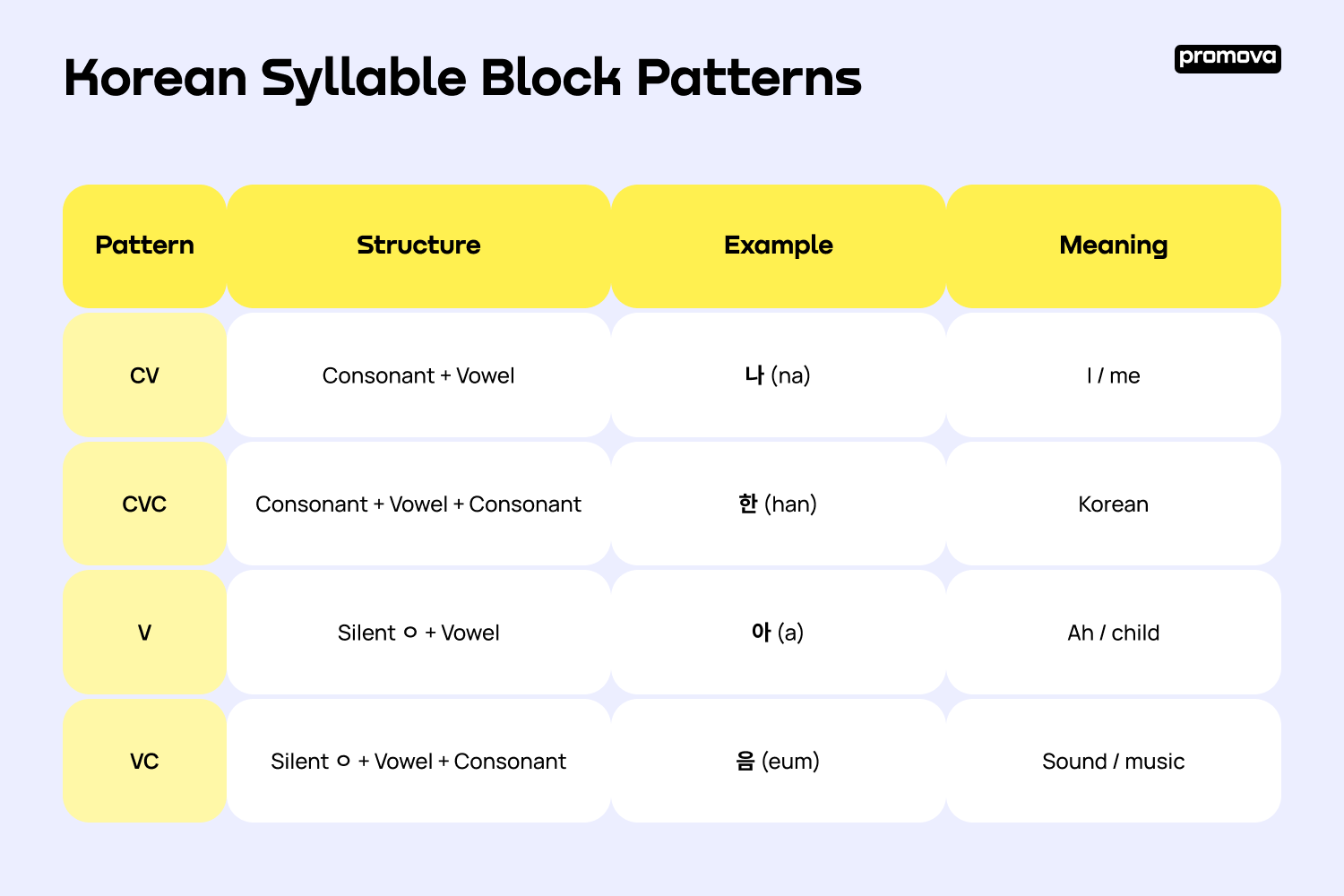
There are four basic syllable block patterns:
Pattern 1: Consonant + Vowel (CV) The consonant sits to the left of the vowel (for vertical vowels) or above it (for horizontal vowels). Example: 나 = ㄴ (n) + ㅏ (a) = “na”
Pattern 2: Consonant + Vowel + Consonant (CVC) The initial consonant and vowel sit on top, and a final consonant (called a 받침, batchim) sits below. Example: 한 = ㅎ (h) + ㅏ (a) + ㄴ (n) = “han”
Pattern 3: Vowel only (V) When a syllable starts with a vowel sound, the silent ㅇ is used as a placeholder consonant. Example: 아 = ㅇ (silent) + ㅏ (a) = “a”
Pattern 4: Vowel + Final Consonant (VC) Same as above but with a batchim at the bottom. Example: 음 = ㅇ (silent) + ㅡ (eu) + ㅁ (m) = “eum”
Understanding batchim is key. When a consonant appears at the bottom of a syllable block, its sound often changes slightly. For example, ㄱ at the bottom sounds more like a soft “k” stop. This is something you’ll pick up naturally through listening and practice.
How to Write Korean Letters: Stroke Order
Hangul stroke order matters — not just for artistic reasons, but for consistency, speed, and producing neat, legible handwriting. Hangul stroke order is the specific order of strokes in writing the letters of the Korean alphabet, and following it is essential for maintaining the structure of each character. The rules for stroke order in Hangul originate from Chinese calligraphy traditions and are designed to help learners write clearly and efficiently. Using the correct stroke order not only makes your handwriting neater but also aids in reading handwritten notes more easily.
Korean is typically written following two basic rules:
- Top to bottom
- Left to right
Let’s look at a few examples, paying attention to vertical strokes and their order:
ㄱ (g/k)
- Stroke 1: Horizontal line from left to right
- Stroke 2: Vertical line downward from the right end of stroke 1 (the vertical stroke is crucial for proper structure)
ㄴ (n)
- Stroke 1: Vertical line downward (start with the vertical stroke)
- Stroke 2: Horizontal line to the right from the bottom
ㅏ (a)
- Stroke 1: Vertical line downward (vertical stroke comes first)
- Stroke 2: Short horizontal line to the right from the middle
ㅗ (o)
- Stroke 1: Horizontal line left to right
- Stroke 2: Short vertical line upward from the center
Once you know the hangul stroke order for each basic letter, combining them into syllable blocks becomes much easier. Most learners find that writing by hand — not just reading — speeds up memorization significantly and helps keep your writing clear and easy to read.
Korean Letters in Practice: Writing Your First Words
Let’s put it all together with a few simple Korean words you can practice writing right now. Practicing writing Korean characters daily, even for a short time, is more effective for building your Korean skills than infrequent, longer sessions. For best results, use grid paper to help maintain consistent proportions for the square-shaped syllable blocks. As you practice, you may notice that native Korean handwriting often simplifies complex shapes to write more quickly—don’t be surprised if real-life writing looks a bit different from textbook forms.
한글 (Hangul — the Korean alphabet)
- 한 = ㅎ + ㅏ + ㄴ
- 글 = ㄱ + ㅡ + ㄹ
사랑 (sarang — love)
- 사 = ㅅ + ㅏ
- 랑 = ㄹ + ㅏ + ㅇ
안녕 (annyeong — hello / goodbye)
- 안 = ㅇ + ㅏ + ㄴ
- 녕 = ㄴ + ㅕ + ㅇ
물 (mul — water)
- 물 = ㅁ + ㅜ + ㄹ
감사합니다 (gamsahamnida — thank you)
- 감 = ㄱ + ㅏ + ㅁ
- 사 = ㅅ + ㅏ
- 합 = ㅎ + ㅏ + ㅂ
- 니 = ㄴ + ㅣ
- 다 = ㄷ + ㅏ
Try writing each one by hand. Trace the strokes slowly the first time, then try without looking. Repetition is the fastest path to muscle memory. For a practical exercise, practice writing your own name in Hangul (name hangul)—this is a great way to apply what you’ve learned and further develop your Korean skills.
Tips for Learning to Write Korean Faster
Start with the vowels. They’re simpler in shape and easier to distinguish from each other. Once vowels feel natural, adding consonants is much smoother. Hangul was designed to represent the Korean spoken language accurately, making it easier to learn Korean.
Write by hand, not just on a screen. Research on motor learning consistently shows that handwriting strengthens memory more than typing. Get a notebook and practice daily — even 10 minutes a day adds up fast.
Learn consonants by mouth position. King Sejong designed each consonant shape to reflect the shape of the mouth when making that sound. ㄱ looks like the back of the tongue raised to the roof of the mouth. ㄴ looks like the tongue pressed to the front of the mouth. Use that logic — it helps.
Group similar letters. ㄱ, ㅋ, and ㄲ all come from the same base sound. Learning them together makes each one easier to remember.
Practice with real words. Don’t just drill isolated letters. Write words you already know — your name in Korean, Korean food you’ve eaten, K-pop artist names. Context makes things stick.
Use mnemonic devices. Associating each Hangul character with a memorable illustration or story can help you memorize them more easily.
Use audio alongside writing. Pronunciation and writing go hand-in-hand. Hear the sound, then write the letter. This connection between ear and hand speeds everything up. English speakers may find some Korean pronunciation challenging, so focusing on Korean pronunciation is key to learning.
A note on Romanization: While the Roman alphabet is often used to represent Korean sounds for beginners, relying too much on Romanization can hinder your ability to master the Korean language and culture. Aim to connect Hangul directly to the sounds of the Korean spoken language for the best results.
How Long Does It Take to Learn Hangul?
Most beginners can read and write basic Hangul in one to two weeks with 15–20 minutes of daily practice. That's not fluency — that's the ability to decode the writing system and understand how it works.
Reading fluently without sounding out each letter takes longer, usually a few more weeks of exposure. Writing from memory takes regular practice — like any motor skill.
The important thing: Hangul is genuinely learnable in a short time. It's one of the few writing systems in the world where beginners can go from zero to functional literacy in days, not months.
What Comes After Hangul?
Learning Hangul is the first step — and a big one. Once you can read and write Korean letters, you lay the foundation to read Korean fluently, which is essential for building your overall Korean skills. Mastering Hangul allows you to look up words in a dictionary, read subtitles, follow along with song lyrics, and start building vocabulary that actually sticks.
The next natural steps after Hangul are:
- Basic Korean vocabulary (greetings, numbers, colors, everyday objects)
- Simple sentence patterns (subject + object + verb structure)
- Common grammar markers (particles that show the role of each word)
- Listening and speaking practice with native Korean speakers or media to develop authentic pronunciation and fluency
To continue to learn Korean, expand your vocabulary, study grammar, and practice conversation regularly. Engaging with native Korean speakers is especially valuable for improving your Korean skills and achieving natural-sounding speech.
Promova’s Korean language learning app takes you from Hangul basics all the way through structured courses at your own pace. Bite-sized lessons mean you can fit real progress into a busy schedule — and the AI Tutor gives you instant feedback on pronunciation as you practice speaking aloud.
FAQ
How many Korean letters are there?
Hangul has 14 basic consonants and 10 basic vowels, for a total of 24 basic letters. With double consonants and compound vowels, the full set includes 19 consonants and 21 vowels — 40 characters in total. Most learners focus on the 24 basic ones first. While the core set is the same, there are some minor differences in usage and orthography between North Korean and South Korean standards.
Is Korean hard to write?
Hangul itself is not hard to write. The characters are built from simple strokes, and the rules for combining them into syllable blocks are consistent. The challenge is building speed and muscle memory — which comes with regular practice. Most beginners find Hangul much easier than Japanese or Chinese scripts. However, there are some differences in Hangul usage and orthographic conventions between North and South Korea, which can affect writing style and punctuation.
Can I learn to write Korean on my own?
Yes. Many learners teach themselves Hangul using apps, YouTube videos, and workbooks. The writing system is logical enough that self-study works well for the basics. Hangul has also been adapted for use in other languages beyond Korean, such as for writing Chinese, Japanese, Russian, and English sounds, especially among diaspora communities. For moving beyond Hangul into actual Korean communication, structured lessons and speaking practice make a significant difference.
What is the correct stroke order for Korean letters?
The general rules are top-to-bottom and left-to-right. Each letter has a specific stroke sequence, and learning the correct order helps with both consistency and speed. Most Korean handwriting guides and language apps include stroke order demonstrations for each character. Note that North and South Korea may have slight differences in stroke order conventions.



 English


Comments