Travel Vocabulary
Contents

Key Takeaways
- Travel vocabulary covers much more than airports and hotels — knowing the right terms for different trip types (leisure, business, adventure, wellness) helps you communicate confidently in any situation.
- Common travel categories include leisure trips like vacations and road trips, professional journeys like conferences and client meetings, and special interest trips like culinary tours or eco-tours.
- Practical hotel phrases — like checking in, asking about amenities, or requesting a double room — are some of the most useful expressions to learn before any trip.
- Educational and wellness trips have their own vocabulary, from "language immersion" and "study abroad" to "spa retreat" and "detox retreat" — learning these terms helps you plan and talk about your travels more clearly.
- The best way to build travel vocabulary is to practice it in real-life contexts, not just memorize definitions.
Travel and exploration are integral parts of the human experience, offering opportunities for adventure, relaxation, and learning. If you're a language learner, understanding the travel vocabulary can enrich your travel experiences and communication. This guide aims to expand your vocabulary by introducing various trip-related terms, making your next adventure even more rewarding.
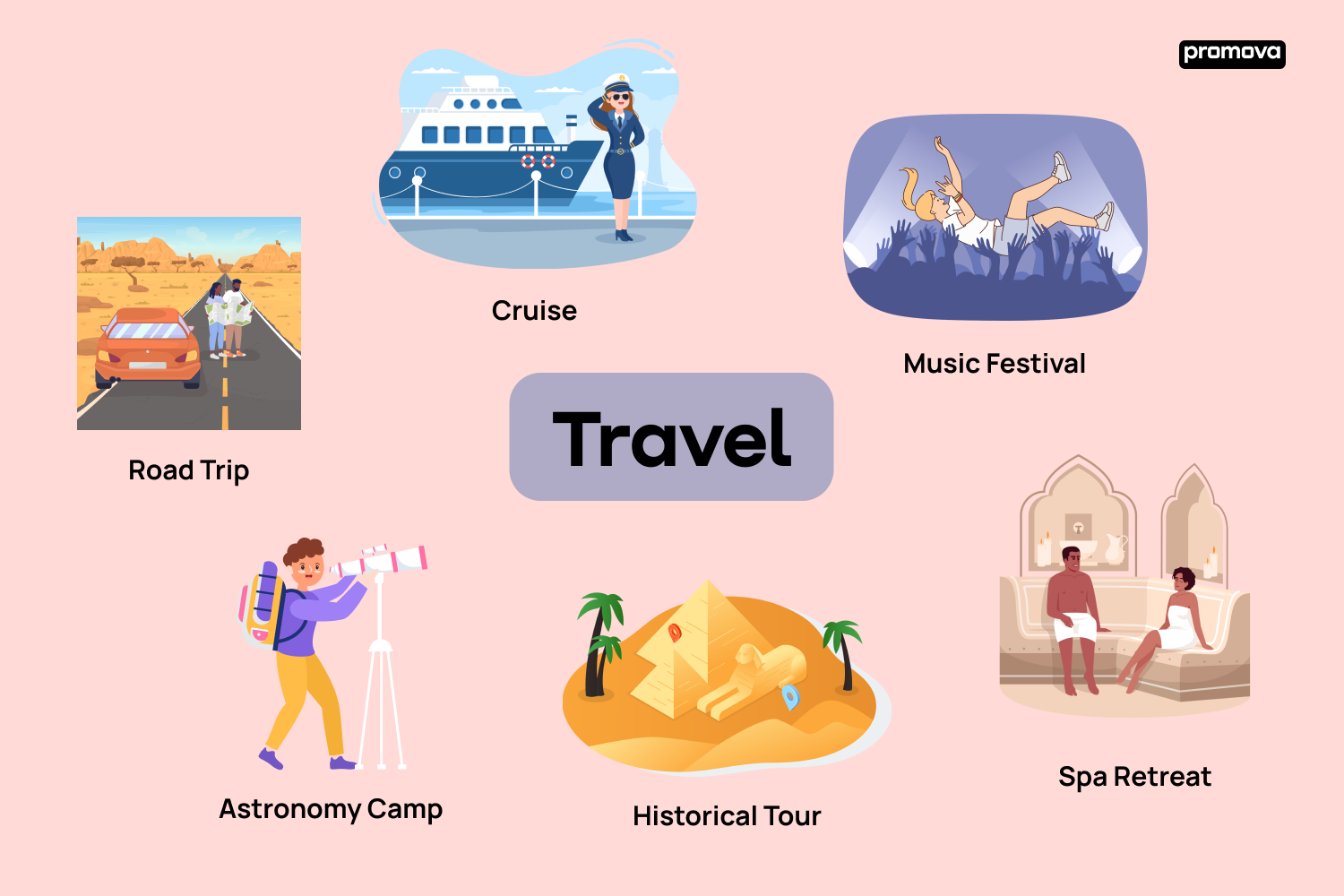
Vacation english vocabulary
Leisure trips are all about exploring and enjoying the world at your own pace. They offer a chance to escape from the daily grind and indulge in activities that bring you joy and relaxation. Whether you're seeking a tranquil beach holiday or an exciting city adventure, some getaways involve a flight, a journey through the air by plane, and leisure trips cater to a wide range of interests and preferences.
- Vacation. A general term for a leisure trip away from home for relaxation and enjoyment.
- Staycation. Enjoying a vacation in your own city or home, exploring local attractions.
- Cruise. A journey by ship, visiting different places, often with entertainment on board.
- Safari. An adventurous trip to observe wildlife in their natural habitat, usually in Africa.
- Road Trip. A long-distance journey on the road, typically by car, exploring multiple destinations.
- Backpacking. Traveling with your belongings in a bag on your back, often on a budget, and often staying in a hostel, a budget-friendly place where guests rent a bed in a shared dormitory, or camping.
- Pilgrimage. A religious journey to a sacred place or site of importance to a particular faith.
- Retreat. A trip focused on relaxation, wellness, or spiritual growth, often in a secluded place.
- Honeymoon. A romantic trip taken by newlyweds shortly after their wedding.
- City Break. A short trip spent in a city for a short time, exploring its culture, history, and attractions.
Some leisure travelers also take an excursion for fun or learning, or head off the beaten path to explore the countryside and avoid crowded areas popular with tourists.
Leisure trips are a fantastic way to recharge your batteries and create memorable experiences. Long leisure trips involving air travel can also cause jet lag, which is extreme tiredness from crossing time zones quickly. They provide an opportunity to explore new cultures, indulge in your hobbies, or simply relax in a new environment. As a language learner, this vacation vocabulary can be a wonderful opportunity to practice language skills in real-world settings.
Types of Business Trip
Business trips are primarily focused on professional development and work-related tasks. However, they can also offer unique opportunities to explore new cities, cultures, and experiences. These trips are a great way to network, learn, and grow in your professional field while sometimes enjoying a bit of leisure.
- Conference. A formal gathering for discussion, typically involving experts in a particular field.
- Seminar. A meeting for training or sharing information on a specific topic or industry.
- Trade Show. An event where companies in a specific industry showcase and demonstrate their new products.
- Corporate Retreat. A getaway with colleagues or clients, often for team-building or strategic planning.
- Networking Event. An event focused on meeting and interacting with professionals in your field.
- Site Visit. A trip to inspect or review a location for business purposes, such as potential investments.
- Client Meeting. Traveling to meet with clients or potential clients, often to discuss business opportunities.
- Incentive Trip. A reward trip given to employees for achieving specific business goals.
- Research Trip. Traveling to gather information or data for a project, study, or business development.
- Lecture Tour. A series of lectures given by a speaker in different locations.
Stepping away from your job for a professional journey can be about more than just meetings and conferences; a business trip can also be an enriching experience, and mastering key travel terminology helps you navigate the airport, hotels, and transit systems more smoothly, starting at the terminal, the large building where passengers board and exit planes. Travelers also frequently ask about luggage, including checked baggage stored in the aircraft cargo area and the smaller bags they carry themselves.
A boarding pass is the document that allows you onto the plane, and it shows your specific gate number and seat allocation. International business travelers also need a passport as official government ID. They offer the chance to develop new skills, meet diverse people, and understand different business cultures, and a layover is a temporary stop between flights. For language learners, they provide a practical context to apply language skills in a professional environment.
5
Adventure and Road Trip Special Interest Trips
Adventure and special interest trips are designed for those who seek more than just a getaway. These trips cater to specific passions or hobbies, offering unique and immersive experiences. Whether it's diving into the deep sea, hiking through mountains, or exploring culinary delights, these trips promise excitement and personal growth. Many adventure travelers also plan an itinerary, a detailed day-by-day plan of their travel route and activities.
- Eco-Tour. A trip focused on observing and appreciating natural environments, often involving conservation efforts and time in the countryside.
- Ski Trip. A journey to a ski resort for skiing or snowboarding.
- Culinary Tour. A trip centered around experiencing and learning about local cuisines and cooking techniques.
- Volunteer Tourism. Traveling to offer your services for free, often for humanitarian, educational, or environmental causes.
- Scuba Diving Trip. A journey specifically to engage in scuba diving, often in exotic marine locations.
- Photography Tour. A trip focused on taking photographs, usually guided by a professional photographer.
- Wine Tasting Tour. A trip to visit vineyards and wineries, sampling different types of wines.
- Music Festival. Traveling to attend a music festival, often featuring various artists and genres.
- Historical Tour. A journey focusing on visiting historical sites and learning about the past.
- Wildlife Tour. A trip specifically to observe and learn about wildlife in their natural habitats.
Some of these trips can turn into a long journey lasting days or even weeks.
Adventure and special interest trips provide enriching experiences that go beyond the ordinary. Understanding these traveling words, you amy delve deep into your interests, challenge yourself, and create unforgettable memories. For language learners, these trips are a way to connect with others who share your interests and to practice language skills in specialized contexts.
Educational Trips
Educational trips are journeys with the primary purpose of learning and gaining knowledge. They are an excellent way for you to immerse yourself in a new environment while preparing for an international destination and acquiring new skills or information, often through lessons or a course focused on travel communication. Local currency is the money used in the destination country, while currency is the country's money system. A visa is official permission granted by a country for a foreigner to enter. These trips can range from school field trips to academic research expeditions.
Speaking and talking practice can build confidence with English vocabulary in real travel situations, and each new word becomes easier to use on the go.
- Field Trip. A short journey by students and teachers to explore and learn outside the classroom.
- Study Abroad. Traveling to another country to study at a foreign educational institution.
- Language Immersion. A trip focused on learning and practicing a foreign language in its native environment.
- Cultural Exchange. Traveling to experience and learn about a different culture, often living with a local family.
- Archaeological Expedition. A journey to excavate and study historical or prehistoric sites.
- Educational Cruise. A sea voyage that includes lectures and learning activities related to various subjects.
- Research Expedition. Traveling specifically for academic or scientific research purposes.
- Art Tour. A trip visiting museums, galleries, and art studios to study art and art history, including practical questions like whether a museum open time fits your plans.
- Historical Reenactment. Participating in recreations of historical events or eras.
- Astronomy Camp. A trip focused on observing celestial objects and learning about astronomy.
Students also practice common travel questions, including asking for directions with a map, using phrases like turn left, and asking where the bus stop, bus station, or train station is. This also helps with public transit, since a bus station is a designated area for bus departures, public transit includes local transport systems like buses and trains, and you may need to ask how to catch one. At the airport or border, travelers may also go through customs, where officials check goods entering a country, and complete a declaration form for valuable items or food. Students abroad also learn practical money terms such as exchange rate and VAT, especially before reaching their final destination.
Educational trips offer a unique blend of travel and learning experiences. They allow you to explore new places while expanding your knowledge and skills. These trips are not just about seeing new sights but also about deepening your understanding of the world.
Wellness and Health Trips with Internet Access
Wellness and health trips focus on improving your physical, mental, and spiritual well-being. They are perfect for rejuvenating your body and mind, offering a break from the stresses of everyday life. These trips can range from spa retreats to fitness boot camps. Accommodation is the place where you arrange to stay during your trip, and wellness travelers often choose a hotel or resort, though some book a cruise ship for a wellness journey at sea. On longer voyages, some routes cross the Atlantic Ocean.
- Spa Retreat. A relaxing trip to a spa, focusing on health and beauty treatments.
- Yoga Retreat. A journey to practice yoga, often in a serene and natural setting.
- Medical Tourism. Traveling to another country for medical treatment or surgery.
- Detox Retreat. A trip focused on cleansing the body through special diets and therapies.
- Fitness Boot Camp. A rigorous exercise-focused trip, often with personal training and nutrition advice.
- Thermal Bath. A trip to hot springs or thermal baths for relaxation and health benefits.
- Meditation Retreat. A journey to practice meditation, often in a peaceful and secluded location.
- Holistic Healing. Traveling to receive alternative therapies for overall wellness.
- Adventure Therapy. Engaging in outdoor activities as a form of physical and mental therapy.
- Weight Loss Camp. A dedicated program focused on exercise, diet, and lifestyle changes for weight loss.
Check-in is when you officially arrive to receive your room keys, and travelers often ask about amenities then, sometimes showing a voucher to confirm payment; later, check out is when you must leave your room after your stay. Some also ask about currency exchange before heading into the city. A flyer might ask when the plane will take off. Another traveler may request an aisle seat for easier access. At the station, someone may ask what time the train leaves. Others check whether a return ticket costs less than two single fares. Guests may also ask for a double room, whether breakfast is included, if there is air conditioning, and if the stay is all-inclusive, with food and drink covered in one price.
Wellness and health trips provide an opportunity to focus on your personal well-being. They offer a chance to step away from your daily routine and focus on health, relaxation, and self-care. You might head to London for a short reset and learn useful phrasal verbs as you talk about getting away for a few hours. These journeys are not just about travel; they're about transforming your life for the better.
FAQ
What are some essential travel vocabulary words for beginners?
How can learning travel vocabulary benefit adventurers?
What phrases should travelers know for emergencies?
How does travel vocabulary vary across different regions?
Make your next step to fluency with Promova

Other articles on this topic
Vocabulary of Adventure WordsVocabulary of Countries and Nationalities in EnglishVocabulary of Places English
 Français
 Português
 Español


Comments