Japanese Particles: The Complete Guide to は, が, を, に, and More
Contents
Key Takeaways
- Japanese particles are short words that show the role of each word in a sentence — similar to how word order works in English.
- The most common particles are は (wa), が (ga), を (wo), に (ni), and で (de). Each one has a specific function.
- Particles come after the word they modify — this is the opposite of how English prepositions work.
- は (wa) marks the topic of a sentence; が (ga) marks the subject — and yes, there is a difference.
- Mistakes with particles are normal and expected. Native Japanese speakers will understand you even when you get them wrong.
If you’ve just started learning Japanese, you’ve probably already met them: those tiny little words that show up after nouns, pronouns, and phrases. Words like は, が, を, に. They look small. They seem simple. But somehow, they manage to confuse almost every learner — at least at first.
Don’t worry. That’s completely normal.
Japanese particles are function words that give context to other words in a sentence, making meaning clearer in the japanese language. Once you understand what they do, reading and speaking Japanese gets a whole lot easier, since they can work like English prepositions, conjunctions, or even punctuation to shape meaning. This guide breaks down the most common Japanese particles in plain language, with real examples and clear explanations.
Let’s start from the beginning.
What Are Japanese Particles?
A Japanese particle (助詞, joshi) is a short word — usually just one or two hiragana characters — that comes after a word or phrase to show its grammatical role in the sentence.
Think of particles as labels. They tell you: is this the topic? The subject? The object? The location? The tool used to indicate meaning in basic japanese?
In English, you rely on word order to figure this out. “The cat chased the dog” is very different from “The dog chased the cat.” Change the order, change the meaning — and changing even one particle can flip the meaning too.
Japanese works differently. The particles do that job, and Japanese word order is relatively flexible because particles show grammatical relationships. So you can say the same sentence in different orders — as long as the particles are in the right place, the meaning stays clear.
Here’s a simple example:
- 私は猫が好きです。(Watashi wa neko ga suki desu.) — “I like cats.”
In this sentence:
- 私 (watashi) = “I”
- は (wa) = topic marker
- 猫 (neko) = “cat”
- が (ga) = subject marker
- 好き (suki) = “like”
- です (desu) = polite ending
The particles tell you exactly who’s doing what — and that structure is the foundation of Japanese grammar.
The 8 Most Common Japanese Particles
1. は (wa) — The Topic Marker
Function: Marks the topic of the sentence — what the sentence is about.
は (wa) is one of the first particles you'll encounter, and it's used constantly. It tells the listener: "Here's what we're talking about."
Examples:
- 私は学生です。(Watashi wa gakusei desu.) — "I am a student."
- 東京は大きいです。(Tōkyō wa ōkii desu.) — "Tokyo is big."
Important note: は is written with the hiragana character for "ha," but when used as a particle, it's always pronounced "wa." This trips up a lot of beginners — and now you know.
2. が (ga) — The Subject Marker
Function: Marks the subject of a sentence and indicates who performs the action or what condition is true.
This is where many learners get confused: what’s the difference between は (topic) and が (subject)?
The short answer: は says “as for X…”, while が specifically points to X as the one doing something, often emphasizing exactly who or what it is.
Examples:
- 猫が走っています。(Neko ga hashitte imasu.) — “The cat is running.”
- 誰が来ましたか?(Dare ga kimashita ka?) — “Who came?”
When to use が instead of は:
- When answering a “who” or “what” question, especially when a question word is involved
- When expressing ability, desire, or preference (“I can…”, “I want…”, “I like…”)
- When making a contrast or introducing new information
For example:
- 私は英語が話せます。(Watashi wa eigo ga hanasemasu.) — “I can speak English.” (は = topic “I,” が = subject “English” as the ability)
Don’t worry if は vs. が still feels fuzzy — even advanced learners keep working on this one. It comes with practice.
3. を (wo/o) — The Object Marker
Function: Marks the direct object — the noun that receives the action of a verb.
This particle is straightforward. Whatever is being acted upon — that’s marked with を.
Examples:
- 水を飲みます。(Mizu wo nomimasu.) — “I drink water.”
- 本を読んでいます。(Hon wo yonde imasu.) — “I am reading a book.”
- 映画を見ました。(Eiga wo mimashita.) — “I watched a movie.”
- 私はチョコを食べます。(Watashi wa choko o tabemasu.) — “I eat chocolate.”
Pronunciation note: を is written as “wo” but usually pronounced just “o” in modern Japanese. You’ll see both romanizations depending on the textbook or app you’re using.
4. に (ni) — Direction, Time, and Location
Function: One of the most flexible particles. に marks destination, time, and indirect objects.
This particle has a few different uses, which can make it feel tricky. But the underlying idea is consistent: に points to a target — a place you're going, a time something happens, or a person receiving something.
Examples by use:
Destination (where you're going):
- 学校に行きます。(Gakkō ni ikimasu.) — "I go to school."
- 日本に来ました。(Nihon ni kimashita.) — "I came to Japan."
Time (when something happens):
- 三時に起きます。(Sanji ni okimasu.) — "I wake up at 3 o'clock."
- 月曜日に会議があります。(Getsuyōbi ni kaigi ga arimasu.) — "There's a meeting on Monday."
Indirect object (who receives something):
- 友達にプレゼントをあげました。(Tomodachi ni purezento wo agemashita.) — "I gave a present to my friend."
Quick tip: If に follows a verb of motion (go, come, return), it marks the destination. If it follows a time expression, it marks when.
1
5. で (de) — Location of Action and Means
Function: Marks where an action takes place or how something is done (the method or tool).
Here's a common confusion: に and で both relate to location — but in different ways. に marks where something is or where you're going. で marks where an action happens.
Examples:
Location of action:
- 図書館で勉強します。(Toshokan de benkyō shimasu.) — "I study at the library."
- レストランで食べました。(Resutoran de tabemashita.) — "I ate at the restaurant."
Method or means:
- バスで行きます。(Basu de ikimasu.) — "I go by bus."
- 日本語で話してください。(Nihongo de hanashite kudasai.) — "Please speak in Japanese."
- はしで食べます。(Hashi de tabemasu.) — "I eat with chopsticks."
The rule of thumb: に = where something exists or where you're headed. で = where something happens, or what tool/method you use.
6. の (no) — The Possessive Particle
Function: Shows possession or relationship between two nouns. Like "of" or "'s" in English.
の is one of the easiest particles to learn. Put it between two nouns to show that the first belongs to or relates to the second.
Examples:
- 私の本 (watashi no hon) — "my book" (literally: "I's book")
- 日本の食べ物 (Nihon no tabemono) — "Japanese food" (literally: "Japan's food")
- 友達の名前 (tomodachi no namae) — "my friend's name"
の can also be used to nominalize verbs and adjectives (turn them into noun phrases), but that's a more advanced use. For now, just remember: A の B = "B of A" or “A's B.”
7. も (mo) — "Also" and "Too"
Function: Replaces は or が to mean "also," "too," or "as well."
も is used when you want to say that something applies to an additional item — not just the one already mentioned.
Examples:
- 私も学生です。(Watashi mo gakusei desu.) — "I am also a student."
- コーヒーも好きです。(Kōhī mo suki desu.) — "I also like coffee."
も replaces は and が — it doesn't come after them. So you say 私も, not 私はも.
In negative sentences, も takes on the meaning of "either" or "neither":
- 魚も食べません。(Sakana mo tabemasen.) — “I don't eat fish either.”
8. と (to) — "And" and "With"
Function: Connects nouns ("and") or indicates who you're doing something with ("with").
と is used in two main ways:
Connecting nouns (and):
- りんごとみかん (ringo to mikan) — "apples and oranges"
- 本とペン (hon to pen) — "a book and a pen"
Doing something with someone:
- 友達と映画を見ました。(Tomodachi to eiga wo mimashita.) — "I watched a movie with my friend."
- 家族と旅行します。(Kazoku to ryokō shimasu.) — "I travel with my family."
Note: と connects nouns only, not verbs or clauses. For connecting verbs, you'd use て-form conjugation — but that's a topic for another time.
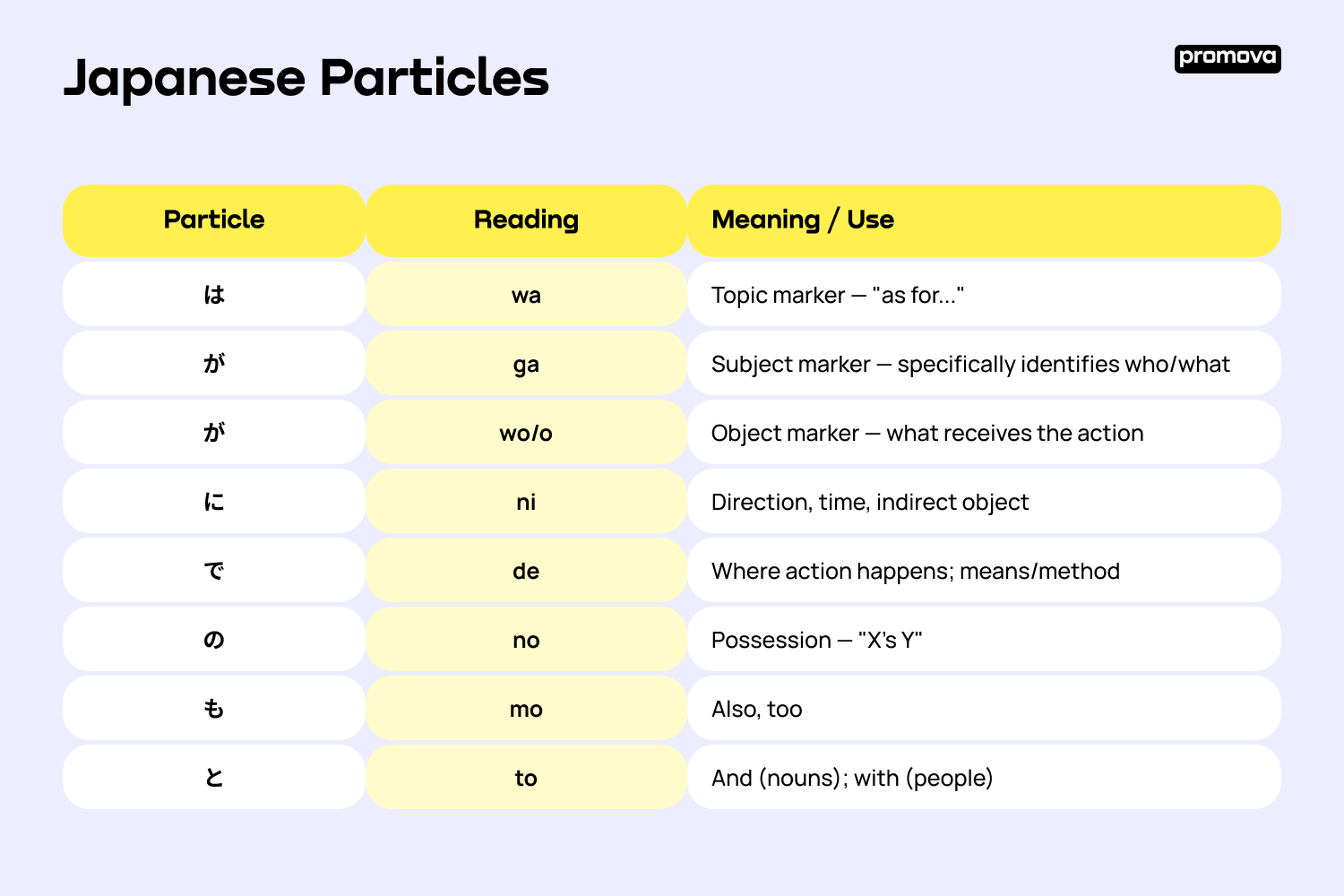
Japanese Particles at a Glance
Here's a quick reference table to keep nearby as you practice:
| Particle | Reading | Main Function | Example |
| は | wa | Topic marker | 私は学生です (I am a student) |
| が | ga | Subject marker | 猫が好きです (I like cats) |
| を | wo/o | Object marker | 水を飲みます (I drink water) |
| に | ni | Direction, time, indirect object | 学校に行きます (I go to school) |
| で | de | Location of action, means | バスで行きます (I go by bus) |
| の | no | Possession, relationship | 私の本 (my book) |
| も | mo | Also, too | 私も学生です (I am also a student) |
| と | to | And (nouns), with | 友達と行きます (I go with a friend) |
は vs. が: The Difference Explained Simply
This is the question every Japanese learner asks eventually — so let's spend a moment on it.
Both は and が can translate to "I" or "the cat" or whatever noun you're using. So what's the difference?
は (wa) = "As for X..."
は introduces the topic — the overall subject of conversation. It's often used for general statements, things already known, or to contrast two ideas.
- 私は寿司が好きです。(Watashi wa sushi ga suki desu.) — "As for me, I like sushi."
が (ga) = "It is X that..."
が specifically identifies which thing is being pointed out. It's used when something is new information, when answering "who?" or "what?" questions, or when expressing ability, desire, or natural states.
- 誰が来ましたか?— 田中さんが来ました。(Dare ga kimashita ka? — Tanaka-san ga kimashita.) — "Who came? — Tanaka came."
The simplest way to think about it:
- は = "the topic is X (which we're going to talk about)"
- が = "it's specifically X (not something else)"
You'll develop an intuitive feel for this over time. And in the meantime, native speakers will understand you either way — the difference is subtle, not a communication blocker.
に vs. で: Location Particles Compared
Another common source of confusion. Both に and で involve location — so which one do you use?
Use に when:
- Something exists at a location: 公園に犬がいます (kōen ni inu ga imasu) — "There's a dog in the park."
- You're going to a location: 駅に行きます (eki ni ikimasu) — "I'm going to the station."
Use で when:
- An action happens at a location: 公園で走ります (kōen de hashirimasu) — "I run in the park."
- You're using a means or method: 電車で行きます (densha de ikimasu) — "I go by train."
Quick memory trick: If you can ask "where does it exist?" → use に. If you can ask "where does the action happen?" → use で.
How to Practice Japanese Particles
Learning particles is a bit like learning chord shapes on a guitar. You can understand the theory, but what really cements it is repetition — hearing them in context, using them yourself, and making mistakes until the right form feels natural.
Here are a few practical ways to build your particle skills:
- Read Japanese sentences out loud. Even reading beginner texts — manga, children's books, news apps — exposes you to particles in real sentences.
- Focus on patterns, not rules. Instead of memorizing "に is used for direction and time," try to remember full phrases: 学校に行く (gakkō ni iku, "go to school"), 三時に (sanji ni, "at 3 o'clock"). Patterns stick faster than abstract rules.
- Use spaced repetition. Apps that use flashcard-style review — showing you what you're about to forget before you forget it — are great for locking in particle usage.
- Don't obsess over perfection. Native speakers learn to parse imperfect particle usage from context. Your goal is communication — particles will sharpen over time.
If you're learning Japanese and want structured lessons that go from basic grammar to real conversation, the Promova language learning app offers bite-sized Japanese lessons designed for busy people. You can practice particles in context, track your progress, and use AI tools to practice speaking — all in one place.
Common Mistakes With Japanese Particles (And How to Fix Them)
Even fluent Japanese speakers sometimes slip up with particles. Here are the most common errors learners make, and simple fixes.
Mistake 1: Using に for action locations
❌ 図書館に勉強します。 ✅ 図書館で勉強します。
Fix: Location of an action takes で, not に.
Mistake 2: Forgetting を with action verbs
❌ 本読みます。 ✅ 本を読みます。
Fix: The direct object always needs を between the noun and the verb.
Mistake 3: Dropping particles in writing
In casual spoken Japanese, particles sometimes get dropped. This is fine in speech — but in writing (especially formal writing), always include them.
Mistake 4: Confusing も and は
も replaces は, not adds to it. So don't say 私はも — just say 私も.
Mistake 5: Using は when が is needed
This usually happens with expressions of ability or emotion: ❌ 英語は話せます。 ✅ 英語が話せます。
With verbs like できる (dekiru, "can"), 好き (suki, "like"), and わかる (wakaru, "understand"), the object takes が — not は.
Summary
Japanese particles might seem small, but they carry a lot of weight. They tell you the role of every word in a sentence — who's doing what, where, when, and with what. Once you get a feel for them, reading and speaking Japanese becomes much more natural.
Here's a quick recap:
- は (wa) — marks the topic of the sentence
- が (ga) — marks the subject, especially when highlighting specific information
- を (wo) — marks the direct object (what receives the action)
- に (ni) — marks direction, time, and indirect objects
- で (de) — marks where an action happens, or how it's done
- の (no) — shows possession or relationship between nouns
- も (mo) — means "also" or "too"
- と (to) — means "and" (for nouns) or "with"
Start with は, が, を, and に. Practice them in real sentences. Build up from there. And remember: getting them wrong is part of learning — it's how every Japanese speaker got better.
FAQ
What are Japanese particles?
Japanese particles (助詞, joshi) are short function words — usually one or two hiragana characters — placed after nouns, pronouns, or phrases to show their grammatical role in a sentence. They tell you whether a word is the topic, subject, object, location, or something else. Common particles include は (wa), が (ga), を (wo), に (ni), and で (de).
What is the difference between は and が in Japanese?
は (wa) marks the topic of the sentence — what you’re generally talking about. が (ga) marks the subject — specifically pointing out who or what is doing something or being identified. In practice: は introduces general or known information, while が highlights specific, new, or contrasted information. For example: 私は学生です (I am a student — general topic) vs. 誰が来ましたか (Who came? — identifying the specific subject).
How many particles are there in Japanese?
Japanese has around 188 particles, according to the Nihongo Daijiten (一大 日本語辞典), but most of them are rare or appear only in formal and literary writing. In everyday conversation, learners typically need around 10 to 20 particles. The most essential ones are: は, が, を, に, で, の, も, と, から (from), and まで (until/up to), plus common sentence-ending particles like か, ね, and よ at the end of a sentence. These are used at the end: か marks a question, ね seeks agreement, and よ adds emphasis or new information.
Do Japanese particles always come after a word?
Yes. Japanese particles are postpositions — they always follow the word or phrase they modify. This is the opposite of English prepositions like “in,” “at,” or “to,” which come before their objects. In Japanese: 学校に (gakkō ni) means “to school,” where に comes after the noun.


 English


Comments