Japanese Numbers: Your Complete Guide to Counting in Japanese
Contents
Key takeaways
- Japanese has two number systems: Sino-Japanese (on’yomi), which is used for most everyday counting, and Native Japanese (kun’yomi), which is used for counting small objects and ages up to ten. The main difference between these systems lies in their origins and usage: Sino-Japanese is derived from Chinese and is used for general counting, while Native Japanese is used for specific objects and situations.
- Japanese numbers can be written in two ways: using Arabic numerals (1, 2, 3) or Chinese numerals (一, 二, 三). Arabic numerals are more common in horizontal writing, while Chinese numerals are used in vertical writing.
- Numbers 4, 7, and 9 have two pronunciations each — shi/yon, shichi/nana, and ku/kyū — because the first reading of each sounds like an unlucky word in Japanese.
- Japanese numbers follow a logical, additive pattern. Once you know 1–10, building any number up to 100 is straightforward.
- The word for 100 is hyaku (百). At 300, 600, and 800, pronunciation changes due to a process called rendaku (sequential voicing).
- Japanese uses counter words — special suffixes that change depending on what you’re counting. These come after the number and take practice to master.
- Numbers 7 (nana) and 8 (hachi) are considered lucky in Japanese culture for different reasons. Numbers 4 and 9 are often avoided.
Can you imagine traveling through Japan — navigating train schedules, reading price tags, ordering food, or giving your hotel floor — without knowing numbers? Numbers are everywhere, and in Japanese, they come with their own unique system that’s both logical and culturally rich.
The good news: once you understand the basic rules, counting in Japanese is actually more systematic than in English. There are no irregular tens like “eleven” or “twelve.” Everything follows a pattern. And once you see it, you won’t forget it.
This guide covers Japanese numbers from 0 to 100 and beyond, including both number systems, pronunciation rules, ordinal numbers, counters, and cultural notes worth knowing.
Japanese cardinal numbers: the two systems
Japanese uses two different number systems, and both are active in modern Japanese. The main difference between them is that the Sino-Japanese system uses readings derived from Chinese (On reading), while the Native Japanese system uses native Japanese readings (Kun reading). Japanese numerals can be written using kanji numerals or Arabic numerals, and both are commonly seen in daily life.
Sino-Japanese numbers (on’yomi – 音読み) are derived from Chinese numerals and adopted into Japanese. These numbers are used in most everyday situations — telling the time, stating prices, counting objects, giving phone numbers, and expressing large quantities. Sino-Japanese numbers are often written with kanji numerals or Arabic numbers, and the On reading is used for cardinal numbers.
Native Japanese numbers (kun’yomi – 訓読み) are the original Japanese counting words. The native Japanese reading (Kun reading) is used for numbers up to 10 and is different from the Sino-Japanese (On) reading. They are used only up to ten, primarily for counting general objects without a specific counter, counting days, and expressing age in some contexts. You can identify native Japanese numbers because they all end in つ (tsu), except for ten, which is とう (tō).
For most learners, mastering the Sino-Japanese system first is the practical priority. That’s what this guide focuses on.
Start with the basics: Japanese numbers from 0 to 10
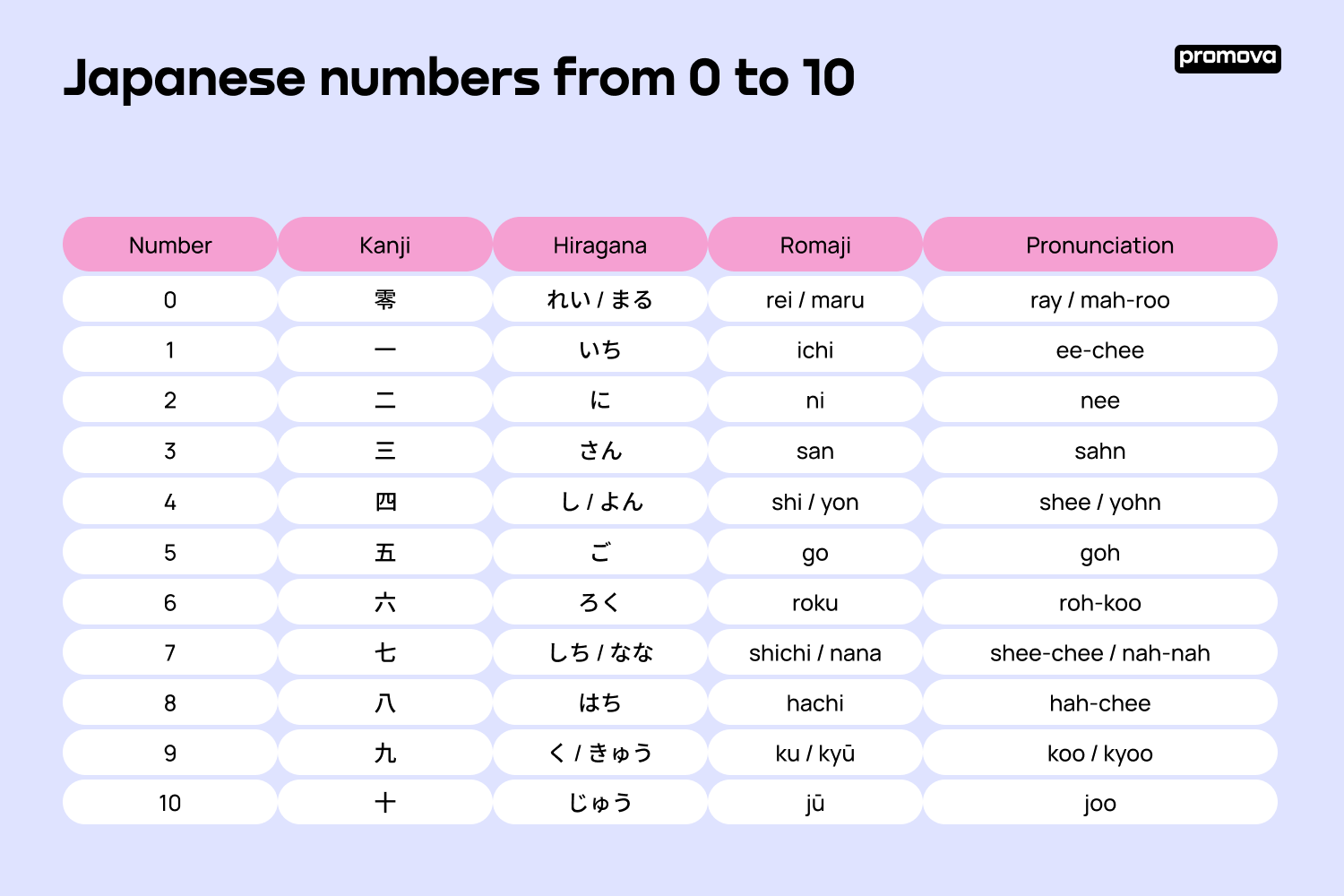
Every learner should know how to count from zero to ten in Japanese. These are the foundations for every other number. Get them solid and everything else builds naturally on top. Some numbers, like 4 (shi/yon), 7 (shichi/nana), and 9 (ku/kyū), have alternate pronunciations due to cultural reasons, such as avoiding unlucky associations.
Here is how numbers from zero to ten are written in kanji, hiragana, and romaji:
| Number | Kanji | Hiragana | Romaji | Pronunciation |
| 0 | 零 | れい / まる | rei / maru | ray / mah-roo |
| 1 | 一 | いち | ichi | ee-chee |
| 2 | 二 | に | ni | nee |
| 3 | 三 | さん | san | sahn |
| 4 | 四 | し / よん | shi / yon | shee / yohn |
| 5 | 五 | ご | go | goh |
| 6 | 六 | ろく | roku | roh-koo |
| 7 | 七 | しち / なな | shichi / nana | shee-chee / nah-nah |
| 8 | 八 | はち | hachi | hah-chee |
| 9 | 九 | く / きゅう | ku / kyū | koo / kyoo |
| 10 | 十 | じゅう | jū | joo |
There are exceptions to the standard pattern, especially for numbers 4, 7, and 9, which have alternate readings and are pronounced differently in certain situations. Understanding how to count things in Japanese means learning these exceptions, alternate pronunciations, and the correct use of counters for different objects.
The unlucky numbers: 4, 7, and 9
You’ll notice that numbers 4, 7, and 9 each have two pronunciations. This isn’t random; it’s cultural. These alternate pronunciations are often used specifically to avoid unlucky associations in Japanese culture.
The word shi (し, 4) sounds identical to the Japanese word for death (死). The word ku (く, 9) is also viewed as unlucky because it sounds like the word for suffering (苦). And shichi (しち, 7), while considered lucky in some contexts, contains the し (shi) sound of death. As a result, Japanese speakers often prefer yon for 4, nana for 7, and kyū for 9 in everyday use to avoid these unlucky associations.
You’ll still encounter both readings depending on context, but in general conversation, yon, nana, and kyū are the safer, more common choices.
1
Japanese numbers from 11 to 20
Once you know 1–10, numbers 11 to 20 follow a completely predictable pattern. You simply say the word for ten (jū) followed by the next digit. The term 'jū' is used to form the teens and multiples of ten in Japanese numbers. Eleven is “ten-one,” twelve is “ten-two,” and so on.
| Number | Kanji | Hiragana | Romaji |
| 11 | 十一 | じゅういち | jūichi |
| 12 | 十二 | じゅうに | jūni |
| 13 | 十三 | じゅうさん | jūsan |
| 14 | 十四 | じゅうよん | jūyon |
| 15 | 十五 | じゅうご | jūgo |
| 16 | 十六 | じゅうろく | jūroku |
| 17 | 十七 | じゅうなな | jūnana |
| 18 | 十八 | じゅうはち | jūhachi |
| 19 | 十九 | じゅうきゅう | jūkyū |
| 20 | 二十 | にじゅう | nijū |
Notice: 14 is じゅうよん (jūyon), not じゅうし (jūshi). Avoiding the “shi” reading here is a common preference in everyday speech.
Numbers in Japanese are typically formed by combining characters in a multiplicative additive manner, such as 二十 (ni-jū) for twenty, which literally means 'two tens.' In modern writing, Arabic numerals are also widely used alongside Kanji and Kana, especially in contexts like pricing and official documents.
Japanese numbers from 21 to 100
When forming big numbers in Japanese, such as twenty, you use the pattern 'ni jū' (にじゅう), which literally means "two tens." Japanese numbers are typically constructed by breaking them into their component parts—first stating the tens digit, then 十 (jū), then the units digit. For example, twenty-one is “two-tens-one,” thirty-five is “three-tens-five,” and so on. This break into tens and units is a key difference from English, where numbers are not usually grouped this way. In modern contexts, Arabic numbers (like 21, 35, 47) are often used alongside traditional kanji, especially in digital or printed materials.
| Number | Kanji | Hiragana | Romaji |
| 21 | 二十一 | にじゅういち | nijūichi |
| 22 | 二十二 | にじゅうに | nijūni |
| 23 | 二十三 | にじゅうさん | nijūsan |
| 24 | 二十四 | にじゅうよん | nijūyon |
| 25 | 二十五 | にじゅうご | nijūgo |
| 28 | 二十八 | にじゅうはち | nijūhachi |
| 30 | 三十 | さんじゅう | sanjū |
| 31 | 三十一 | さんじゅういち | sanjūichi |
| 40 | 四十 | よんじゅう | yonjū |
| 50 | 五十 | ごじゅう | gojū |
| 60 | 六十 | ろくじゅう | rokujū |
| 70 | 七十 | ななじゅう | nanajū |
| 80 | 八十 | はちじゅう | hachijū |
| 90 | 九十 | きゅうじゅう | kyūjū |
| 100 | 百 | ひゃく | hyaku |
The formula for constructing big numbers works the same across all tens: state the digit, add じゅう (jū), then add the units digit. For example:
- 47 = 四十七 → よんじゅうなな (yonjūnana) – “four-tens-seven”
- 83 = 八十三 → はちじゅうさん (hachijūsan) – “eight-tens-three”
- 99 = 九十九 → きゅうじゅうきゅう (kyūjūkyū) – “nine-tens-nine”
Japanese numbers are formed by combining characters in a multiplicative additive manner, such as 二十 (ni-jū) for twenty, which literally means "two tens." This construction highlights the difference between Japanese and Western numbering systems, especially in how big numbers are grouped and pronounced.
One important note about 40: although 四 (shi) appears in writing, 四十 is always read as よんじゅう (yonjū), never as しじゅう (shijū). The same rule applies to 70: always ななじゅう (nanajū), not しちじゅう (shichijū).
Japanese numbers beyond 100
Learning the first hundred numbers is a strong start, but after 99, 100 is considered a new number in Japanese. When dealing with big numbers, Japanese forms them by breaking them into hundreds, thousands, and ten-thousands.
This is a key difference from English, where numbers are grouped by thousands. In Japanese, numbers are grouped by 10,000 units, which can be confusing at first. For example, instead of thinking of 50,000 as "fifty-thousand," Japanese speakers think of it as "five ten-thousands."
Both Arabic numbers and kanji numerals are used to represent large numbers, and understanding how to break down and pronounce these big numbers is essential for fluency.
Hundreds (百 — hyaku)
In Japanese, hundreds can be written using either kanji numerals or Arabic numbers. Both systems are commonly used: kanji numerals (like 百 for 100) are traditional, while Arabic numbers (like 100) are often used in modern contexts, especially for clarity with large values.
| Number | Kanji | Romaji | Note |
| 100 | 百 | hyaku | - |
| 200 | 二百 | nihyaku | - |
| 300 | 三百 | sanbyaku | h → b (rendaku) |
| 400 | 四百 | yonhyaku | - |
| 500 | 五百 | gohyaku | - |
| 600 | 六百 | roppyaku | h → pp (rendaku) |
| 700 | 七百 | nanahyaku | - |
| 800 | 八百 | happyaku | h → pp (rendaku) |
| 900 | 九百 | kyūhyaku | - |
The pronunciation changes at 300, 600, and 800 are caused by rendaku (連濁) — a phonetic process in Japanese where certain consonants are voiced when combined with other sounds. At 300 (sanbyaku), the “h” softens to “b.” At 600 (roppyaku) and 800 (happyaku), the “h” becomes “pp.” These changes make the words easier to say quickly and are a natural feature of Japanese phonetics.
Thousands (千 — sen)
| Number | Kanji | Romaji | Note |
| 1,000 | 千 | sen | No いち (ichi) prefix needed |
| 2,000 | 二千 | nisen | - |
| 3,000 | 三千 | sanzen | s → z (rendaku) |
| 4,000 | 四千 | yonsen | - |
| 8,000 | 八千 | hassen | s → ss (rendaku) |
| 10,000 | 一万 | ichiman | New unit: 万 (man) |
An important cultural note: the Japanese number system uses both kanji numerals (like 千, 万) and Arabic numbers (1,000, 10,000) for writing large values. Japanese groups large numbers by units of 10,000 (万 — man), not 1,000 as in English. This means 100,000 is written as 十万 (jūman), or “ten ten-thousands,” rather than “one hundred thousand.” The difference in grouping and notation, using kanji numerals, Arabic numbers, and the 10,000-unit system sets Japanese apart from Western conventions and is important to understand when reading or writing large numbers in Japanese.
Native Japanese numbers (Kun'yomi): counting objects up to 10
When counting things in Japanese, there are two ways: the native Japanese reading (wago) and the Sino-Japanese reading (kango). The native Japanese reading is used for counting a few values — specifically, up to ten — and is especially helpful when you don’t know the specific counter for an object. This system provides a 'safety net' by using the suffix -tsu for general objects, such as fruits or abstract ideas, making it easier to express quantities without needing to remember every counter. These are the kun’yomi readings, and they all end in つ (tsu) except for ten. However, there are exceptions to the standard pattern, such as alternate readings for certain numbers and special rules for some counters.
| Number | Native Japanese | Hiragana | Romaji |
| 1 | 一つ | ひとつ | hitotsu |
| 2 | 二つ | ふたつ | futatsu |
| 3 | 三つ | みっつ | mittsu |
| 4 | 四つ | よっつ | yottsu |
| 5 | 五つ | いつつ | itsutsu |
| 6 | 六つ | むっつ | muttsu |
| 7 | 七つ | ななつ | nanatsu |
| 8 | 八つ | やっつ | yattsu |
| 9 | 九つ | ここのつ | kokonotsu |
| 10 | 十 | とお | tō |
You’ll use these native Japanese readings when counting general items in everyday conversation — “give me two of those,” “I have three bags.” For anything that requires a specific counter (people, animals, flat objects, long objects), the Sino-Japanese readings are used instead.
Japanese ordinal numbers: first, second, third
Japanese ordinal numbers — used to express order and position, like first, second, and third — are often written with kanji numerals and are formed differently compared to English. The main difference is that, instead of adding a suffix like "-th" as in English, Japanese uses 第 (dai) before the number or the suffix 番目 (banme) after it.
Formation with 第 (dai):
- 第一 (daiichi) – first
- 第二 (daini) – second
- 第三 (daisan) – third
- 第四 (daishi / daichi) – fourth
- 第五 (daigo) – fifth
Formation with 番目 (banme):
- 一番目 (ichi-banme) – first (literally “number one”)
- 二番目 (ni-banme) – second
- 三番目 (san-banme) – third
Both forms are used in natural Japanese. 第 (dai) tends to appear in more formal or written contexts, such as chapter numbers (第一章 — Chapter One) or competition rankings, and is typically written with kanji numerals. 番目 (banme) is more common in everyday speech — for example, describing floors in a building, order in a queue, or ranking preferences.
Examples in context:
- 第一章はとても面白い。(Dai-ichi shō wa totemo omoshiroi.) — The first chapter is very interesting.
- 三番目の駅で降ります。(San-banme no eki de orimasu.) — I get off at the third station.
- 二番目に好きな食べ物は寿司です。(Ni-banme ni sukina tabemono wa sushi desu.) — My second favorite food is sushi.
Counter words: what makes Japanese counting unique
Counting things in Japanese requires using the correct counter word for each category, and there are exceptions to the standard pattern that you’ll need to remember. When you count specific things in Japanese, you don’t just say a number; you attach a counter word that matches the category of what you’re counting. This is similar to saying “two cups of coffee” or “three sheets of paper” in English, except in Japanese, counters are mandatory and essential for clear communication.
Here are the most common counters you’ll encounter early on in your learning journey:
| Counter | Hiragana | Used for | Example |
| 人 | にん (nin) | People (person) | 三人 (sannin) – three people; 四人 (yonin) – four people; 五人 (gonin) – five people BUT: 一人 (hitori) – one person; 二人 (futari) – two people |
| 枚 | まい (mai) | Flat objects (paper, plates, tickets) | 二枚 (nimai) – two sheets |
| 本 | ほん (hon) | Long, round, or cylindrical objects (pens, bottles, rivers) | 一本 (ippon) – one bottle (cylindrical object) |
| 匹 | ひき (hiki) | Small animals | 二匹 (nihiki) – two cats |
| 冊 | さつ (satsu) | Bound books | 三冊 (sansatsu) – three books |
| 個 | こ (ko) | Small round objects | 四個 (yonko) – four apples |
| 台 | だい (dai) | Machines, vehicles | 一台 (ichidai) – one car |
| 杯 | はい (hai) | Cups, glasses, bowls | 二杯 (nihai) – two cups |
Counter words often trigger pronunciation changes due to rendaku. For example:
- 一本 (ippon) – one long or cylindrical object (not “ichi-hon”)
- 六本 (roppon) – six long objects (not “roku-hon”)
- 一匹 (ippiki) – one small animal (not “ichi-hiki”)
There are exceptions in the way numbers and counters combine. For example, the counter for people is 人 (にん, nin), but the first two numbers use the native readings: 一人 (ひとり, hitori, one person) and 二人 (ふたり, futari, two people). From three people onward, the Sino-Japanese readings are used: 三人 (sannin), 四人 (yonin), 五人 (gonin), and so on. The rest follow this standard pattern.
In dining scenarios, you might request a table by saying "San-nin de onegai shimasu" for three people. These changes and exceptions are common and become natural with practice. The key is to encounter them in real contexts — ordering at a restaurant, counting items at a shop, or asking how many people are coming to dinner.
Tips for learning Japanese numbers
Japanese numbers are an essential part of everyday communication — from telling the time and reading prices to understanding train announcements and giving your phone number. Here are some practical ways to make them stick:
- Don’t try to memorize everything at once: Start with 1–10, get confident, then add 11–20, and so on. Building gradually prevents overwhelm.
- Practice numbers in daily life: Count your steps in Japanese, read prices in yen, say the time aloud when you check your phone. Real context makes numbers memorable.
- Practice writing numbers in Japanese: Try to write numbers using both kanji and Arabic numerals, as both are commonly used in Japan for things like pricing and official documents.
- Pay attention to the unlucky numbers: Knowing why 4 and 9 have two readings makes them easier to remember — and helps you understand cultural references you’ll come across.
- Listen to native Japanese audio: Numbers appear constantly in podcasts, TV shows, and daily conversations. Resources like JapanesePod101 include dedicated number lessons with audio so you can hear the correct pronunciation.
- Use the Sino-Japanese readings first: Don’t try to master both systems simultaneously. Get comfortable with on’yomi (ichi, ni, san, …) before adding kun’yomi (hitotsu, futatsu, …).
- Note the difference in grouping large numbers: Japanese groups large numbers by units of 10,000 (man), unlike English, which uses thousands. Understanding this difference will help you read and say big numbers correctly.
- Consistency matters more than intensity: Fifteen minutes of daily practice beats a two-hour session once a week. Numbers in particular benefit from repeated, short exposure.
A fun cultural note: the number 8 (hachi) is considered lucky in Japan because its kanji 八 widens at the bottom, resembling a fan — a symbol of expanding good fortune. And 7 (nana) holds significance in Buddhism and is connected to the Seven Gods of Luck (七福神, Shichifukujin). You’ll see these numbers everywhere in Japan, from product prices to lucky draws.
Learn Japanese numbers with Promova
Self-learning is available to everyone, but building real fluency with numbers means more than memorizing a chart. It means using them in actual conversation and understanding how the Japanese language handles counting, pronunciation, and writing.
Promova is a language learning platform built for today’s busy learners. It offers interactive, bite-sized Japanese lessons covering numbers, vocabulary, and grammar — developed to fit real schedules, not ideal ones.
With Promova, you can:
- Practice numbers in real-life contexts — prices, times, dates, and everyday conversations, not just abstract lists.
- Reinforce vocabulary with spaced repetition, so what you learn today actually stays with you next week.
- Practice talking about numbers in the Japanese language with the AI Tutor, which gives you instant feedback in a comfortable, judgment-free space — perfect for building confidence with pronunciation.
- Learn how to write Japanese numbers using kanji and symbols, with clear guidance and practice exercises.
- Follow structured Japanese courses from beginner to advanced, so you always know what to study next and can track your progress clearly.
Whether you’re preparing for a trip to Japan, studying for a language exam, or simply feeling curious about Japanese culture, Promova helps you build real, usable skills. Learn more at promova.com and explore our full guide on how to learn Japanese to see what a complete beginner roadmap looks like.
Conclusion
Japanese numbers are more logical than they first appear. Understanding the difference between Japanese and Western counting systems, especially how to write Japanese numerals using kanji and symbols, is key to mastering numbers. Once you know 1–10, counting to 100 is mostly a matter of combining what you already know. The pronunciation changes at 300, 600, 800, 3,000, and 8,000 take a little extra practice, but they follow predictable patterns once you understand rendaku.
The counter system and the dual number readings (on’yomi and kun’yomi) add some complexity, but they’re also what makes Japanese so interesting to learn. Every counter word you pick up, every Japanese numeral you write or use correctly in conversation, is a real step toward fluency.
Start with 1 to 10. Build from there. And practice them every chance you get.
FAQ
How do you say the numbers 1 to 10 in Japanese?
The Sino-Japanese readings are: ichi (1), ni (2), san (3), yon/shi (4), go (5), roku (6), nana/shichi (7), hachi (8), kyū/ku (9), jū (10). Numbers 4, 7, and 9 each have alternate pronunciations — yon, nana, and kyū are preferred in everyday speech to avoid unlucky word associations in Japanese. These are exceptions to the standard pattern, and the alternate readings are often used in different contexts to promote good luck or avoid bad luck.
What is the word for 100 in Japanese?
100 in Japanese is 百 (hyaku). It does not require the prefix ichi (one) before it — you simply say hyaku. Pronunciation changes apply at 300 (sanbyaku), 600 (roppyaku), and 800 (happyaku) due to rendaku, a phonetic process where consonants change when combined with certain sounds.
What are the two Japanese number systems?
Japanese uses both Arabic numerals (the standard 0-9 digits) and kanji numerals (Chinese-derived characters like 一, 二, 三) in writing. Arabic numerals are commonly seen in everyday contexts such as pricing, dates, and official documents, while kanji numerals are used for traditional, formal, or legal purposes. The difference between them lies in their appearance and usage: Arabic numerals are more universal and practical, while kanji numerals carry historical and cultural significance.
What are counter words in Japanese?
Counter words are suffixes attached to numbers when counting specific types of things. The counter for person is 人 (nin). For one person, use 一人 (ひとり, hitori); for two people, use 二人 (ふたり, futari); and for the rest (three or more), use the standard pattern with the reading 'nin' (e.g., 三人, sannin). Other common counters include 本 (hon) for long objects and 枚 (mai) for flat objects. Counters are mandatory in Japanese and often cause pronunciation changes in the preceding number.
Are any numbers considered lucky or unlucky in Japanese?
Yes. Numbers 4 (shi sounds like “death”) and 9 (ku sounds like “suffering”) are considered unlucky and are often avoided — you’ll notice some buildings skip floor 4. Numbers 7 (nana) and 8 (hachi) are considered lucky. Eight is especially prized because its kanji 八 widens at the base, symbolizing expanding fortune.
How are Japanese numbers pronounced?
Japanese numbers can be pronounced differently depending on context, such as when combined with counters, in phone numbers, or when reading large numbers and decimals. Accent placement and vowel length may change, and certain numbers have alternate pronunciations to avoid unlucky associations or to fit specific counting conventions.
Can I learn Japanese numbers on my own?
Absolutely. With consistent daily practice and the right tools, most learners become comfortable with Japanese numbers 1–100 within a week or two. Apps like Promova offer structured lessons with audio and real-life context, making it easy to practice numbers and build from there into broader Japanese conversation skills.



 English


Comments