Basic Japanese Phrases Every Beginner Should Know
Contents
Key takeaways
- Attempts to speak Japanese are genuinely appreciated by local residents — even using a few basic phrases shows politeness and respect, and can enhance your interactions.
- Basic greetings differ by time of day: "ohayō gozaimasu" (morning), "konnichiwa" (daytime), "konbanwa" (evening).
- Sumimasen (すみません) is one of the most useful all-purpose words in Japanese; it works as “excuse me,” “I’m sorry,” and to get someone’s attention.
- Most questions in Japanese end with the particle か (ka) — it signals that you’re asking something, not stating it.
- Politeness is built into the Japanese language through formal and casual speech levels; for beginners, formal (using desu and masu endings) is always the safer choice.
- You don’t need to be fluent to connect. Starting with simple phrases in context — greetings, travel, food, shopping — builds real confidence faster than memorizing word lists.
You don’t have to wait until you’re fluent to speak Japanese. In fact, the earlier you start using real phrases in real situations, the faster everything else clicks. Vocabulary sticks better. Grammar starts to make intuitive sense. And the fear of speaking — that wall most learners hit — shrinks a little every time you successfully communicate.
This guide covers the most useful basic Japanese phrases for beginners, organized by situation. Greetings, introductions, travel, shopping, dining, and emergencies — everything you actually need to get started. Each phrase includes the Japanese script, romaji (Latin alphabet) pronunciation, and a note on when to use it.
Quick pronunciation guide
Before diving into the phrases, a few pronunciation basics will help you sound more natural from the start.
Japanese vowels are always pronounced the same way, unlike English:
- a – like the "a" in "father"
- i – like the "ee" in "see"
- u – a short, unrounded sound (shorter than "oo")
- e – like the "e" in "bed"
- o – like the "o" in "go"
Two more things worth knowing: when the same consonant appears twice in a row (like in konnichiwa or ittekimasu), pause briefly before it — the double consonant is held slightly longer. And when a question ends in か (ka), the vowel before it is often not fully pronounced. "Ikura desu ka?" sounds more like "ee-koo-ra dess-ka" than “ee-koo-ra deh-soo-ka.”
Basic Japanese greetings
Greetings are the most essential phrases to learn first. In Japan, how you greet someone at the beginning of any interaction is especially important. Japanese culture places a high value on politeness and respect, and even a simple correct greeting signals effort and good manners.
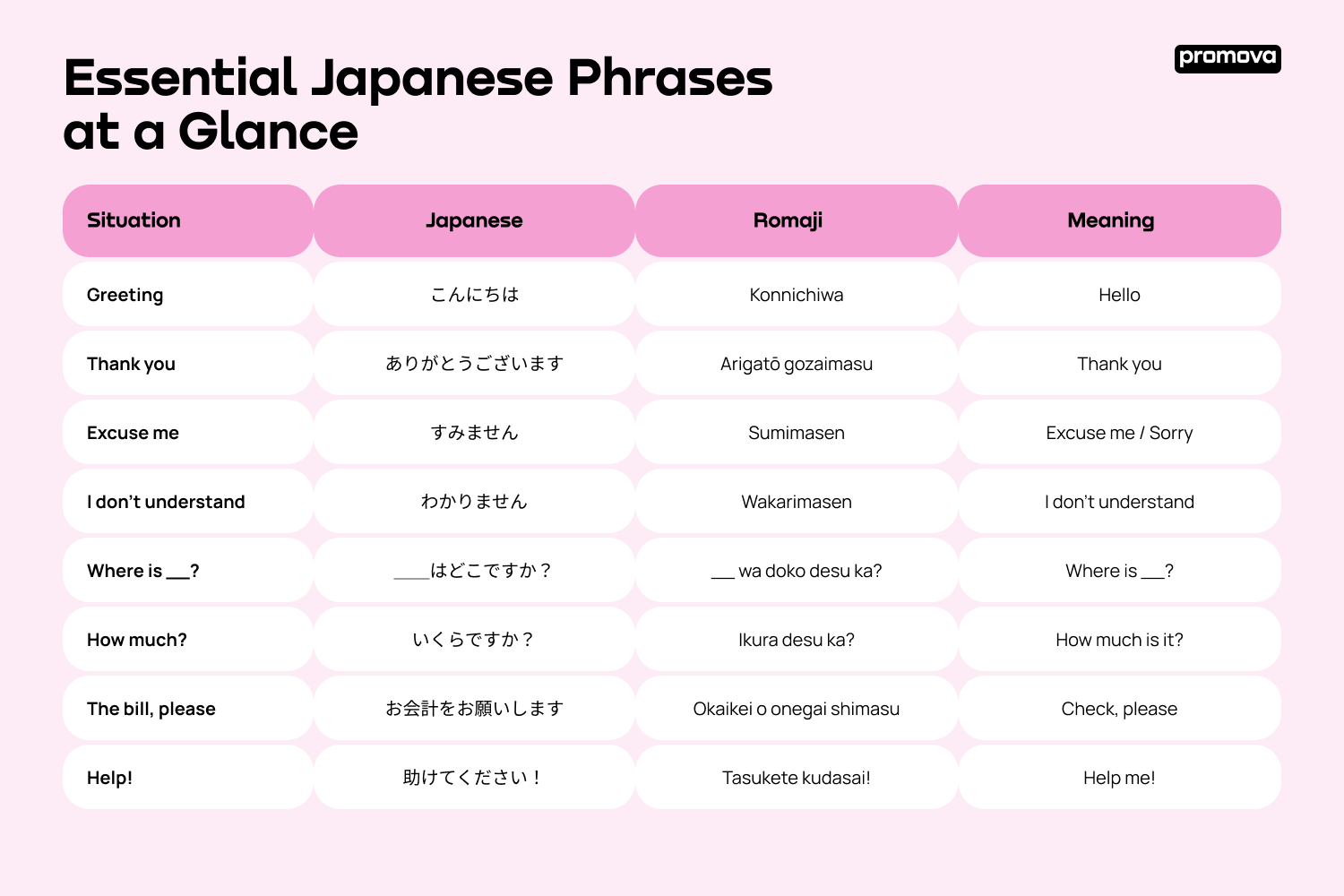
| Japanese | Romaji | Meaning | When to use |
| おはようございます | Ohayō gozaimasu | Good morning (formal) | Before around 11 am |
| おはよう | Ohayō | Good morning (casual) | With friends, close colleagues |
| こんにちは | Konnichiwa | Hello / Good afternoon | Daytime, general use |
| こんばんは | Konbanwa | Good evening | From late afternoon onward |
| おやすみなさい | Oyasuminasai | Good night (formal) | Before bed, parting in the evening |
| おやすみ | Oyasumi | Good night (casual) | With friends or family |
| さようなら | Sayōnara | Goodbye (final farewell) | When parting for a long time |
| またね | Mata ne | See you later | Casual, everyday goodbye |
| じゃあね | Jā ne | Bye / See ya | Very casual, among friends |
| はじめまして | Hajimemashite | Nice to meet you | First time meeting someone |
| よろしくお願いします | Yoroshiku onegai shimasu | Pleased to meet you / I’m in your care | After introducing yourself |
A note on さようなら (Sayōnara): This is one of the most recognized Japanese words worldwide, but native speakers use it less often in casual settings than you might expect. It carries a sense of finality — like “farewell” rather than “bye.” For everyday goodbyes when you’ll see someone again soon, またね (mata ne) or じゃあね (jā ne) are more natural.
Self-introduction phrases
When you meet another person in Japan, it’s polite to introduce yourself using basic Japanese phrases. Once you’ve said hello, sharing a little bit about yourself is the natural next step. Japanese introductions follow a fairly consistent pattern, which makes them easy to practice. When introducing yourself, you can start with "hajimemashite" (はじめまして), which means "nice to meet you."
You can insert your own name or details into the template phrases below to personalize your introduction.
| Japanese | Romaji | Meaning |
| 私は__です。 | Watashi wa __ desu. | I am __ . (My name is __ .) |
| __と申します。 | __ to mōshimasu. | My name is __ .(formal, humble) |
| __から来ました。 | __ kara kimashita. | I’m from __. |
| 日本語を勉強しています。 | Nihongo o benkyō shite imasu. | I’m studying Japanese. |
| よろしくお願いします。 | Yoroshiku onegai shimasu. | Pleased to meet you / I look forward to working with you. |
| お名前は何ですか? | O-namae wa nan desu ka? | What is your name? |
| どこから来ましたか? | Doko kara kimashita ka? | Where are you from? |
Tip: よろしくお願いします (Yoroshiku onegai shimasu) is one of those phrases that doesn’t translate cleanly into English. It’s said after introductions, when starting a new working relationship, or when asking someone for help. Think of it as a polite “I’m counting on you” or “I’m glad to know you.” You’ll hear it constantly, and using it correctly will immediately make you sound more natural.
1
Polite expressions and everyday phrases
These are the phrases you’ll use every single day, such as responses, expressions of understanding, and polite fillers that keep conversations smooth. Many of these basic Japanese phrases are helpful in daily interactions, especially when traveling or navigating new situations.
| Japanese | Romaji | Meaning |
| はい | Hai | Yes |
| いいえ | Iie | No |
| ありがとうございます | Arigatō gozaimasu | Thank you (formal, polite) |
| ありがとう | Arigatō | Thank you (casual, friendly) |
| どうも | Dōmo | Thanks (very casual) / can be combined for extra politeness |
| どういたしまして | Dō itashimashite | You’re welcome |
| すみません | Sumimasen | Excuse me / I’m sorry / Pardon |
| ごめんなさい | Gomen nasai | I’m sorry (sincere apology) |
| 大丈夫です | Daijōbu desu | It’s okay / I’m fine / No problem |
| 大丈夫ですか? | Daijōbu desu ka? | Are you okay? / Is that alright? |
| わかりました | Wakarimashita | I understand / Got it |
| わかりません | Wakarimasen | I don’t understand |
| もう一度お願いします | Mō ichido onegai shimasu | Please say that again |
| ゆっくり話してください | Yukkuri hanashite kudasai | Please speak slowly |
| 英語を話せますか? | Eigo o hanasemasu ka? | Do you speak English? |
When expressing gratitude, it’s helpful to know the difference between these phrases:
- "Arigatō" (also "arigatou" or "arigato") is the simplest way to say "thank you" in Japanese, used casually among friends or close acquaintances.
- "Arigatō gozaimasu" is more polite and formal, appropriate for situations like thanking shop clerks, service staff, or in business settings.
- "Dōmo" is a versatile word that can be used alone for a casual "thanks," or combined as in "domo arigatō" (thanks a lot) or "domo arigatō gozaimasu" (thank you very much) for extra politeness.
In Japan, it is common to bow slightly while saying thank you to add emphasis to your gratitude.
すみません (Sumimasen) deserves special attention. It’s easily one of the five most useful words in Japanese for beginners. Use it to get someone’s attention in a restaurant or on the street, to apologize for bumping into someone, to excuse yourself when passing through a crowd, and to soften a request. It’s polite, versatile, and you can’t use it too much.
Travel and directions phrases
Japan has one of the most efficient public transport systems in the world, but navigating it becomes dramatically easier when you know a few key sentences. When language barriers exist, pointing is a common and effective way to communicate, especially when asking for directions or ordering food.
| Japanese | Romaji | Meaning |
| __はどこですか? | __ wa doko desu ka? | Where is __? (example: 東京駅はどこですか?/ Tōkyō eki wa doko desu ka?/ Where is Tokyo Station?) |
| 駅はどこですか? | Eki wa doko desu ka? | Where is the train station? |
| お手洗いはどこですか? | O-tearai wa doko desu ka? | Where is the bathroom? |
| __行きの電車はどれですか? | __ yuki no densha wa dore desu ka? | Which train goes to __? |
| このバスは__に行きますか? | Kono basu wa __ ni ikimasu ka? | Does this bus go to __? |
| __に止まりますか? | __ ni tomarimasu ka? | Will we stop at __? (example: 京都に止まりますか?/ Kyōto ni tomarimasu ka?/ Will we stop at Kyoto?) |
| 次の__は何時ですか? | Tsugi no __ wa nanji desu ka? | When is the next __? (example: 次の電車は何時ですか?/ Tsugi no densha wa nanji desu ka?/ When is the next train?) |
| 切符売り場はどこですか? | Kippu uriba wa doko desu ka? | Where is the ticket counter? |
| タクシーを呼んでください | Takushī o yonde kudasai | Please call a taxi |
| ここに連れて行ってください | Koko ni tsurete itte kudasai | Please take me here (show map) |
| 迷子になりました | Maigo ni narimashita | I’m lost |
| 地図を見せてください | Chizu o misete kudasai | Please show me the map |
Useful tip: When asking for directions, you may not understand the full spoken answer — and that’s completely okay. Most local residents will point, gesture, or even walk with you to help. Pointing to maps, signs, or photos is a practical way to communicate if you’re unsure of the words. Japanese people are generally very willing to help tourists, sometimes going significantly out of their way to do so. Don’t let the fear of not understanding the reply stop you from asking.
Shopping phrases
Japan is a world-class destination for shopping, and knowing how to ask a few key questions will save you time and frustration. These helpful phrases can make your shopping experience much smoother, especially for tourists navigating language barriers.
| Japanese | Romaji | Meaning |
| これはいくらですか? | Kore wa ikura desu ka? | How much is this? |
| (insert item)はいくらですか? | __ wa ikura desu ka? | How much is __? |
| 試着できますか? | Shichaku dekimasu ka? | Can I try this on? |
| 別のサイズはありますか? | Betsu no saizu wa arimasu ka? | Do you have a different size? |
| 別の色はありますか? | Betsu no iro wa arimasu ka? | Do you have a different color? |
| これをください | Kore o kudasai | I’ll take this one, please |
| カードで払えますか? | Kādo de haraemasu ka? | Can I pay by card? |
| 袋はいりません | Fukuro wa irimasen | I don’t need a bag |
| 領収書をください | Ryōshūsho o kudasai | Please give me a receipt |
| 見ているだけです | Mite iru dake desu | I’m just looking |
Tip: If you know the name of the item you want to ask about, you can insert it into the phrase: “__ wa ikura desu ka?” to ask for its price. For example, “Kutsu wa ikura desu ka?” means “How much are the shoes?”
Helpful phrase: When dining or shopping, you can ask “Eigo no menyū wa arimasu ka?” to request an English menu, which is especially helpful if you’re unfamiliar with Japanese characters or cuisine.
A practical note on cash in Japan: Many smaller restaurants, local shops, and traditional establishments are still cash-only. It’s always worth asking "Kādo de haraemasu ka?" (Can I pay by card?) before assuming card payment is accepted. ATMs at 7-Eleven stores (called Seven Bank) reliably accept international cards across Japan.
Restaurant and food phrases
Food is one of the great joys of visiting Japan, and knowing some basic Japanese phrases is helpful for ordering food or a drink. Using the local language in restaurants is appreciated and adds fun to your dining experience.
| Japanese | Romaji | Meaning |
| いただきます | Itadakimasu | Said before eating (expression of gratitude) |
| ごちそうさまでした | Gochisōsama deshita | Said after eating (thank you for the meal; expresses gratitude after eating) |
| メニューを見せてください | Menyū o misete kudasai | Please show me the menu |
| おすすめは何ですか? | Osusume wa nan desu ka? | What do you recommend? |
| これをください | Kore o kudasai | I’ll have this, please |
| お水をお願いします | O-mizu o onegai shimasu | Water, please |
| ビールをお願いします | Bīru o onegai shimasu | Beer, please |
| 飲みます | Nomimasu | To drink |
| 食べます | Tabemasu | To eat |
| お会計をお願いします | Okaikei o onegai shimasu | The bill, please |
| おいしい! | Oishii! | Delicious! |
| アレルギーがあります | Arerugī ga arimasu | I have an allergy |
| __は入っていますか? | __ wa haitte imasu ka? | Does this contain __? |
いただきます (Itadakimasu) and ごちそうさまでした (Gochisōsama deshita) are not optional etiquette. They’re deeply embedded in Japanese food culture. "Itadakimasu" (literally “I humbly receive”) is said before every meal as an expression of gratitude. "Gochisōsama deshita" is said when you finish eating to thank the cook or host for the meal. Using both correctly shows genuine cultural respect and will earn you visible appreciation from restaurant staff. These helpful phrases make eating out more enjoyable and can turn a simple meal into a fun and memorable experience.
Emergency and health phrases
These phrases are rarely needed, but when you need them, you really need them. In emergency situations, it's important to express your needs clearly. For example, to express a need for medical help, you can say びょういんにいきたい (byoin ni ikitai), which means "I want to go to the hospital."
| Japanese | Romaji | Meaning |
| 助けてください! | Tasukete kudasai! | Help me, please! |
| 警察を呼んでください | Keisatsu o yonde kudasai | Please call the police |
| 救急車を呼んでください | Kyūkyūsha o yonde kudasai | Please call an ambulance |
| 気分が悪いです | Kibun ga warui desu | I don’t feel well |
| 病院はどこですか? | Byōin wa doko desu ka? | Where is the hospital? |
| びょういんにいきたい | Byōin ni ikitai | I want to go to the hospital |
| __が痛いです | __ ga itai desu | My __ hurts |
| 財布を盗まれました | Saifu o nusumaremashita | My wallet was stolen |
| パスポートをなくしました | Pasupōto o nakushimashita | I lost my passport |
Japan’s emergency number is 110 for police and 119 for ambulance and fire. In an emergency, you can also call these numbers and speak English; major emergency response centers have English language support available.
Tips for learning and using Japanese phrases
Knowing a phrase on a list and being able to use it in a real conversation are two different things. Here’s how to close that gap:
Consider enrolling in a Japanese course: A structured course provides systematic lessons and guided practice, making it easier to build your skills and confidence in the local language.
Practice out loud from day one: Reading phrases silently is much less effective than saying them aloud. Even practicing in your own room — ordering imaginary food, asking imaginary strangers for directions — builds the muscle memory that real conversations require.
Learn phrases in the situations you’ll actually use them: Greetings for when you meet someone, transport phrases for when you’re at a station, food phrases for when you’re at a restaurant. Context makes vocabulary stick faster and easier to recall when it matters. Learning these key phrases is especially helpful for real-life situations, such as navigating travel or asking for assistance.
Don’t worry about politeness levels at first: Japanese has formal and casual speech registers, and getting them perfectly right from day one is unrealistic. As a beginner, using the formal forms (desu and masu endings) is always appropriate and will never offend anyone. Casual speech comes naturally later.
Use what you know, even if it’s imperfect: Japanese people almost universally appreciate the effort from foreign learners, even when the pronunciation isn’t perfect and the grammar is a little broken. Attempting to communicate in Japanese is almost always met with warmth and encouragement, not judgment. Making the effort to speak the local language can greatly enhance your travel experience and help you connect with people.
Build on phrases with vocabulary swaps: Many of these phrases are templates. Once you know "__はどこですか?" (Where is __?), you can swap in any location: the station, the bathroom, the hotel, or the nearest convenience store. The more vocabulary you build, the more useful each phrase becomes.
Learn Japanese with Promova
Learning phrases is a great starting point, but building real conversational ability means developing vocabulary, grammar, and listening skills together over time.
Learn Japanese online with Promova and get access to a structured Japanese course featuring bite-sized lessons, AI-powered speaking practice, and a judgment-free space to make mistakes, improve, and actually use what you’re learning. Whether you’re a complete beginner working through your first hiragana characters or preparing for an upcoming trip to Japan, Promova fits the practice into your schedule — not the other way around.
This article, written by language experts, is a helpful resource for learning basic Japanese phrases and understanding cultural context. Promova's AI Tutor is available 24/7 for real-life conversation practice, so you can go from memorizing phrases like the ones in this guide to actually using them in simulated conversations, all while getting instant feedback along the way.
You can also explore Promova’s broader guide on how to learn Japanese to see what a complete beginner roadmap looks like, and the Promova language learning app to start your first lesson today.
Conclusion
You don't need thousands of words to start communicating in Japanese. A handful of well-chosen phrases, said with confidence and genuine effort, will get you further than you expect — whether you're ordering food in Osaka, asking for directions in Tokyo, or just trying to connect with Japanese culture from wherever you are in the world.
Start with greetings. Add polite expressions. Build from there, situation by situation. The rest will follow.
FAQ
What are the most basic Japanese phrases to learn first?
Start with everyday greetings: Konnichiwa (hello), Arigatō gozaimasu (thank you), Sumimasen (excuse me / sorry), Hai (yes), and Iie (no). These five alone will help you navigate most basic interactions and make a positive impression on Japanese speakers from day one.
What is the difference between formal and casual Japanese?
Japanese has different speech levels depending on who you're talking to. Formal speech uses desu and masu verb endings and is appropriate with strangers, in shops, and in professional settings. Casual speech drops these endings and is used with friends and family. As a beginner, always use formal speech — it's universally appropriate.
Is it hard to pronounce Japanese phrases?
Japanese pronunciation is actually quite consistent — each vowel always makes the same sound, unlike English. The five vowels (a, i, u, e, o) are pronounced the same way in every word. Most beginners find basic pronunciation manageable within a few hours of practice, especially with audio resources.
How can I practice basic Japanese phrases before a trip?
The most effective approach is to practice phrases in context — out loud, not just by reading them. Apps like Promova let you practice pronunciation and conversation with AI feedback, building the confidence to actually use phrases when it counts.

 English


Comments