Japanese Words With Deep Meaning That Have No English Translation

Contents
Key takeaways
- Japanese has dozens of words with deep meaning that don't have a single English equivalent — each one captures a feeling, moment, or idea that takes a whole sentence to describe in English.
- These words reflect core Japanese values: appreciating impermanence, finding beauty in imperfection, and being present in small moments.
- Understanding words like 木漏れ日 (komorebi) or 物の哀れ (mono no aware) gives you real insight into Japanese culture — not just vocabulary.
- Many of these words come from Buddhism, Shinto, and traditional Japanese aesthetics that have shaped the language for centuries.
- Learning emotionally rich vocabulary is one of the most effective ways to deepen your connection to a language and understand how its speakers see the world.
Some languages have words for things you've always felt but never had a name for.
Japanese is full of them.
Words like komorebi — the light filtering through leaves — or wabi-sabi — the beauty found in imperfect, aging things. There's no clean English translation for either. You'd need a whole sentence, maybe a paragraph, to explain what a single Japanese word holds.
That's not a coincidence. Japanese culture has spent centuries paying attention to things that other cultures glossed over — the texture of silence, the sadness of beautiful things ending, the quiet satisfaction of a task done alone. The language reflects all of that.
This article covers the most meaningful Japanese words that don't translate easily into English, what they actually mean, and what they reveal about the people who use them. If you're just getting started with the language itself, our guide to basic Japanese words for beginners is a good companion piece — it covers the practical vocabulary you'll need before diving into concepts like these.
Why does Japanese have so many untranslatable words?
Language reflects how a culture pays attention to the world. Japanese has developed a rich vocabulary for emotional nuance and fleeting experiences because Japanese aesthetics have long valued exactly those things.
Several philosophical and artistic traditions shaped this vocabulary:
- Zen Buddhism — which emphasizes impermanence (mujo, 無常) and the suffering that comes from clinging to things that change; both mono no aware and wabi-sabi are shaped by those teachings.
- Shinto — Japan's indigenous spirituality, which finds the sacred in natural objects, seasons, and everyday rituals.
- Mono no aware (物の哀れ) — a core aesthetic concept meaning the bittersweet awareness that beautiful things don't last.
The result is a language that has specific, precise words for experiences most other languages leave unnamed. According to NHK World's Japanese language resources, these culturally embedded expressions are among the hardest things to teach non-native learners — but also the most rewarding.
Japanese words with deep meaning — the full list
Words about nature and beauty
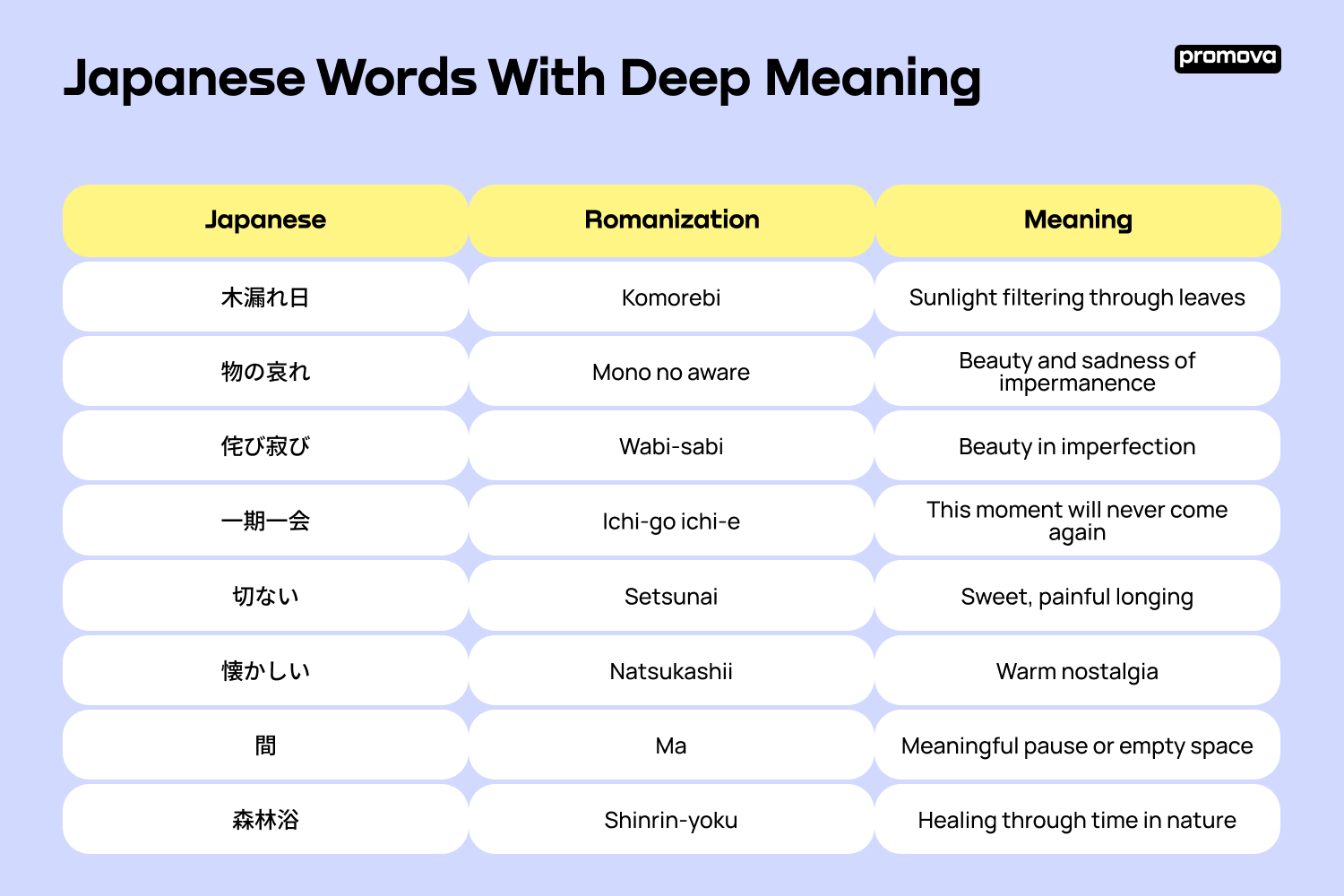
木漏れ日 (Komorebi) — The sunlight that filters through leaves. There's no English word for this. Komorebi describes that specific light — broken, shifting, half-shadow — that you see when sunlight passes through a forest canopy or a row of trees. It's one of those things everyone has noticed but most languages never named.
木枯らし (Kogarashi) — The first cold wind of winter. Literally "tree-withering wind." Kogarashi is the wind that signals the end of autumn — the one that makes you pull your coat tighter and realize summer is truly gone. It's not just cold air; it carries the weight of a season ending.
花吹雪 (Hanafubuki) — Cherry blossom snowstorm. When cherry blossom petals fall all at once in the wind, it looks like a blizzard of pink and white. Hanafubuki captures that exact moment — the word combines hana (flower) and fubuki (snowstorm). It's beautiful and gone in seconds.
翠雨 (Suiu) — Rain that falls through fresh green leaves. Spring rain, filtered through new foliage, has its own quality of light and sound. Suiu captures it. Where English might say "it's raining," Japanese has a word for the specific mood of rain in a green, living landscape.
Words about impermanence and beauty in passing
物の哀れ (Mono no aware) — The bittersweet awareness that beautiful things don't last. This might be the most important concept on this list. Mono no aware — often translated as "the pathos of things" — is the feeling you get when you watch cherry blossoms fall, or realize a perfect moment is ending. It's not purely sad. It's the recognition that beauty and impermanence are inseparable.
The concept has shaped Japanese art, literature, and film for over a thousand years. Scholar Donald Keene, one of the West's most respected translators of Japanese literature, described mono no aware as one of the most fundamental Japanese aesthetic concepts.
無常 (Mujo) — Impermanence — nothing lasts. Mujo is the Buddhist idea that all things change and nothing is permanent. It's not a pessimistic word — in Japanese culture, accepting impermanence is seen as wisdom, not defeat. The beauty of cherry blossoms means more because they fall within a week.
一期一会 (Ichi-go ichi-e) — This moment will never come again. Literally "one time, one meeting." It comes from the Japanese tea ceremony tradition and means that every encounter is unique and unrepeatable. You should treat each moment — each conversation, each meeting — as if it will never happen again. Because it won't.
侘び寂び (Wabi-sabi) — The beauty of imperfect, incomplete, and impermanent things. Wabi-sabi is a full aesthetic philosophy, not just a word. Wabi originally meant loneliness or simplicity; sabi referred to the beauty that comes with age and wear. Together, they describe the appreciation for things that are imperfect, weathered, unfinished — a cracked tea bowl, a mossy stone, an asymmetrical flower.
In a world obsessed with polish and perfection, wabi-sabi is a reminder that worn things have their own kind of beauty.
1
Words about people and emotions
甘え (Amae) — The comfort of depending on someone's goodwill. Amae describes a particular kind of emotional reliance — the feeling of knowing someone loves you enough that you can be vulnerable, ask for help, or simply lean on them without explaining yourself. It's the comfort of being taken care of. Psychologist Takeo Doi devoted an entire book — The Anatomy of Dependence — to explaining this concept and why it has no Western equivalent.
縁 (En) — A bond or connection that was meant to be. En describes the invisible thread that connects people — the idea that some relationships, meetings, or coincidences were fated. Meeting your closest friend at a random event, ending up in a city you never planned to visit, finding a book at exactly the right moment. En is the word for that sense of meaningful connection.
懐かしい (Natsukashii) — A warm, nostalgic feeling for something from the past. This one is tricky to translate because it's more specific than "nostalgia." Natsukashii is what you feel when you hear a song from childhood, smell something that takes you back ten years, or see a photo of people you loved. It's warm, not sad — a fondness for what's gone rather than grief.
切ない (Setsunai) — A painful, sweet feeling of longing. Setsunai sits between sadness and longing — the specific ache you feel when something is beautiful and out of reach, or when you're moved by something bittersweet. It often comes up in Japanese music and poetry. A lot of people describe it as the feeling a particular kind of sad song gives you.
照れ隠し (Tere kakushi) — Hiding embarrassment by acting the opposite way. When someone deflects a compliment by making a joke, brushes off something kind by being sarcastic, or acts annoyed when they're actually flattered — that's tere kakushi. It's such a specific social behavior that Japanese gave it its own word.
Words about quiet and solitude
森林浴 (Shinrin-yoku) — Forest bathing — healing through time spent in nature. Shinrin-yoku is the practice of spending time in forests for mental and physical restoration. It's not hiking or exercising — it's simply being present in natural surroundings. Japanese researchers at Chiba University have studied the physiological benefits, including reduced cortisol and lower blood pressure, of regular shinrin-yoku. The practice has spread globally, but the word comes from Japan.
余白 (Yohaku) — Meaningful empty space. In traditional Japanese art — calligraphy, painting, garden design — empty space is not nothing. It's intentional. Yohaku is the white space around a brushstroke, the silence between notes, the pause in a conversation that gives the words around it more weight. It's the idea that absence can be as meaningful as presence.
間 (Ma) — A pregnant pause — the meaningful gap between things. Ma is related to yohaku but broader. It means the gap, pause, or interval that gives structure to time, space, and relationships. In music, it's the silence between notes. In architecture, it's the space between objects. In conversation, it's the moment of quiet that says more than words. Ma is one of the most studied Japanese concepts in design, music, and communication.
What these words tell us about Japanese culture
There's a pattern across all of these words: they pay attention to things most cultures rush past.
The quality of light through leaves. The first wind of winter. The feeling of a beautiful moment ending. The healing effect of a quiet forest. The meaning in empty space.
Japanese culture has developed a vocabulary for experiences that other languages leave unnamed — not because those experiences don't exist elsewhere, but because Japanese tradition made a deliberate choice to notice them, name them, and pass them down. Each Japanese phrase captures values as much as definitions, preserving ways of noticing beauty, relationships, and waste.
Learning these words isn't just vocabulary practice; unique Japanese words such as ichi-go ichi-e show how even a gathering with the same group is never truly the same moment twice. It's a different way of seeing.
How to use these words in real life
A few of these words have made it into everyday speech; others are more literary or poetic. Here's a quick guide — and some also come up in daily life around food and waste, such as mottainai, which conveys regret over waste and appreciation for what has been lost or used.
Used in normal conversation:
- なつかしい (Natsukashii) — very common, used casually
- 縁 (En) — common in conversation and writing
- 甘え (Amae) — common in psychological and everyday contexts
- 切ない (Setsunai) — used regularly, especially about music or movies
More poetic or literary:
- 物の哀れ (Mono no aware) — more often in essays, art criticism, literature
- 余白 (Yohaku) — used in design and art contexts
- 間 (Ma) — used in music, architecture, and philosophy discussions
Can be used in both contexts:
- 侘び寂び (Wabi-sabi) — popular internationally, used conversationally and philosophically
- 一期一会 (Ichi-go ichi-e) — common in speeches, toasts, and meaningful conversations
- 森林浴 (Shinrin-yoku) — increasingly common in health and wellness conversations
For a broader look at getting started or leveling up, check out our guide on the best ways to learn Japanese, which walks through methods, tools, and realistic timelines for reaching fluency.
Start understanding the language behind the words
Vocabulary like this is why so many people fall in love with Japanese. There's a whole way of experiencing the world encoded in these words — and once you know them, you start noticing those experiences everywhere.
If you're learning Japanese, Promova's Japanese course gives you structured, bite-sized lessons that go beyond basic phrases and help you build real fluency — including the cultural context that makes vocabulary actually stick, especially when native Japanese teachers can show you when a word, phrase, or cultural concept sounds natural. You can also practice speaking through AI role-play scenarios, get instant feedback, and move at your own pace.
Final thoughts
Japanese words with deep meaning aren't just beautiful — they're useful. They give you language for experiences you already have but couldn't quite name. Natsukashii for the warmth of nostalgia. Setsunai for bittersweet longing. Komorebi for the light through trees you've noticed a hundred times without knowing what to call it.
Learning these words changes how you pay attention. That's what the best vocabulary does.
FAQ
What are some Japanese words with no English translation?
Some of the most well-known include 木漏れ日 (komorebi — sunlight through leaves), 物の哀れ (mono no aware — the bittersweet feeling that beautiful things end), 侘び寂び (wabi-sabi — beauty in imperfection), and 切ない (setsunai — a sweet, painful longing). Each describes a specific feeling or experience that English doesn't have a single word for.
What does wabi-sabi mean in Japanese?
Wabi-sabi (侘び寂び) is a Japanese aesthetic philosophy that finds beauty in imperfect, incomplete, and impermanent things, and kintsugi is a classic example, where broken pottery is repaired with gold rather than disguised. It values the worn, the simple, and the asymmetrical over the polished and perfect. A cracked tea bowl or a mossy stone wall can be more beautiful than something new and flawless.
What is mono no aware?
Mono no aware (物の哀れ) means the bittersweet awareness that beautiful things don't last. It's the feeling you get watching cherry blossoms fall or realizing a perfect moment is ending. It combines beauty and sadness — the recognition that impermanence is what makes things precious.
What is komorebi in Japanese?
Komorebi (木漏れ日) is the Japanese word for sunlight filtering through the leaves of trees. It describes the dappled, shifting light you see in a forest or under a canopy of branches. English has no single word for this specific quality of light.


 English
 Español


Comments