Basic Japanese Words for Beginners: Your Starter Vocabulary Guide

Contents
Key takeaways
- Japanese has three writing systems — hiragana, katakana, and kanji — but you can start speaking with just romaji (romanized phonetic spelling).
- The most important basic Japanese words cover greetings, numbers, food, directions, and everyday situations.
- Knowing 500–1,000 Japanese words is enough for basic conversations, according to language learning research.
- Japanese pronunciation is more regular than English — most sounds stay the same every time.
- Short, consistent practice sessions (15–20 minutes a day) build vocabulary faster than long, irregular study marathons.
You've decided to learn Japanese. Maybe it's the food, the culture, a trip you're planning, or a show you've been watching. Whatever the reason, you're here — and that's the right start.
Japanese can feel intimidating at first — three writing systems, honorifics, and grammar that flips the sentence structure you're used to. But here's the thing: spoken Japanese is actually very learner-friendly. The pronunciation is consistent, the vowel sounds are simple, and a handful of basic Japanese words will get you surprisingly far in real conversations.
This guide gives you the essential vocabulary — organized by topic, written in romaji so you can read it immediately, and explained in plain language. No fluff, no overwhelming word lists. Just the words you'll actually use.
Why start with the most common Japanese words?
Learning vocabulary first makes everything else click faster. When you recognize words in a sentence, grammar starts to make sense on its own.
According to research cited by Fluent in 3 Months, knowing the most common 1,000 words in Japanese covers around 85–90% of everyday conversation. You don't need to master kanji to start communicating. You just need a working vocabulary and the confidence to use it.
Start small, use words in context, and build from there.
1
How does Japanese pronunciation work?
Before diving into vocabulary, a quick note on pronunciation — the Japanese language is phonetic, so words are pronounced much like they’re written once you know the rules.
Japanese has five vowels, and they always sound the same:
- a — like “ah” (as in “father”)
- i — like “ee” (as in “feet”)
- u — like “oo” (as in “soon,” but shorter)
- e — like “eh” (as in “bed”)
- o — like “oh” (as in “oh!”)
Basic Japanese greetings
| Japanese | Romaji | Meaning | When to use it |
| こんにちは | Konnichiwa | Hello / Good afternoon | Daytime greeting, the most common one |
| おはようございます | Ohayou gozaimasu | Good morning | Until roughly 11am; drop gozaimasu with friends |
| こんばんは | Konbanwa | Good evening | From early evening onwards |
| ありがとうございます | Arigatou gozaimasu | Thank you (polite) | Standard polite thanks; arigatou alone is casual |
| すみません | Sumimasen | Excuse me / Sorry | To get attention, apologise lightly, or thank someone who helped you |
| はい / いいえ | Hai / Iie | Yes / No | The basics |
| さようなら | Sayounara | Goodbye | Formal or long partings; ja ne is the casual version |
| おやすみなさい | Oyasumi nasai | Good night | When parting at night or before sleep |
Essential Japanese phrases for daily life
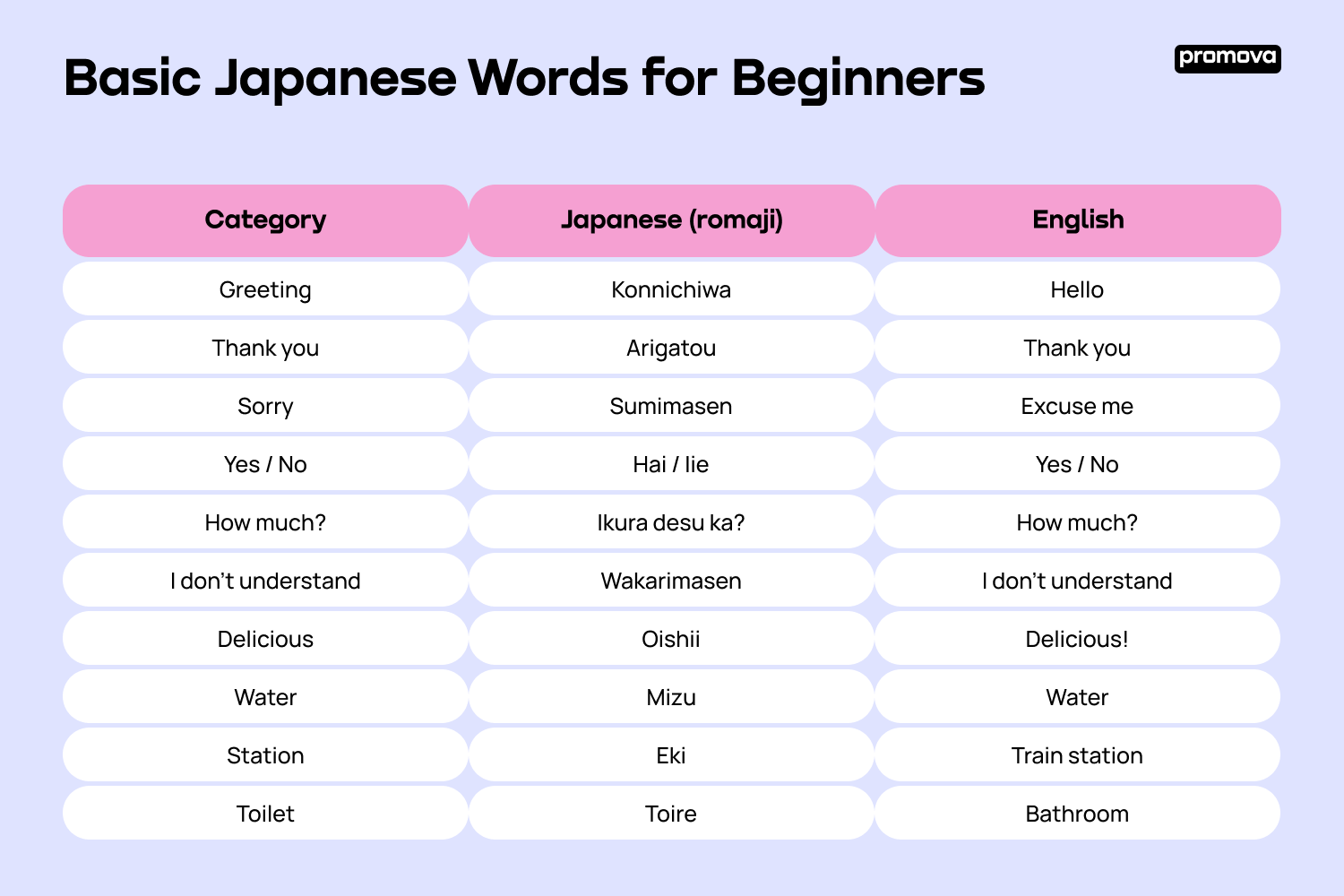
- Ikura desu ka? — How much does this cost?
- Wakarimasen — I don’t understand.
- Eigo ga wakarimasu ka? — Do you understand English?
Everyday Japanese nouns
These are the words you point at, ask for, and look for on signs. Learn them early — they do more work per word than almost anything else.
| Japanese | Romaji | English |
| 水 | Mizu | Water |
| ご飯 | Gohan | Cooked rice / a meal |
| トイレ | Toire | Toilet / bathroom |
| 駅 | Eki | Train station |
| 電車 | Densha | Train |
| 店 | Mise | Shop |
| 家 | Ie | House / home |
| 人 | Hito | Person |
| 友達 | Tomodachi | Friend |
| 猫 | Neko | Cat |
| 犬 | Inu | Dog |
| お金 | Okane | Money |
Note that toire is written in katakana (トイレ) because it comes from the English word “toilet”. Once you can read katakana, dozens of everyday words like this become instantly recognisable.
Common Japanese verbs
Japanese puts the verb at the end of the sentence, which feels strange at first and stops being strange quickly. The dictionary form is listed here; the polite -masu form is what you will actually say to strangers.
| Japanese | Dictionary form | Polite form | English |
| 食べる | Taberu | Tabemasu | To eat |
| 飲む | Nomu | Nomimasu | To drink |
| 行く | Iku | Ikimasu | To go |
| 来る | Kuru | Kimasu | To come |
| 見る | Miru | Mimasu | To see / watch |
| する | Suru | Shimasu | To do |
| 買う | Kau | Kaimasu | To buy |
| 寝る | Neru | Nemasu | To sleep |
| 話す | Hanasu | Hanashimasu | To speak |
| 分かる | Wakaru | Wakarimasu | To understand |
Japanese numbers 1 to 10
Numbers come up constantly — prices, platforms, quantities, times. Japanese has two counting systems for small numbers, and both are worth recognising.
| Numeral | Japanese | Sino-Japanese reading | Native reading |
| 1 | 一 | Ichi | Hitotsu |
| 2 | 二 | Ni | Futatsu |
| 3 | 三 | San | Mittsu |
| 4 | 四 | Shi / Yon | Yottsu |
| 5 | 五 | Go | Itsutsu |
| 6 | 六 | Roku | Muttsu |
| 7 | 七 | Shichi / Nana | Nanatsu |
| 8 | 八 | Hachi | Yattsu |
| 9 | 九 | Kyuu / Ku | Kokonotsu |
| 10 | 十 | Juu | Tou |
The Sino-Japanese readings (ichi, ni, san…) are what you use for prices, phone numbers and dates. The native readings (hitotsu, futatsu…) are used for counting objects generally: hitotsu kudasai means “one, please”, which is genuinely all you need in a shop.
One quirk worth knowing: shi (4) and ku (9) sound identical to the words for “death” and “suffering”, so yon and kyuu are often preferred in speech.
Common Japanese food words
Food is one of the best entry points into a culture — and in Japan, food also opens a window into japanese culture, from everyday meals to cities like Tokyo. Knowing the names of dishes, ingredients, and dietary terms makes every meal easier and more enjoyable.
Dishes:
- Sushi — vinegared rice with fish or other toppings
- Ramen — noodle soup with various broths and toppings
- Tempura — lightly battered and fried seafood or vegetables
- Tonkatsu — breaded, fried pork cutlet
- Udon — thick wheat noodles, usually in a mild broth
- Onigiri — rice ball, often with a filling inside
- Miso shiru — miso soup, served with most traditional meals
- Yakitori — grilled chicken skewers
Key food vocabulary:
| Japanese (romaji) | English |
| Niku | Meat |
| Sakana | Fish |
| Yasai | Vegetables |
| Tamago | Egg |
| Gohan | Cooked rice / Meal |
| Pan | Bread |
| Miruku | Milk |
| Ocha | Green tea |
| Mizu | Water |
| Karai | Spicy |
| Amai | Sweet |
| Suppai | Sour |
| Shio | Salt |
| Sato | Sugar |
Useful for dietary needs:
- Beji-tarian desu — I’m vegetarian.
- Arerugi ga arimasu — I have an allergy.
- Niku nashi de kudasai — Without meat, please.
- Gochisousama deshita — said after finishing a meal to thank the host or restaurant for the food.
Basic Japanese words for time and days
Knowing how to talk about time is essential for making plans, catching trains, and keeping up with schedules.
Days of the week:
| Japanese (romaji) | English |
| Nichiyoubi | Sunday |
| Getsuyoubi | Monday |
| Kayoubi | Tuesday |
| Suiyoubi | Wednesday |
| Mokuyoubi | Thursday |
| Kinyoubi | Friday |
| Doyoubi | Saturday |
Useful time words:
- Kyou — Today
- Ashita — Tomorrow
- Kinou — Yesterday
- Ima — Now
- Ato de — Later
- Hayai — Early / Fast
- Osoi — Late / Slow
- Nan-ji desu ka? — What time is it?
Adjectives that every beginner needs
Adjectives let you describe things, express opinions, and react to what's happening around you. Even a small set of adjectives dramatically expands what you can say.
| Japanese (romaji) | English |
| Ii / Yoi | Good |
| Warui | Bad |
| Ookii | Big |
| Chiisai | Small |
| Atsui | Hot |
| Samui | Cold (weather) |
| Tsumetai | Cold (to the touch) |
| Furui | Old |
| Atarashii | New |
| Kirei | Beautiful / Clean |
| Kawaii | Cute |
| Omoshiroi | Interesting / Funny |
| Muzukashii | Difficult |
| Yasashii | Easy / Kind |
| Tanoshii | Fun / Enjoyable |
In Japanese, adjectives come before the noun — just like in English. So chiisai inu means "small dog." Simple enough.
How to actually remember Japanese vocabulary
Learning words is one thing. Remembering them a week later is another. Here’s what works:
- Use spaced repetition. Apps and flashcard systems show you words right before you’re about to forget them. This technique is backed by decades of memory research. The Cambridge Dictionary has a useful learner section if you want to check definitions as you go.
- Learn words in context, not in isolation. Instead of memorizing taberu (to eat) alone, learn it in a phrase and build short sentences: Nani o tabemasu ka? (What do you eat?). Context sticks.
- Speak out loud from day one. Silent vocabulary study is only half the work. Say words aloud, record yourself, listen to your own speech, or native audio. The more Japanese you hear, the easier it becomes to recognize common expressions.
- Group words by topic. The way this article is organized isn’t random. Your brain remembers thematic clusters better than random word lists, which also makes new vocabulary easier to review.
- Review daily, even briefly. Ten minutes every day beats a two-hour session once a week. Consistency is the engine of language learning and helps turn new words into active recall.
Promova’s language learning app makes this easier — bite-sized Japanese lessons fit into real life, not the other way around while studying Japanese.
A note on Japanese writing systems
If you want to start learning Japanese, you can begin speaking without learning to read kanji, but learning hiragana and katakana early will help you a lot — especially in Japan, where they appear everywhere.
- Hiragana — 46 characters used for native Japanese words and grammar. This is the first writing system beginners learn.
- Katakana — 46 characters used for foreign loanwords (like terebi for TV or koohii for coffee). Once you learn katakana, you can read a surprisingly large number of words that come from English.
- Kanji — Chinese-derived characters used for meaning. There are thousands of them. You don’t need these to start.
These scripts are part of your Japanese core and help you recognize common Japanese words more easily.
Both hiragana and katakana can be learned in a few weeks with daily practice. Once you know them, the sounds you’ve been reading in romaji will make even more sense.
Final thoughts
Learning basic Japanese words is the most practical thing you can do on day one. You don't need grammar rules to say konnichiwa or order ramen with confidence. You just need to start, use what you learn, and let the vocabulary grow from there.
Japanese rewards consistent effort. A little every day adds up faster than you'd think. And the moment you use a word correctly in a real conversation — even a tiny one — you'll feel exactly why people keep going.
If you want a structured path to take you from these basics to real fluency, Promova offers Japanese courses from A1 through more advanced levels, with AI-powered speaking practice to help you build confidence at your own pace.
FAQ
What are the most important basic Japanese words to learn first?
Start with greetings, numbers one through 10, and practical phrases like ikura desu ka and wakarimasen.
Is Japanese hard to learn for English speakers?
Japanese is considered challenging mainly because of grammar structure and three writing systems, but pronunciation is regular and learner-friendly.
How many Japanese words do I need to have a basic conversation?
Around 500–1,000 high-frequency words is enough for basic conversation.
Can I learn Japanese without learning kanji?
Yes. Romaji and hiragana are enough to get started at the beginner stage.
What's the best way to practice basic Japanese vocabulary?
Use spaced repetition, learn words in context, and speak aloud daily to build confidence.


 English


Comments