What Is JLPT? Everything You Need to Know About the Japanese Proficiency Test

Contents
Key Takeaways
- JLPT (Japanese Language Proficiency Test) is the world's most widely recognized standardized test of Japanese for non-native speakers, offered in over 80 countries twice a year.
- The test has five levels — N5 (beginner) to N1 (advanced) — each testing vocabulary, grammar, reading, and listening. There is no speaking or writing section.
- Kanji requirements range from around 100 characters at N5 to 2,000+ at N1.
- Passing requires both a minimum total score and a minimum score in each section. You can't compensate for a weak section with a strong one.
- JLPT certificates never expire — once you earn a level, it's yours for life.
- Starting from December 2025, JLPT score reports include a CEFR reference level (A1–C1), making your result easier to use in international academic and professional contexts.
If you've started learning Japanese and looked into how to measure your progress, you've almost certainly come across the term JLPT. It shows up in job listings, university requirements, visa applications, and learner forums everywhere. But what exactly is it, how does it work, and which level should you be aiming for?
This guide covers everything a Japanese learner needs to know about the Japanese Language Proficiency Test — from the five levels and their requirements to scoring, registration, and practical tips for how to prepare.
What is JLPT?
The JLPT, or Japanese Language Proficiency Test (日本語能力試験, Nihongo Nōryoku Shiken), is a standardized, criterion-referenced test that evaluates and certifies Japanese language proficiency for non-native speakers. As the most widely recognized Japanese language test, the JLPT is a key credential for non-native speakers. The JLPT consists of multiple sections that assess language knowledge, reading, and listening skills. It measures language knowledge, reading ability, and listening ability.
The test is administered by two organizations: the Japan Foundation (for tests held outside Japan) and the Japan Educational Exchanges and Services (for tests held within Japan). It has been running in its current five-level format since 2010, when a major revision added the N3 level and reworked the scoring system.
The JLPT is held twice a year in Japan — on the first Sunday of July and December — and once a year in most other countries (either July or December, depending on the region). It’s taken by approximately one million people each year in more than 80 countries, making it the most widely recognized Japanese proficiency certification in the world.
One important thing to know upfront: the JLPT does not test speaking or writing. It tests what you can understand — reading, listening, grammar, and vocabulary. Understanding the JLPT test format, which is entirely multiple choice, is crucial for effective preparation. This is worth keeping in mind both when preparing for it and when presenting your result to employers or institutions.
JLPT levels explained: N5 to N1
The JLPT has five independent levels. N5 is the most basic and N1 is the most advanced. You don’t have to take them in order — you can register for any test level at any time, though taking a test level you’re not ready for is just a waste of registration fees.
Here’s a clear breakdown of what each level requires:
| Level | Ability description | Kanji needed | Vocabulary | Study hours (approx.) |
| N5 | Understanding basic Japanese | ~100 | ~800 words | 150–300 hrs |
| N4 | Understanding basic Japanese in familiar contexts | ~300 | ~1,500 words | 300–600 hrs |
| N3 | Understanding everyday Japanese at a moderate level | ~650 | ~3,750 words | 450–900 hrs |
| N2 | Understanding Japanese in everyday and wider contexts | ~1,000 | ~6,000 words | 600–1,200 hrs |
| N1 | Understanding Japanese in a broad range of circumstances | 2,000+ | 10,000+ words | 900–2,000+ hrs |
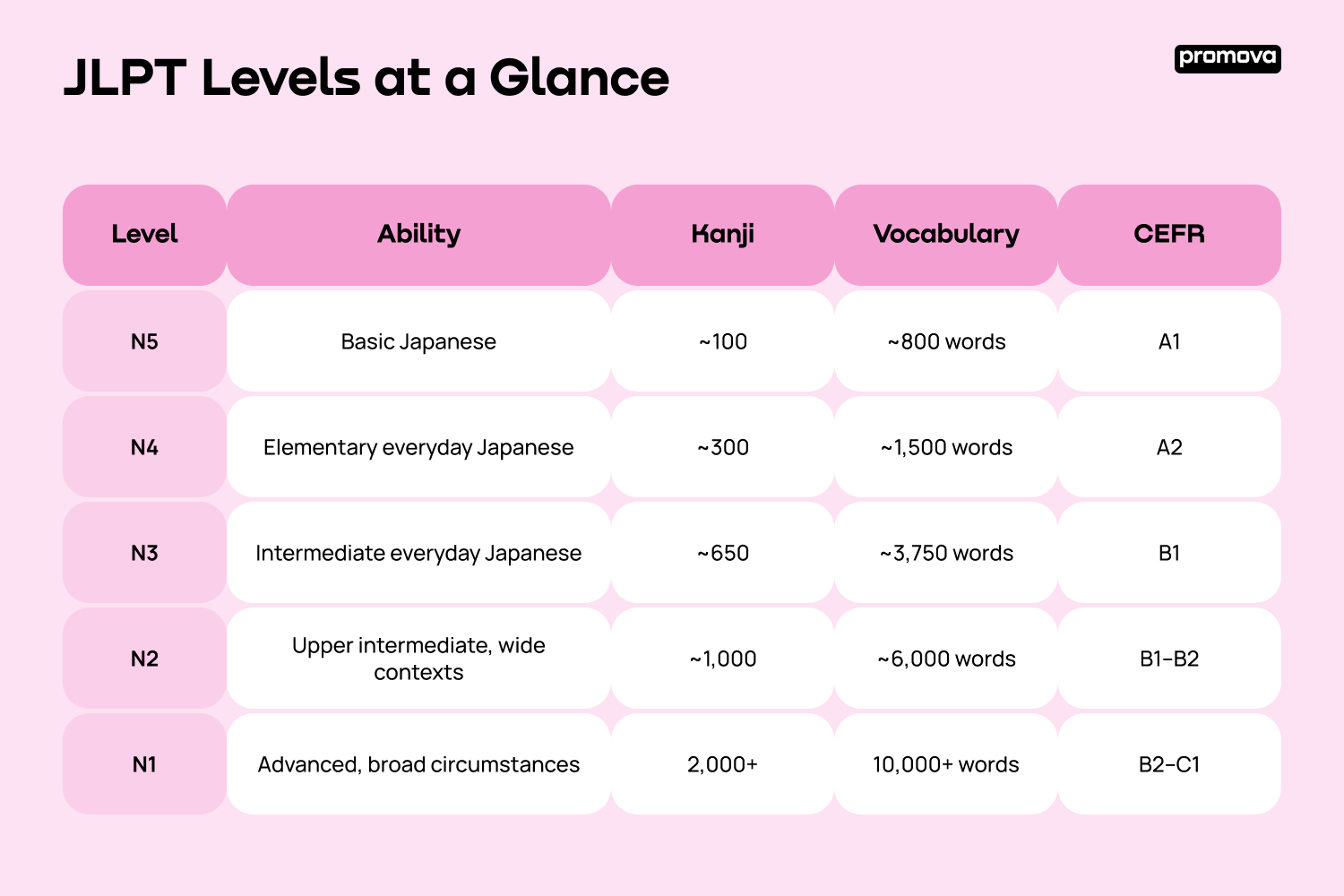
The higher levels, N2 and N1, demand a much deeper understanding of Japanese and greater test-taking stamina, reflecting their increased difficulty and comprehensive content.
Study hour estimates are based on data compiled by Interac Network for learners with prior kanji knowledge. Learners without a kanji background (such as those whose native language doesn’t use Chinese characters) typically need significantly more time.
N5 — Beginner
N5 is the beginning of the JLPT journey and serves as the entry-level certification. It tests the ability to understand basic Japanese — simple sentences, short conversations, and very common expressions. You’ll need to recognize around 100 kanji and about 800 vocabulary words. N5 benchmarks roughly 100 kanji and 800 vocabulary words, and corresponds to A1 (Beginner) on the CEFR scale. If you’ve been studying Japanese for a few months and can read hiragana and katakana, N5 is a realistic first target.
N4 — Elementary
N4 builds on N5 with more vocabulary and slightly more complex grammar. You need around 300 kanji and 1,500 words. N4 tests understanding of basic Japanese used in familiar, everyday contexts — greetings, simple requests, common daily situations. This is the level where grammar patterns start to matter more.
N3 — Intermediate
N3 was added to the JLPT in 2010 specifically to bridge what had been a large gap between N4 and N2. It requires around 650 kanji and 3,750 words, and tests the ability to understand everyday Japanese at a moderate level — including conversation at near-natural speed and everyday written materials like newspaper headlines. N3 is often described as the first level that feels genuinely practical.
N2 — Upper Intermediate
N2 is where the JLPT becomes a meaningful professional credential in many fields. With approximately 1,000 kanji and 6,000 words, it tests the ability to understand Japanese in everyday situations and a wider range of contexts, including understanding intent and nuance in texts, not just surface meaning. N2 benchmarks roughly 1,000 kanji and 6,000 vocabulary words, and corresponds to B2 (Upper-Intermediate) on the CEFR scale. Many jobs in Japan — and many Japanese university programs — list N2 as a minimum requirement for foreign nationals. N2 or N1 certification is typically required for white-collar jobs in Japan, including fields like web development.
N1 — Advanced
N1 is the highest level of the JLPT. It requires 2,000+ kanji and over 10,000 words, and tests the ability to understand Japanese across a broad range of circumstances — formal writing, complex arguments, nuanced conversation, and specialized texts. N1 certification is often required for professional roles in Japan, for medical licensing exams, and for competitive graduate school applications. Achieving N1 is a significant accomplishment by any measure.
1
JLPT test structure and sections
Each JLPT level consists of the same core areas of measurement, but the sections are organized slightly differently depending on whether you’re taking N1/N2 or N3/N4/N5. The JLPT assesses various aspects of Japanese language proficiency, focusing on receptive skills.
For N1 and N2, the test has two sections:
- Language Knowledge section (Vocabulary/Grammar) and Reading section
- Listening
The Language Knowledge section focuses on vocabulary and grammar, while the Reading section assesses reading comprehension through authentic passages and questions. There are no writing sections in the JLPT.
For N3, N4, and N5, the test has three sections:
- Language Knowledge section (Vocabulary)
- Language Knowledge section (Grammar) and Reading section
- Listening
Again, the Reading section tests reading comprehension, and there are no writing sections included.
The total test time varies by level:
| Level | Total duration |
| N5 | 105 minutes |
| N4 | 125 minutes |
| N3 | 140 minutes |
| N2 | 155 minutes |
| N1 | 170 minutes |
Test takers may have a short break between sections, depending on the test center's schedule. All questions are multiple choice. Test takers record their answers on an answer sheet. There are no open-ended answers, no writing sections, and no speaking component. This means the JLPT is purely a test of receptive skills — how well you can understand Japanese, not how well you can produce it.
How JLPT scoring works
The JLPT uses a scaled scoring system rather than raw scores, which means your result is adjusted based on the difficulty of the specific test you sat. Instead of simply counting the number of questions wrong or right, the JLPT applies Item Response Theory to convert your raw score into a scaled score. This ensures a consistent and fair measure of proficiency across different test administrations. Each level is scored out of 180 points in total, distributed across the sections.
To pass, you need to meet two requirements simultaneously:
- Achieve the minimum total scaled score for your level.
- Achieve the minimum section scaled score in every individual section.
If you score brilliantly on reading but fail to meet the minimum in listening, you fail — even if your total score would otherwise be high enough. This dual requirement means you can’t compensate for a weak area by excelling elsewhere. It's important to understand how questions wrong in each section can impact your scaled scores, as even a few mistakes may affect your overall result due to the scoring system.
Passing scores by level:
| Level | Minimum total score | Minimum per section |
| N5 | 80/180 (44%) | 19/60 per section |
| N4 | 90/180 (50%) | 19/60 per section |
| N3 | 95/180 (53%) | 19/60 per section |
| N2 | 90/180 (50%) | 38/120 (combined sections) |
| N1 | 100/180 (56%) | 38/120 (combined sections) |
Source: official JLPT FAQ.
Note: N2 and N1 have a lower minimum total score percentage than N3 — but the content itself is significantly more difficult. The scaled scoring accounts for this.
After the test, you will receive a score report that details your scaled scores for each section and your overall performance. Your test results are typically announced online and sent by mail, providing official documentation of your proficiency.
CEFR levels and JLPT (new from December 2025)
Starting from December 2025, JLPT score reports include a CEFR reference level (A1 through C1) alongside your JLPT result. This makes it much easier to present your Japanese proficiency in international academic or professional contexts where CEFR is the standard framework.
The approximate correspondence is:
| JLPT Level | CEFR Reference |
| N5 | A1 |
| N4 | A2 |
| N3 | B1 (lower scores) |
| N2 | B1–B2 (depending on score) |
| N1 | B2–C1 (depending on score) |
Note: CEFR levels shown are reference indicators, not exact equivalents. The JLPT measures receptive skills only, so a CEFR B2 on the JLPT doesn't mean you can speak or write at B2 level.
Why take the JLPT?
The JLPT certificate never expires. Once you pass a level, that credential is valid for life. That alone makes it worth earning — you don’t have to worry about recertifying every few years.
Beyond permanence, there are several practical reasons to take it:
- Employment in Japan. Many individuals take the JLPT to enhance their job prospects in Japan, as employers often require N2 or N1 certification for positions that require advanced Japanese skills. Most jobs in Japan that are open to non-native speakers require at least N2. Professional and specialized roles often require N1. For medical and nursing licensing exams in Japan, N1 is typically mandatory.
- Immigration and visa benefits. JLPT certification can be used for various official purposes in Japan, such as receiving preferential immigration treatment and being exempt from certain educational requirements. Earning N2 or N1 qualifies you for points under Japan’s “Point-based Preferential Immigration Treatment System for Highly Skilled Foreign Professionals.” Applicants with JLPT certification receive priority treatment in some immigration procedures.
- University and academic programs. A high JLPT score is often a prerequisite for enrolling in Japanese universities or vocational schools, especially for a program taught in Japanese. Many Japanese universities accept JLPT N2 results in place of other Japanese proficiency requirements. Some programs accept N1 as a substitute for the EJU (Examination for Japanese University Admission for International Students). Demonstrating your Japanese skills through the JLPT is essential for admission to these programs.
- Measurable progress. Even if you’re learning Japanese purely out of personal interest, having a structured target makes studying easier. Working toward N5 or N4 gives your early study a clear shape — vocabulary lists, grammar targets, listening practice — that open-ended learning often lacks.
- Recognition. The JLPT is recognized in over 80 countries. It’s not just a Japan-specific credential.
How to register for the JLPT
Registration is handled through official JLPT portals and local partner organizations, and the process varies by country.
In Japan, registration opens several months before each test date, including the July test, and is done online through the official JLPT website. In the United States, registration is managed by the American Association of Teachers of Japanese, with the annual exam held each December.
After registering, examinees receive a test voucher, which must be brought on test day along with a photo ID. The test voucher contains important information, such as login details for retrieving test results, and is required for admission to the exam.
Key points to know before registering:
- You can register for any level — there are no prerequisites and no age restrictions.
- You can skip levels. If you’re confident at N4 level, you can register directly for N3.
- Exam fees vary by country and level, typically ranging from around $50 for N5 to around $100 for N1.
- Registration deadlines are strict and non-negotiable — late applications are not accepted.
Tips for preparing for the JLPT
Knowing what the JLPT tests is one thing. Building the skills to actually pass it is another. Here are practical approaches that work across all levels.
- Know your current level before you register. Take a practice test before committing to a level. The official JLPT sample questions are free and give you an accurate sense of the difficulty. Registering for a level you're nowhere near ready for is a waste of time and money.
- Focus on kanji and vocabulary first. Most learners find that limited vocabulary is the biggest barrier to progress. A strong kanji and vocabulary base makes grammar and reading sections significantly more manageable. Use spaced repetition tools to build retention systematically.
- Listen to Japanese daily. The listening section catches many learners off guard because it moves at natural speed. Build your ear by listening to Japanese podcasts, news, dramas, and conversation content regularly — not just during dedicated study sessions. NHK Web Easy (nhk.or.jp/news/easy) is a free resource with simplified Japanese news articles paired with audio.
- Practice with real past papers. The Japan Foundation publishes official practice workbooks for every level. These are the most accurate representation of actual test content and are worth working through systematically.
- Don't neglect the sections you're strong in. Because the JLPT requires minimum scores in every section, a section where you feel comfortable still needs active practice. Letting a strength slide while focusing on weaknesses can create a new failing point.
- Build consistency, not intensity. Fifteen to twenty minutes of focused study every day beats a three-hour session on weekends. Vocabulary retention and listening comprehension both improve through daily exposure, not occasional deep dives. If you're building toward learning Japanese from scratch, consistent daily practice is the single most important habit to establish.
Learn Japanese with Promova
Preparing for the JLPT means building real language skills — not just memorizing test strategies. Reading, listening, vocabulary, and grammar all need to develop together, and that takes regular, structured practice.
Promova is a language learning platform designed for busy adults who want to make real progress without rearranging their lives around a study schedule. Structured Japanese courses cover vocabulary and grammar progressively, bite-sized lessons fit into the gaps in your day, and the AI Tutor lets you practice comprehension and conversation in a judgment-free environment — any time you have a few minutes.
Whether you're building toward N5 as your first milestone or working toward N2 for a job in Japan, Promova helps you stay consistent, track your progress, and develop the kind of deep vocabulary and grammar knowledge the JLPT actually tests.
Conclusion
The JLPT is the clearest, most widely recognized way to measure and prove your Japanese proficiency to the world. Its five levels — N5 through N1 — cover the full spectrum from beginner to near-native, and its certificates are permanent, never expiring credentials.
It doesn't test speaking or writing, which means it's not a complete picture of Japanese fluency. But as a measure of what you can understand — reading, listening, vocabulary, and grammar — it's thorough, rigorous, and globally respected.
The most important thing is to pick the right level for where you actually are, prepare consistently, and show up ready on the day. Every level you pass is real evidence of real progress in one of the world's most fascinating languages.
FAQ
What does JLPT stand for?
JLPT stands for Japanese Language Proficiency Test (日本語能力試験, Nihongo Nōryoku Shiken). It is a standardized test that evaluates Japanese proficiency for non-native speakers across five levels — N5 (beginner) to N1 (advanced). It is administered by the Japan Foundation and Japan Educational Exchanges and Services.
How many levels does the JLPT have?
The JLPT has five levels: N5, N4, N3, N2, and N1. N5 is the most basic and N1 is the most advanced. Each level independently certifies a specific range of language ability. You can register for any level without taking lower levels first — there are no prerequisites.
How do I register for the JLPT?
Registration is done through the official JLPT website or local partner organizations such as the American Association of Teachers of Japanese in the US. You select your level, pay the exam fee (typically $50–$100 depending on level and country), and submit your application before the deadline. Registration windows open several months before each test date.
How long do JLPT certificates last?
JLPT certificates never expire. Once you pass a level, that certification is valid for life. You don't need to retake a level to maintain its validity. This makes it a durable credential for long-term academic and professional use.



 English


Comments