Days of Week in Japanese: Names, Meanings, and How to Use Them

Contents
Key takeaways:
- Japanese days of the week are all two-syllable words ending in youbi (曜日), which means "day of the week."
- Each day is named after a natural element: the Sun, Moon, Fire, Water, Wood, Metal, and Earth.
- Once you learn the seven element words, you know all seven days.
- Japanese uses a Monday-first week, different from the US Sunday-first standard.
What Are the Days of the Week in Japanese?
In Japanese, the days of the week follow a simple, logical pattern. Each day combines one kanji (Chinese character) representing a natural element with the word youbi (曜日), meaning “day of the week.”
| Day | Japanese | Romaji | Element | Literal Meaning |
| Sunday | 日曜日 | Nichiyoubi | Sun (日) | Sun day |
| Monday | 月曜日 | Getsuyoubi | Moon (月) | Moon day |
| Tuesday | 火曜日 | Kayoubi | Fire (火) | Fire day |
| Wednesday | 水曜日 | Suiyoubi | Water (水) | Water day |
| Thursday | 木曜日 | Mokuyoubi | Wood (木) | Wood day |
| Friday | 金曜日 | Kin’youbi | Metal/Gold (金) | Metal day |
| Saturday | 土曜日 | Doyoubi | Earth (土) | Earth day |
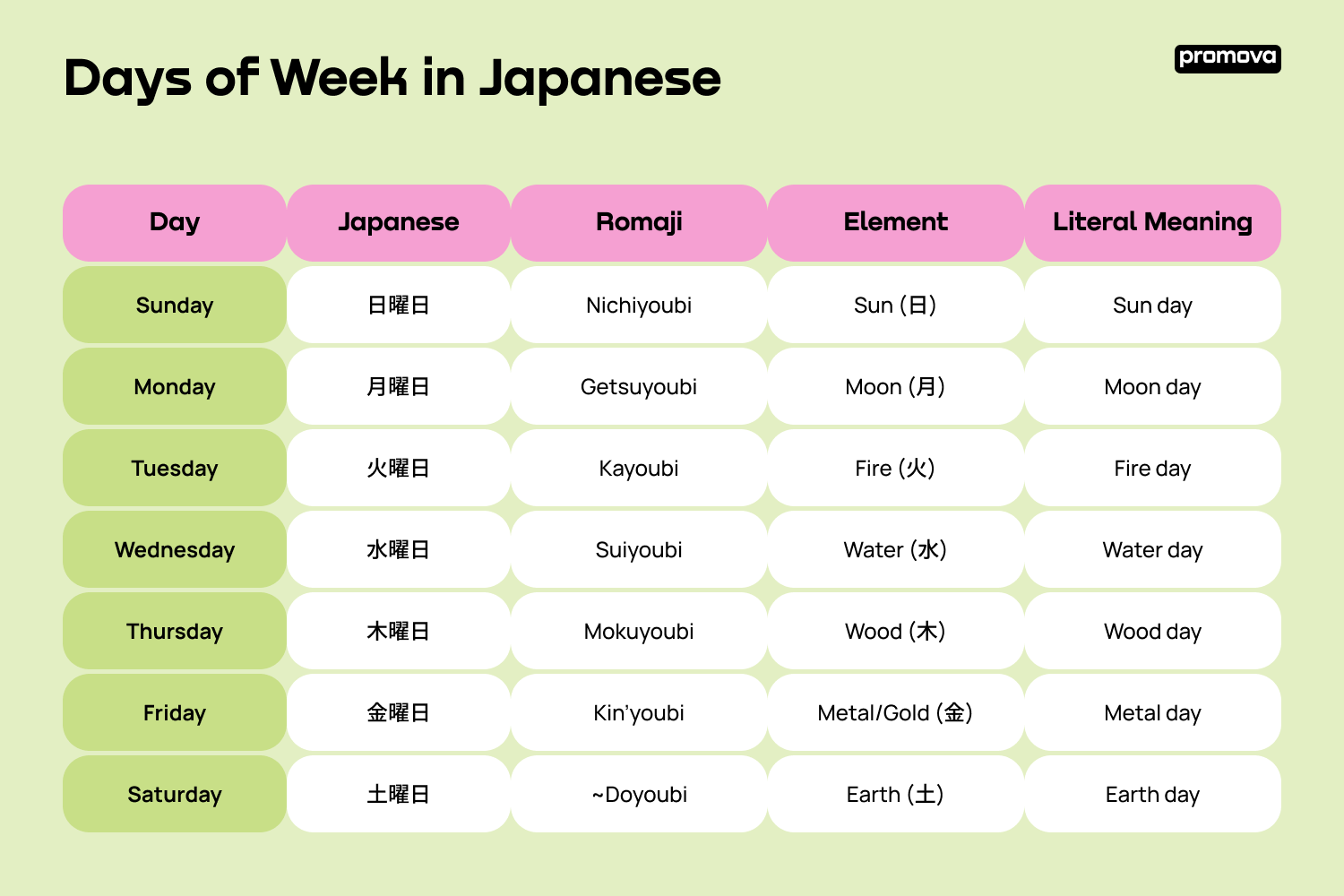
This system comes from ancient Chinese astronomy and mythology, especially the seven luminaries—the sun, moon, and the five planets—and the Japanese word yō in youbi (曜日), tied to a Mandarin Chinese sense of a shining body, reflects ideas that also spread to other countries. The kanji for each day link those celestial bodies with nature and the elements in Japanese cosmology and philosophy.
How to Pronounce the Days of the Week in Japanese
Japanese pronunciation is consistent, which makes it easier to pronounce Japanese words in weekday examples — each letter makes one sound, and that sound never changes. Here’s a quick guide:
- Nichiyoubi — nee-chee-yoh-bee
- Getsuyoubi — get-soo-yoh-bee
- Kayoubi — kah-yoh-bee
- Suiyoubi — swee-yoh-bee
- Mokuyoubi — moh-koo-yoh-bee
- Kin’youbi — keen-yoh-bee
- Doyoubi — doh-yoh-bee
The youbi part (yoh-bee) is the same in every word. Notice the long o-sound in yōbi. Once you hear it a few times, it becomes automatic. Hearing them from native speakers in Japanese lessons can also make the rhythm easier to copy.
1
A Shortcut: Learn the Elements, Not Just the Names
The smartest way to learn the days isn’t to memorize seven separate words. It’s to learn the seven element kanji.
- 日 (nichi/ni) — Sun
- 月 (getsu/tsuki) — Moon
- 火 (ka/hi) — Fire
- 水 (sui/mizu) — Water
- 木 (moku/ki) — Wood
- 金 (kin/kane) — Metal / Gold
- 土 (do/tsuchi) — Earth
Each kanji character works as a helpful memory hook tied to its element, and that’s the main point of the shortcut.
These characters appear everywhere in Japanese — in weather forecasts, calendars, text messages, and street signs, often as japanese characters inside dates and day names. Learning them gives you a head start on hundreds of other words too, so this knowledge pays off fast; 木 is the one linked to wood, which can also make you think of a tree, and 金 means “gold” or “metal.” For example, hi (火) also means “fire” in everyday speech, and mizu (水) means “water.” When learning new words, imagine Tuesday as fire and Wednesday as water to make them stick.
How Japanese Weeks Are Structured
In Japan, the week officially starts on Sunday, matching international standards set by ISO 8601. However, in everyday life — school schedules, the typical work week shown in calendars and planners, and printed planners — Monday is often treated as the first day of the week.
This is worth knowing when you’re reading a Japanese calendar. Don’t be surprised if Monday appears on the left side of the grid.
For example, this week may be shown in the current row, while next week appears in the row that follows.
How to Use Days of the Week in Conversation
Japanese sentence structure puts time expressions near the beginning of a sentence, which is especially helpful for speaking and talking about plans. Here are some simple, practical phrases:
- Getsuyoubi ni aimashō — Let’s meet on Monday.
- Kayoubi wa hima desu ka? — Are you free on Tuesday?
- Kin’youbi ni kaigi ga arimasu — There’s a meeting on Friday.
- Doyoubi to Nichiyoubi wa yasumi desu — Saturday and Sunday are days off.
The particle に marks a specific day, similar to “on” in English, and it also appears with a specific date when you say when something happens. For example, if your date is Monday the 10th, you can place that time expression early in the sentence when making plans in Japanese.
Abbreviations for the Days
In casual writing and conversations — like text messages, quick speech, or app interfaces — Japanese speakers often shorten the days to just the element kanji:
- 日 — Sunday
- 月 — Monday
- 火 — Tuesday
- 水 — Wednesday
- 木 — Thursday
- 金 — Friday
- 土 — Saturday
In text messages or quick speech, people often drop ~yōbi and just say the first kanji, as in casual plans for friday night.
You’ll see these abbreviations on phone calendars, train schedules, and TV guides. Recognizing them makes navigating daily Japanese life much easier.
Tips for Remembering Japanese Days
Here are a few tricks that actually work:
Connect to English. Saturday in English traces back to Saturn, a planet. In Japanese, Doyoubi (Earth day) covers the same idea — planets connected to days. The logic runs deep in both languages.
Pair them with images. Picture Monday as a glowing moon. See Tuesday as a burning flame, and imagine each one more vividly. These visual links stick faster than repetition alone, which is especially helpful when learning japanese.
Say them out loud. Japanese pronunciation is phonetic — what you see is what you say. Practicing aloud, even for five minutes a day, builds muscle memory quickly.
Use them in context. Don’t just repeat lists. Write your weekly schedule in Japanese. Label your calendar. For example, you might write that Saturday is for fun with friends. The more you use the words in real situations, the faster they become automatic.
Learn Japanese: Practice Days of the Week with Promova
Memorizing vocabulary is one part of the puzzle. The other part is using it in real conversations — and that’s where most learners get stuck.
Promova’s structured Japanese course helps you learn practical vocabulary step by step, at a pace that fits your day, with bite-sized lessons, videos, and built-in practice. Every lesson is built around how Japanese is actually used, not just how it looks on paper, so you can also schedule practice with an online tutor when you want more speaking time.
Summary
The seven days of the week in Japanese are all built on the same formula: element kanji + youbi. Once you learn the seven elements — Sun, Moon, Fire, Water, Wood, Metal, Earth — the names become easy to recognize, spell, and remember. These aren't just vocabulary words. They're a window into Japanese culture, history, and the way the language is structured.
Start with the elements. Practice the full names out loud. Then use them in a sentence or two every day. Progress builds faster than you'd expect.
FAQ
What are the days of the week in Japanese in order?
The days start with Sunday: Nichiyoubi (Sunday), Getsuyoubi (Monday), Kayoubi (Tuesday), Suiyoubi (Wednesday), Mokuyoubi (Thursday), Kin'youbi (Friday), Doyoubi (Saturday). Each name ends in youbi, which means "day of the week."
What does "youbi" mean in Japanese?
Youbi (曜日) means "day of the week." It appears at the end of every day name in Japanese. You can think of it like the word "day" in English phrases like "Monday" or "Friday."
Why are Japanese days named after elements?
Japanese days of the week are based on the Five Elements theory from Chinese philosophy — Fire, Water, Wood, Metal, and Earth — plus the Sun and Moon. This system was adopted from China over a thousand years ago and is still used today in Japan, Korea, and parts of Southeast Asia.
How do you write the days of the week in Japanese kanji?
Each day uses two kanji: the element character + 曜日 (youbi). For example, Wednesday is 水曜日 — 水 (water) + 曜日 (day of the week). In casual writing, just the element kanji is used as an abbreviation.



 English


Comments