Alphabet Japanese: Hiragana, Katakana, and Kanji Explained
Contents
Key Takeaways
- Japanese doesn't have one alphabet — it has three writing systems used together: hiragana, katakana, and kanji.
- Hiragana (46 characters) is the foundation of Japanese reading and the best place for every beginner to start.
- Katakana (46 characters) represents the same sounds as hiragana but is used for foreign loanwords, names, and emphasis.
- Kanji are logographic characters with meaning, not sound. There are 2,136 in common use, learned gradually over years.
- You don't need kanji to start reading real Japanese — hiragana and katakana alone open up a huge amount of everyday text.
- Consistent daily practice of 10 to 15 minutes is more effective than occasional long study sessions.
Learning a new language can feel overwhelming, but understanding the writing system is the first step to reading, writing, and eventually speaking with confidence. Japanese looks unlike any European language, and that first glance at its characters can be intimidating. But once you understand how the system works, it becomes much more approachable than it seems.
This guide covers the three Japanese writing systems — hiragana (ひらがな), katakana (カタカナ), and kanji (漢字) — including character tables, pronunciation rules, digraphs, and practical examples to help you get started.
The Three Japanese Writing Systems
Unlike most languages, Japanese uses three distinct writing systems simultaneously. Every sentence you read in Japanese will likely contain all three. Each system has a specific role, and together they make the language work efficiently — especially since Japanese is written without spaces between words.
| Writing System | Characters | Primary Use |
| Hiragana (ひらがな) | 46 | Grammar, native Japanese words, verb endings |
| Katakana (カタカナ) | 46 | Foreign loanwords, foreign names, emphasis |
| Kanji (漢字) | 2,136 (common use) | Nouns, verbs, adjectives — carries meaning |
| Romaji (ローマ字) | Latin letters | Learner materials, tourist signage |
The two phonetic scripts — hiragana and katakana — are collectively called kana (仮名). Each kana character represents a syllable, not a single sound. So unlike the English letter "k," the hiragana character き represents the full syllable “ki.”
Hiragana (ひらがな)
Hiragana is the foundation of Japanese writing. Every Japanese child learns it first, and so should you. It consists of 46 basic characters, each representing one syllable. Hiragana is used for grammatical elements — particles, verb endings, and native Japanese words that either have no kanji or use kanji considered too complex for everyday text. Hiragana is typically used for words of Japanese origin.
Hiragana characters are more rounded and fluid compared to katakana, giving them a distinct, flowing appearance. They developed in the 9th century from simplified Chinese characters.
When learning hiragana, it is important to master the correct stroke order for each Japanese letter, as this ensures proper character formation and readability.
The Hiragana Chart
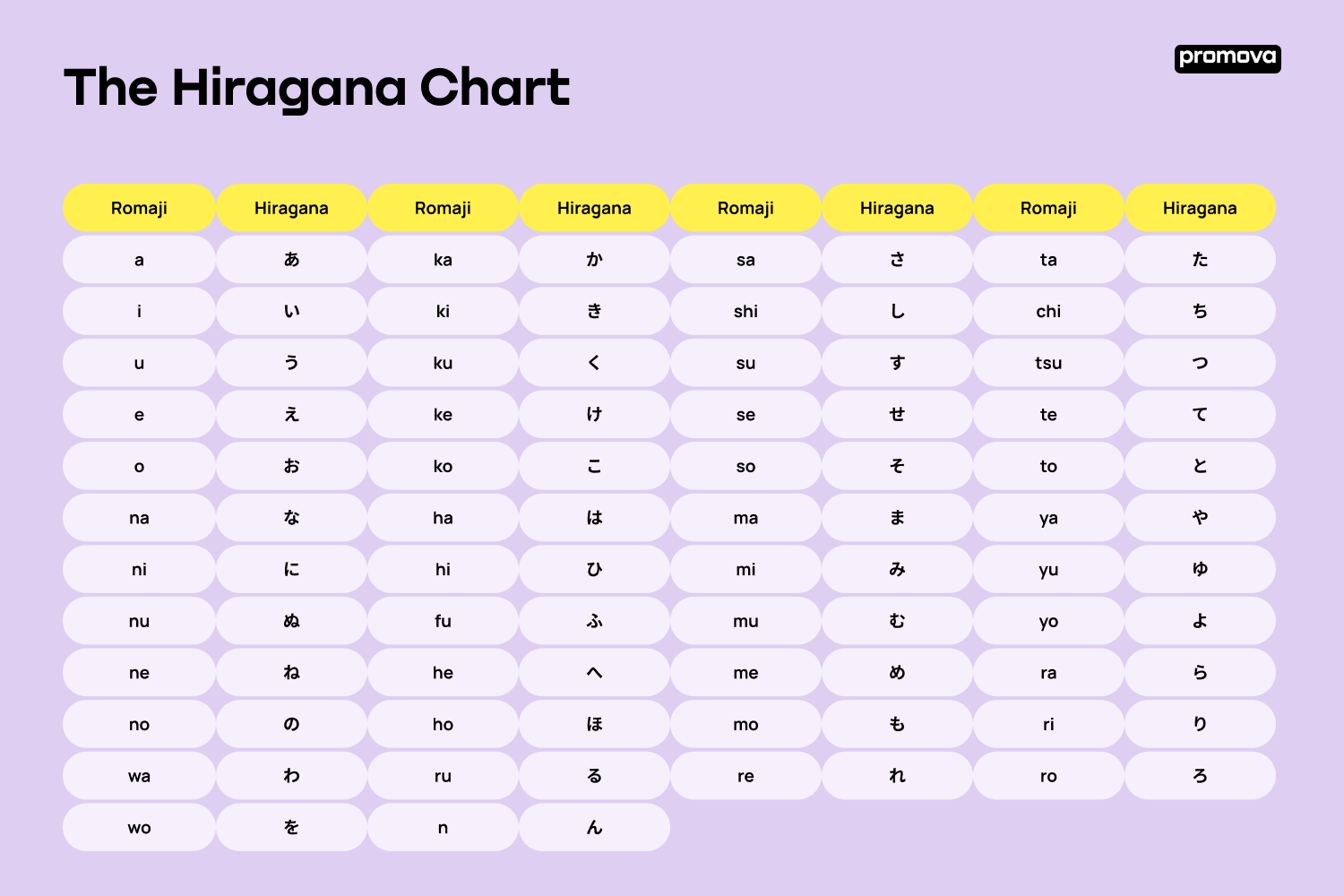
Before diving into the chart, it's important to know that Japanese syllables are organized in a standard order, including sequences like 'sa, shi, su, se, so' and 'ni, nu, ne, no'. Mastering all the kana—both hiragana and katakana—is essential for reading and writing in Japanese, as these characters are used consistently across different contexts. Each hiragana character corresponds to the exact same sounds as its katakana counterpart, ensuring a one-to-one sound correspondence throughout the language.
| Romaji | Hiragana | Romaji | Hiragana | Romaji | Hiragana | Romaji | Hiragana |
| a | あ | ka | か | sa | さ | ta | た |
| i | い | ki | き | shi | し | chi | ち |
| u | う | ku | く | su | す | tsu | つ |
| e | え | ke | け | se | せ | te | て |
| o | お | ko | こ | so | そ | to | と |
| na | な | ha | は | ma | ま | ya | や |
| ni | に | hi | ひ | mi | み | yu | ゆ |
| nu | ぬ | fu | ふ | mu | む | yo | よ |
| ne | ね | he | へ | me | め | ra | ら |
| no | の | ho | ほ | mo | も | ri | り |
| wa | わ | ru | る | re | れ | ro | ろ |
| wo | を | n | ん | — | — | — | — |
Hiragana Vowels and Pronunciation
Hiragana pronunciation is highly consistent — each character always makes the same sound. Mastering Japanese pronunciation, especially the five hiragana vowels, is essential for both reading and spoken Japanese, as it forms the foundation for clear communication. The five vowels are the core of the entire system:
- あ (a) — like the ‘a’ in “father.” Example: あめ (ame) — rain.
- い (i) — like the ‘ee’ in “see.” Example: いぬ (inu) — dog.
- う (u) — a short, unrounded sound, similar to “oo” but without rounding the lips. Example: うみ (umi) — sea.
- え (e) — like the ‘e’ in “bed.” Example: えき (eki) — train station.
- お (o) — like the ‘o’ in “go.” Example: おかね (okane) — money.
Irregular Romanizations in Hiragana
A few hiragana characters have romanizations that don't follow the standard pattern. These are important to know early:
- し is written as "shi" (not "si"). Example: しろ (shiro) — white.
- ち is written as "chi" (not "ti"). Example: ちず (chizu) — map.
- つ is written as "tsu" (not "tu"). Example: つき (tsuki) — moon.
- ふ is written as "fu" (not "hu"). Example: ふゆ (fuyu) — winter.
These irregularities reflect the actual sounds of Japanese, which don't map neatly onto English phonetics. Once you hear them, they feel natural quickly.
1
Katakana (カタカナ)
Katakana represents the exact same 46 syllables as hiragana but looks completely different — katakana characters are angular and geometric, making them visually distinct from the curved shapes of hiragana, even though they represent the same sounds. It was developed around the same time as hiragana by Buddhist monks annotating Chinese texts. The name “katakana” literally means “fragmentary kana,” reflecting that each character was borrowed from just a fragment of a kanji.
Katakana is primarily used for foreign words, names, onomatopoeia, and emphasis, but it is also commonly used for scientific terms and technical vocabulary. This makes katakana essential for reading foreign words and specialized language in Japanese. Learning katakana is especially helpful for English speakers, as it enables them to read and understand foreign loanwords and names that appear frequently in Japanese writing.
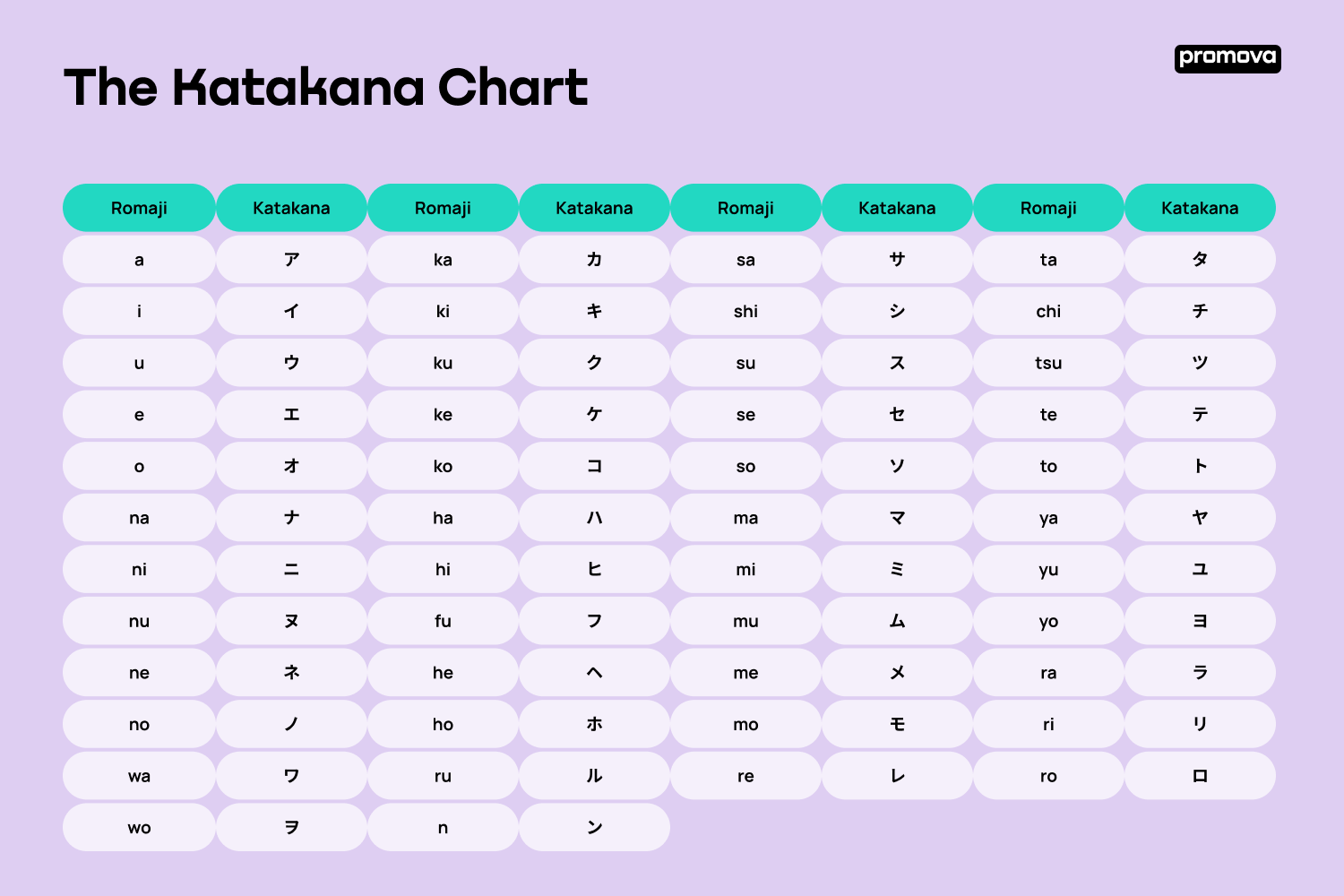
The Katakana Chart
| Romaji | Katakana | Romaji | Katakana | Romaji | Katakana | Romaji | Katakana |
| a | ア | ka | カ | sa | サ | ta | タ |
| i | イ | ki | キ | shi | シ | chi | チ |
| u | ウ | ku | ク | su | ス | tsu | ツ |
| e | エ | ke | ケ | se | セ | te | テ |
| o | オ | ko | コ | so | ソ | to | ト |
| na | ナ | ha | ハ | ma | マ | ya | ヤ |
| ni | ニ | hi | ヒ | mi | ミ | yu | ユ |
| nu | ヌ | fu | フ | mu | ム | yo | ヨ |
| ne | ネ | he | ヘ | me | メ | ra | ラ |
| no | ノ | ho | ホ | mo | モ | ri | リ |
| wa | ワ | ru | ル | re | レ | ro | ロ |
| wo | ヲ | n | ン | — | — | — | — |
What Katakana Is Used For
Katakana’s main job is writing foreign loanwords — words Japanese has borrowed from other languages. Katakana is also used for scientific terms and technical vocabulary, making it essential for reading specialized and technical content. Because so many modern words come from English, katakana gives learners an immediate reading advantage:
- コーヒー (kōhī) — coffee
- コンピューター (konpyūtā) — computer
- テレビ (terebi) — television
- アイスクリーム (aisu kurīmu) — ice cream
- レストラン (resutoran) — restaurant
Katakana is also used for foreign names: アメリカ (Amerika) — America; マリア (Maria) — Maria. In addition, scientific and technical terms, as well as onomatopoeic words, are often written in katakana. If you’re visiting Japan, learning katakana pays off immediately. Menus and shop signs are full of familiar words you’ll recognize the moment you can read them. Mastering all the kana, including both hiragana and katakana, is essential for reading and writing in Japanese.
Kanji (漢字)
Kanji characters are logographic symbols borrowed from Chinese—each one represents a whole word or concept, not just a syllable. Unlike English letters, which represent individual sounds, kanji characters are visually distinct and convey meaning through their form. Japanese people adopted kanji around the 5th century and have adapted them over centuries. Today, there are roughly 50,000 kanji in existence, but the government’s official jōyō kanji (常用漢字) list contains 2,136 characters used in everyday life.
Only a limited number of kanji are commonly known by native speakers, and Japanese people gradually learn these characters throughout their education. Japanese students learn kanji progressively throughout school: around 1,006 by the end of elementary school and all 2,136 by the end of high school. Kanji are prevalent in Japanese newspapers, such as the Asahi Japanese newspaper, and are essential for reading print media.
Basic Kanji Examples
| Kanji | Reading | Meaning | Example |
| 日 | nichi / hi | sun, day | 日本 (Nihon) — Japan |
| 月 | tsuki / gatsu | moon, month | 一月 (ichigatsu) — January |
| 人 | hito / jin | person | 日本人 (Nihonjin) — Japanese person |
| 水 | mizu | water | 水曜日 (suiyōbi) — Wednesday |
| 山 | yama | mountain | 富士山 (Fujisan) — Mt. Fuji |
| 火 | hi / ka | fire | 火曜日 (kayōbi) — Tuesday |
| 木 | ki / moku | tree, wood | 木曜日 (mokuyōbi) — Thursday |
| 大 | oo / dai | big | 大学 (daigaku) — university |
| 小 | ko / shō | small | 小学校 (shōgakkō) — elementary school |
| 本 | hon / moto | book, origin | 日本 (Nihon) — Japan ("sun origin") |
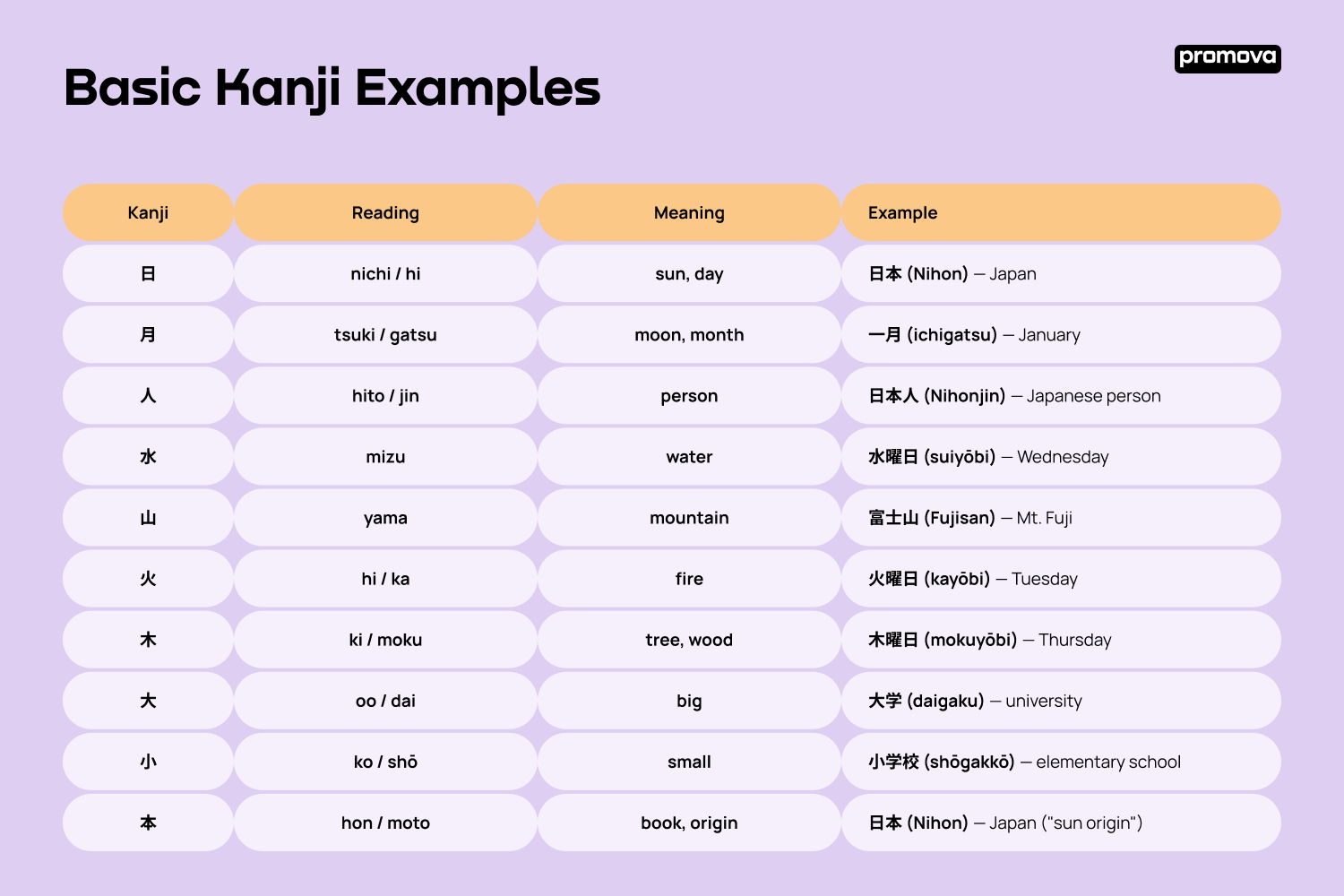
Notice that 日本 (Nihon) — Japan — literally means "sun origin." Kanji often carry poetic logic, and recognizing those connections makes learning them significantly easier.
One Kanji, Multiple Readings
One of the most challenging aspects of kanji is that a single character can have multiple readings depending on context. The character 生, for example, can be read as "sei," "shō," "nama," "i," "u," "ha," or "ki" — all depending on the surrounding word. The core meaning relates to life or birth, but pronunciation shifts with context.
This is why most teachers recommend learning kanji in context — attached to vocabulary words — rather than memorizing characters in isolation. According to Tofugu's guide to learning Japanese, learning kanji through vocabulary is consistently more effective and less frustrating than studying characters as standalone symbols.
How the Three Systems Work Together
One of the most common questions beginners ask is: why does Japanese need three writing systems at once?
Japanese sentences are constructed using a mix of hiragana and katakana characters, kanji, and sometimes a phonetic guide called furigana to aid pronunciation. Writing Japanese involves mastering all three Japanese scripts—hiragana, katakana, and kanji—as Japanese characters are used together to form complete sentences.
The answer is that each system does a different job — and together they actually make reading faster. Here is a real example:
私はコーヒーを飲みます。(Watashi wa kōhī o nomimasu.) “I drink coffee.”
- 私 → kanji (meaning: self, I)
- は, を, ます → hiragana (grammatical particles and verb ending)
- コーヒー → katakana (foreign loanword: coffee)
- 飲み → kanji + hiragana (verb stem + conjugation ending)
The visual variety between the three scripts helps readers parse meaning quickly — in a similar way that capitalization, punctuation, and spacing help English readers identify word boundaries and sentence structure.
Pronunciation Rules: What You Need to Know
Long Vowels
Japanese has both short and long vowels, and the difference in length changes meaning. Long vowels are held for approximately twice the duration of short vowels.
In hiragana, long vowels are written by adding a second vowel character:
- おかあさん (okaasan) — mother [long "a"]
- おにいさん (oniisan) — older brother [long "i"]
In katakana, a dash called the chōonpu (ー) marks a long vowel:
- コーヒー (kōhī) — coffee
- ケーキ (kēki) — cake
Getting long vowels right matters. Compare:
- おばさん (obasan) — aunt
- おばあさん (obaasan) — grandmother
Same characters, different length, completely different people.
Double Consonants: The Small っ / ッ
When you see a small っ (tsu) in hiragana or a small ッ in katakana, it signals a doubled consonant. You create this sound by briefly stopping before the consonant that follows — a tiny but audible pause.
- きって (kitte) — postage stamp
- ざっし (zasshi) — magazine
- ベッド (beddo) — bed
The pause is real and meaningful. Without it, words can sound incorrect or even change meaning.
The Particle は — Pronounced "wa"
One of the first surprises for new learners: the hiragana character は is normally read "ha," but when used as a grammatical topic marker, it's pronounced "wa."
- 私は学生です (watashi wa gakusei desu) — I am a student.
- こんにちは (konnichiwa) — hello [contains は as a particle, pronounced "wa"]
This is a historical quirk preserved in modern Japanese spelling. Once you know the rule, it becomes second nature.
The Particle へ — Pronounced "e"
Similarly, the character へ is normally read "he," but when used as a directional particle meaning "to" or "toward," it's pronounced "e."
- 東京へ (Tōkyō e) — to Tokyo
Digraphs: Combined Kana Characters
Japanese uses combinations of a regular kana character paired with a smaller version of や (ya), ゆ (yu), or よ (yo) to represent sounds that don't exist as single characters. These combinations are written as one syllable, not two.
| Romaji | Hiragana | Katakana | Meaning |
| kya | きゃ | キャ | きゃく (kyaku) — guest |
| sha | しゃ | シャ | しゃしん (shashin) — photo |
| shu | しゅ | シュ | しゅくだい (shukudai) — homework |
| sho | しょ | ショ | しょうがっこう (shōgakkō) — elementary school |
| cha | ちゃ | チャ | おちゃ (ocha) — green tea |
| chi | ちゅ | チュ | ちゅうもん (chuumon) — order (at a restaurant) |
| cho | ちょ | チョ | ちょっと (chotto) — a little bit |
| nya | にゃ | ニャ | にゃあ (nyaa) — meow |
| hya | ひゃ | ヒャ | ひゃく (hyaku) — one hundred |
| ryo | りょ | リョ | りょこう (ryokō) — travel |
The small character is written noticeably smaller than a regular kana — that's how you know to read it as one combined syllable, not two separate ones.
Diacritical Marks: Dakuten and Handakuten
Japanese kana use two diacritical marks that modify the sound of a character.
Dakuten (゛) — The Voiced Mark
The dakuten looks like two small strokes in the upper right corner of a character. It turns an unvoiced consonant into a voiced one — adding vibration to the sound.
| Base Kana | With Dakuten | Sound Change | Example |
| か (ka) | が (ga) | k → g | がっこう (gakkō) — school |
| さ (sa) | ざ (za) | s → z | ざっし (zasshi) — magazine |
| た (ta) | だ (da) | t → d | だいがく (daigaku) — university |
| は (ha) | ば (ba) | h → b | ばんごはん (bangohan) — dinner |
Handakuten (゜) — The Semi-Voiced Mark
The handakuten is a small circle in the upper right corner. It only applies to the は (ha) row and changes "h" sounds to "p" sounds.
| Base Kana | With Handakuten | Result | Example |
| は (ha) | ぱ (pa) | h → p | パン (pan) — bread |
| ひ (hi) | ぴ (pi) | h → p | ぴあの (piano) — piano |
| ふ (fu) | ぷ (pu) | h → p | プール (pūru) — swimming pool |
| へ (he) | ぺ (pe) | h → p | ペン (pen) — pen |
| ほ (ho) | ぽ (po) | h → p | ポスト (posuto) — mailbox |
Learn Japanese with Promova
Understanding the Japanese writing system is your starting point — but reading and speaking are two different skills, and you’ll need regular practice in both. For beginners, children's books are a simple and effective way to practice reading hiragana and katakana, as they focus on basic vocabulary and avoid complex kanji.
Promova is a language learning platform built for busy adults. It combines structured lessons, bite-sized practice sessions, and AI-powered speaking tools in one place — so you can build real Japanese skills without rearranging your life around a study schedule. According to Promova’s guide to learning Japanese, starting with hiragana and katakana before anything else sets you up for significantly faster progress overall. Additionally, the Latin alphabet (Latin script) is used in rōmaji, which helps beginners learn Japanese pronunciation and reading before mastering the native scripts.
With Promova, you get:
- Step-by-step lessons through all three writing systems, with visual mnemonics that make characters stick from the first session.
- Kanji in context, connected to vocabulary you’ll actually use — not isolated symbols to memorize.
- AI Tutor for speaking practice, available any time of day, with instant feedback and no fear of judgment.
- Structured courses from beginner to advanced, so you always know what to study next.
Start learning Japanese today at promova.com. Those beautiful, unfamiliar characters are closer than they look.
Conclusion
Now that you know how the Japanese writing systems work, you have everything you need to take the first step. Start with hiragana. Learn all 46 characters, one small group at a time. Then move to katakana — it goes faster because the sounds are already familiar. Let kanji come in gradually, through vocabulary and real reading practice.
With consistent daily practice, those characters that once looked impossible become words you can actually recognize. And that first sentence you read in Japanese without any help? That's worth every minute of effort it takes to get there.
FAQ
What is the Japanese alphabet called?
Japanese doesn’t use a single alphabet. It uses three writing systems: the script called hiragana, katakana (both phonetic), and kanji (logographic). Hiragana is a fundamental component of the Japanese writing system, used for native words, grammatical particles, and as a phonetic guide for kanji. The two phonetic scripts are collectively called kana (仮名). Together, these three systems form modern written Japanese. Romaji (Latin letters) also exists but is mainly used in learning resources and tourist materials.
How many characters are in the Japanese writing system?
Hiragana has 46 basic characters. Katakana has 46 characters representing the same sounds. The official jōyō kanji list contains 2,136 commonly used characters. Unlike the English alphabet, which consists of 26 individual letters representing sounds, Japanese scripts like hiragana and katakana represent syllables, and kanji represent meanings or whole words. A fluent Japanese reader recognizes all of these, along with additional kanji used in names and specialized fields.
Should I learn hiragana or katakana first?
Start with hiragana. It’s the foundation of Japanese reading and writing, and virtually every learning resource requires it. Once you’re comfortable with hiragana (usually one to two weeks), katakana goes faster because you already know all the sounds — you’re just learning new shapes for them.
Can I learn the Japanese alphabet on my own?
Yes. With consistent daily practice and good resources, self-learners make real progress with hiragana and katakana in just a few weeks. Apps like Promova offer structured lessons through all three writing systems, making it easy to start and stay on track. For further reading, Tofugu’s ultimate hiragana guide is one of the most trusted free resources available.
Make your next step to fluency with Promova
More helpful articles:
Arabic AlphabetComplete Korean Alphabet (조선글) A to Z for BeginnersChinese Alphabet Explained: Chinese Letters, Characters & Symbols (A Beginner’s Guide) English AlphabetFrench AlphabetGerman AlphabetItalian AlphabetSpanish Alphabet Explained: Letters, Pronunciation Rules, and Key Differences from EnglishUkrainian Alphabet English


Comments