How to Say "I Love You" in Japanese: Words, Phrases & Cultural Tips

Contents
Key takeaways
- The direct translation of "I love you" in Japanese is 愛してる (Aishiteru) — but it's rarely used in everyday conversation because it carries very strong emotional weight.
- Most Japanese people say 好きだよ (Suki da yo) or 大好きだよ (Daisuki da yo) to express romantic feelings in daily life.
- Japanese culture tends to show love through actions, not words — so understanding context is just as important as knowing the phrases.
- There are multiple ways to say "I love you" in Japanese depending on your relationship, the situation, and how formal you want to sound.
- Practicing these phrases out loud — especially with feedback — helps you sound natural, not like you read them off a flashcard.
So, you want to say "I love you" in Japanese. Maybe you're learning the language, planning a trip to Japan, or just curious about how love sounds in one of the world's most nuanced languages.
Here's something that surprises a lot of learners: Japanese actually has multiple ways to express love, and none of them works exactly like the English version. The culture, the context, and the relationship all shape which phrase you use — and how often.
This guide covers all the key expressions, from the deep and serious to the warm and casual, so you can pick the right one for the right moment.
How do you say "I love you" in Japanese?
The most direct translation of "I love you" in Japanese is 愛してる (Aishiteru). It comes from the verb 愛する (aisuru), which means "to love." It's honest, deep, and serious.
But here's the thing — Japanese people don't usually say it every day. In fact, saying Aishiteru too casually can sound dramatic or even a little strange to native speakers. It's the kind of phrase you might save for a milestone moment in a long-term relationship.
So what do most people say instead? More on that below.
The most common ways to say "I love you" in Japanese
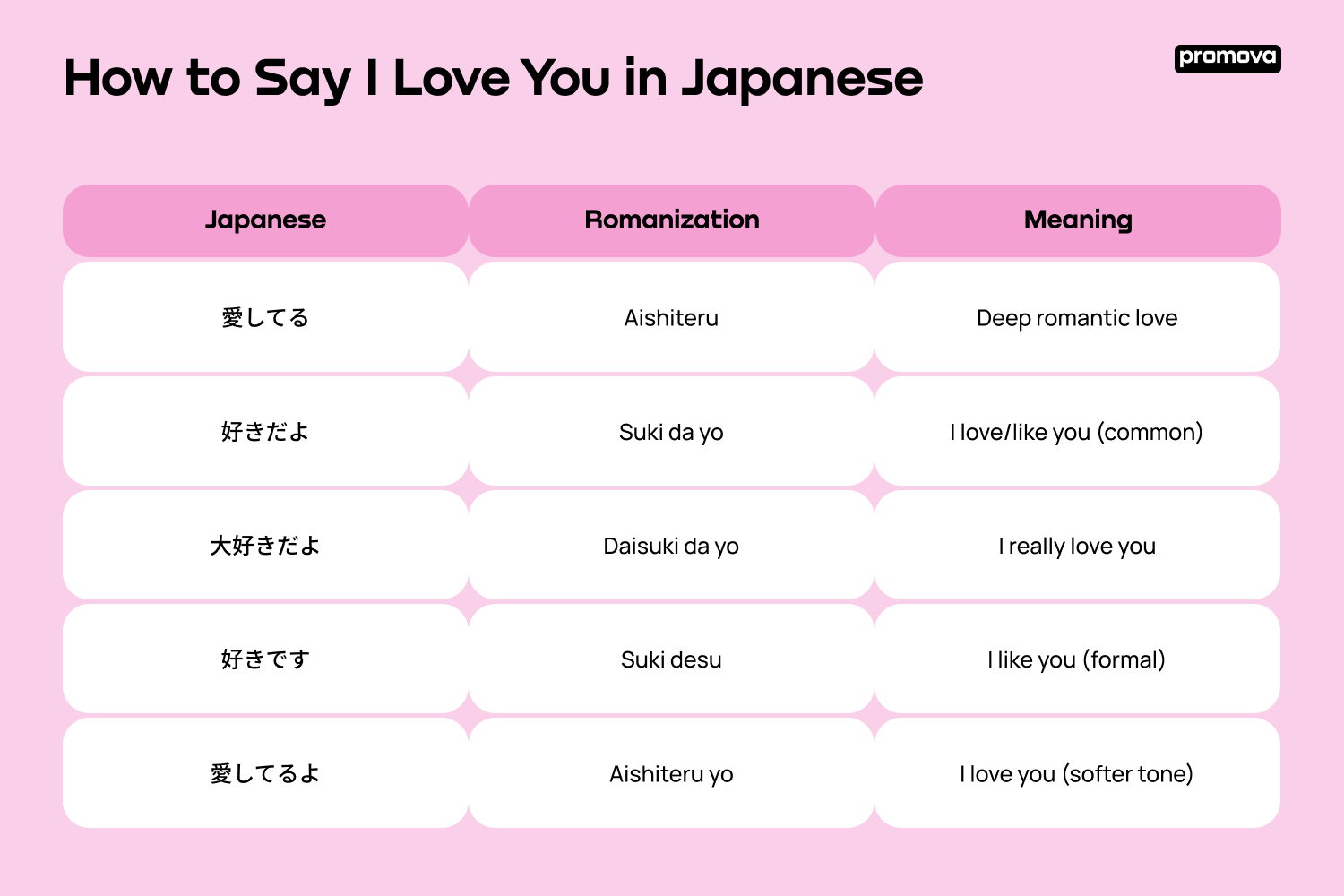
Here's a breakdown of the main phrases, from deep to everyday:
| Japanese | Romanization | Literal meaning | How it's really used |
| 愛してる | Aishiteru | I love you | Deep romantic love; rare in daily speech |
| 愛してるよ | Aishiteru yo | I love you (softer) | Same as above, but slightly warmer in tone |
| 好きだよ | Suki da yo | I like you | Common romantic expression; feels natural in relationships |
| 好きです | Suki desu | I like you (formal) | Polite version; often used when confessing feelings |
| 大好きだよ | Daisuki da yo | I really love you | Warm and expressive; works for both people and things |
| 大好きです | Daisuki desu | I really love you (formal) | More polite; good for early stages of a relationship |
What's the difference between Aishiteru and Suki da yo?
This is the question most learners ask, and it's a good one.
Aishiteru (愛してる) is intense. Think of it as a declaration — the kind you make once and it means everything. It's closer to "I love you deeply and completely." Japanese movies and novels use it a lot, but real-life couples? Not so much.
Suki da yo (好きだよ) literally means "I like you," but in a romantic context, it works more like saying "I love you" in English. It's warmer, more relaxed, and used between couples regularly. It doesn't sound less meaningful — it just sounds more natural.
If you want a middle ground, go with Daisuki da yo (大好きだよ) — "I really love you." It shows strong feelings without the weight of Aishiteru.
1
How to confess your feelings in Japanese
The Japanese concept of confession is called kokuhaku (告白), and it's taken seriously. When someone tells you they like you romantically, it's usually a deliberate moment, not a casual throwaway comment.
Common phrases used in a confession:
- 好きです (Suki desu) — "I like you." Simple, clear, and respectful.
- 付き合ってください (Tsukiatte kudasai) — "Please go out with me."
- あなたのことが好きです (Anata no koto ga suki desu) — "I like you" (more specific and personal).
If you're at the stage of confessing feelings, Suki desu is your go-to phrase. It's sincere without being overwhelming.
Other love-related phrases in Japanese
Knowing how to say "I love you" is a great start, but here are more phrases that come in handy once you're past the first confession:
- 会いたかった (Aitakatta) — "I missed you." / Literally: "I wanted to see you."
- ずっと一緒にいたい (Zutto issho ni itai) — "I want to be with you forever."
- あなたが必要です (Anata ga hitsuyou desu) — "I need you."
- 幸せにします (Shiawase ni shimasu) — "I'll make you happy."
- キスしていい?(Kisu shite ii?) — "Can I kiss you?"
These phrases give you a much richer picture of how Japanese speakers express closeness and affection.
Why Japanese people don't say "I love you" as often
This comes up a lot, and it's worth understanding.
Japanese communication tends to be indirect. Feelings are often expressed through behavior — doing things for someone, spending time with them, or remembering small details about their life. Saying "I love you" out loud every day isn't the cultural norm the way it might be in English-speaking countries.
According to research on cross-cultural communication styles, East Asian cultures generally rely more on high-context communication, where meaning is conveyed through action and tone rather than explicit words. (Source: Edward Hall's work on high- and low-context cultures)
This doesn't mean Japanese people feel love less deeply. It just means the language of love looks different.
How to say "I love you" in Japanese — by relationship type
Context matters a lot in Japanese. Here's a quick guide:
New relationship / early dating: Use 好きです (Suki desu) or 好きだよ (Suki da yo). These are honest without being intense.
Long-term partner: 大好きだよ (Daisuki da yo) feels natural and warm. You can also use 愛してるよ (Aishiteru yo) for a more significant moment.
Telling someone you love them for the first time: Stick with 好きです (Suki desu) — it's the most natural way to confess in Japanese.
Close friend (non-romantic): 大好きだよ (Daisuki da yo) works here too. Japanese uses this phrase freely for friends and family.
Practice makes it natural
Reading about Japanese phrases is one thing. Actually saying them out loud — with the right intonation and confidence — is something else entirely.
If you're learning Japanese, Promova's language learning app gives you bite-sized lessons, AI-powered speaking practice, and real-life scenarios to help you build the kind of confidence you need for actual conversations. You can practice phrases like these through AI role-play scenarios, get instant feedback, and learn at your own pace — whether you're a total beginner or brushing up before a trip.
Final thoughts
Saying "I love you" in Japanese is more nuanced than it looks. The classic Aishiteru (愛してる) exists, but everyday romance in Japan runs on Suki da yo and Daisuki da yo. Understanding both the words and the culture behind them is what turns a textbook phrase into a real connection.
The best way to get comfortable? Practice. Say it out loud. Get feedback. Make mistakes. That's how language learning actually works.
FAQ
How do you say "I love you" in Japanese?
The most common way is 好きだよ (Suki da yo) or 大好きだよ (Daisuki da yo) for everyday romance. 愛してる (Aishiteru) means deep romantic love but is rarely used in casual speech.
Is "Aishiteru" too strong to say casually?
Yes, for most Japanese speakers, Aishiteru feels very intense. It's better saved for significant moments in a long-term relationship. Suki da yo sounds more natural for everyday use.
How do you confess love in Japanese?
The most natural way is 好きです (Suki desu), which means "I like you" but works as a romantic confession. You can also add 付き合ってください (Tsukiatte kudasai) — "Please go out with me."
Do Japanese people say "I love you" often?
Not as often as in Western cultures. Japanese tends to express affection through actions rather than words. That doesn't mean love is felt less — it's just communicated differently.
What does Daisuki mean?
大好き (Daisuki) means "really like" or "love." It's used both romantically and for things you love in general, like food or a hobby. In a romantic context, it works as a warm, sincere expression of love.



 English


Comments