Learn Japanese for Travel: Essential Phrases and Tips for Your Trip to Japan
Contents
Key takeaways
- You don't need to be fluent to travel Japan comfortably — knowing around 50–100 practical phrases covers most everyday situations a traveler encounters.
- Japanese people genuinely appreciate any effort to speak the language, even a few words. It changes the whole experience.
- The most critical phrases to learn before your trip: greetings, ordering food, asking for directions, shopping, and basic emergency phrases.
- Japanese has three writing systems (hiragana, katakana, and kanji), but for travel purposes, learning romaji (the romanized pronunciation) is enough to get started.
- Apps like Promova make it practical to learn travel Japanese in short daily sessions — even if your flight is in three weeks.
Japan is one of the most rewarding travel destinations in the world — and also one where speaking a little of the local language makes a real difference.
English is taught in Japanese schools, and major cities have English signage in train stations and airports. But once you step off the main tourist track — into a small ramen shop, a rural ryokan, or a neighborhood izakaya — you're going to want some Japanese.
The good news: you don't need years of study. A focused set of travel phrases, learned properly, will get you through most situations. This guide gives you exactly that — organized by situation, with pronunciation guides and practical tips.
The two words that cover most interactions
If you memorise nothing else before your flight, memorise these two. Between them they handle the majority of everyday exchanges a tourist has.
| Japanese | Romaji | How to say it | Meaning |
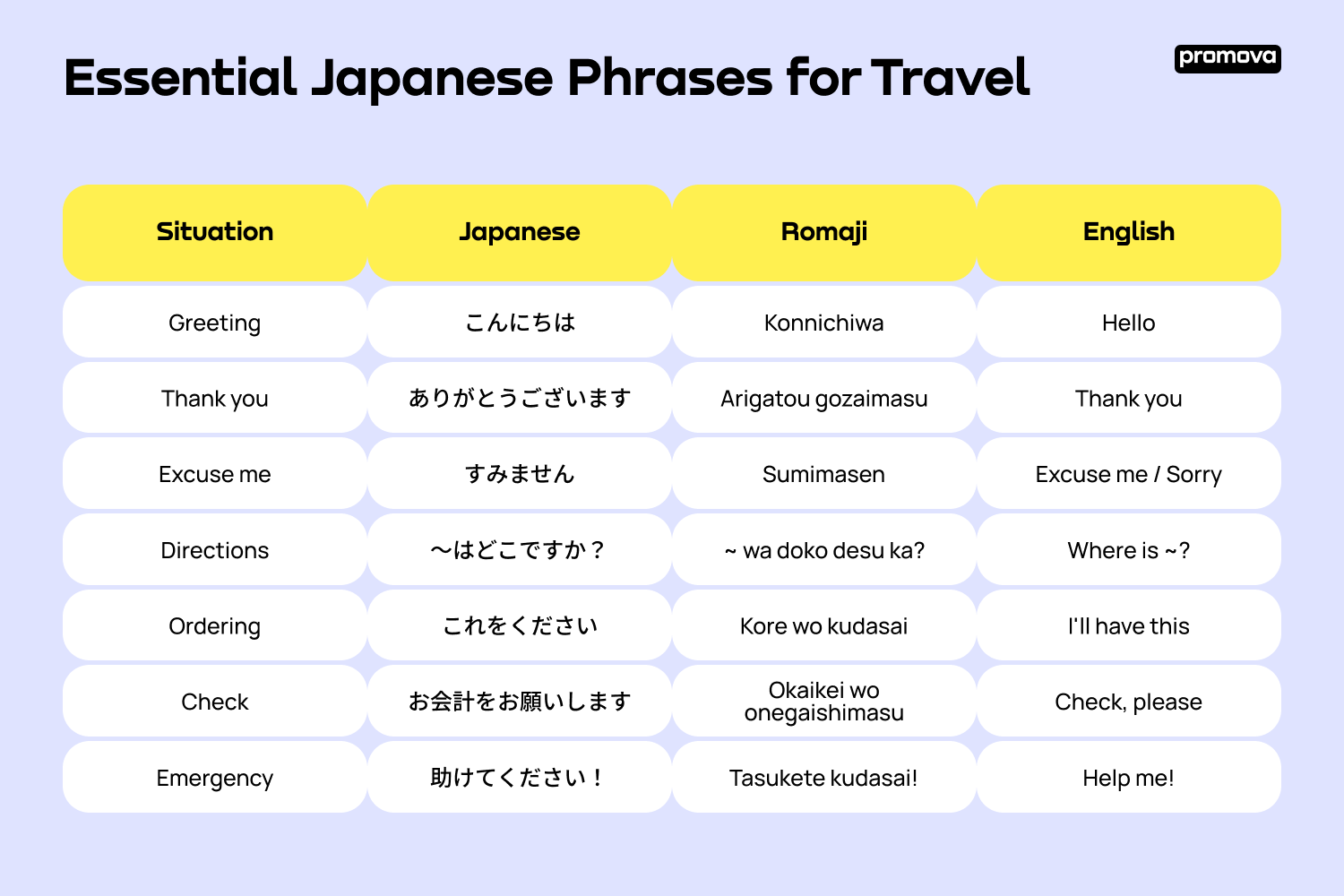
| すみません | Sumimasen | soo-mee-mah-sen | Excuse me / Sorry / Thank you (when someone has helped you) |
| ありがとうございます | Arigatou gozaimasu | ah-ree-gah-toh go-zai-mass | Thank you (polite) |
Sumimasen is the workhorse. Use it to get a server's attention, to squeeze past someone on a crowded train, to apologise for bumping into somebody, and to thank a stranger who has just gone out of their way for you. Arigatou gozaimasu covers most of the rest.
Two pronunciation notes that make a disproportionate difference. The final u in gozaimasu is almost silent, so it lands as “go-zai-mass”, not “go-zai-mah-soo”. And Japanese has no strong stress accent — keep every syllable even instead of leaning on one.
Why learning Japanese before your trip actually matters
Japan consistently ranks among the world's safest and most visitor-friendly countries. But it's also a country where language barriers can be surprisingly real. According to Japan National Tourism Organization (JNTO), over 25 million tourists visit Japan annually — yet many report that communication outside major tourist areas is genuinely challenging without basic Japanese.
It's not just about practicality. Japanese culture places high value on respect and effort. When you try to speak Japanese — even imperfectly — people respond differently. You get warmer service, more patience, and occasionally someone going well out of their way to help you.
A few phrases go a long way.
The Japanese writing systems — what you actually need to know
Japanese uses three writing systems: hiragana, katakana, and kanji. That sounds intimidating, but here's what matters for travel:
- Hiragana — the base phonetic alphabet; good to learn basics.
- Katakana — used for foreign loanwords from other languages, which helps travelers recognize familiar service terms.
- Kanji — Chinese-derived characters; most signs use these alongside hiragana.
- Romaji — Japanese written in the Latin alphabet. Most beginner learners start here.
For travel purposes, you don't need to read kanji. Recognizing a few japanese characters and memorizing core vocabulary helps with signs, menus, and getting around confidently.
Essential Japanese phrases for travel by situation
Basic Japanese greetings and politeness
These go everywhere. Learn these common japanese phrases first.
| Japanese | Romaji | Meaning |
| こんにちは | Konnichiwa | Hello in Japanese / Good afternoon |
| はじめまして | Hajimemashite | Nice to meet you |
| おはようございます | Ohayou gozaimasu | Good morning |
| こんばんは | Konbanwa | Good evening |
| ありがとうございます | Arigatou gozaimasu | Thank you (formal) |
| ありがとう | Arigatou | Thank you (casual) |
| すみません | Sumimasen | Excuse me / Sorry |
| はい / いいえ | Hai / Iie | Yes / No |
| よろしくお願いします | Yoroshiku onegaishimasu | Nice to meet you / Please or I humbly request (when asking for help) |
| さようなら | Sayounara | Goodbye |
If you want to introduce yourself, start with watashi or the fuller watashi no namae wa, then use Hajimemashite with polite language.
Tip: Sumimasen is one of the most useful words you'll use. It works as "excuse me" to get someone's attention, "sorry" when you bump into someone, and a polite way to call a waiter, so it's used both to apologize and to get attention.
Polite phrases matter, especially when paired with simple non-verbal cues.
Getting around — directions and transport
Japanese trains and buses are efficient but can still be confusing the first time. These phrases help.
| Japanese | Romaji | Meaning |
| ~はどこですか? | ~ wa doko desu ka? | Where is ~? (the phrase for asking directions) |
| 駅はどこですか? | Eki wa doko desu ka? | Where is the train station? |
| きっぷ売り場はどこですか? | Kippu uriba wa doko desu ka? | Where is the ticket office? |
| 次の電車は何時ですか? | Tsugi no densha wa nanji desu ka? | What time is the next train? |
| ~までいくらですか? | ~ made ikura desu ka? | How much to ~? |
| ~までお願いします | ~ made onegaishimasu | To ~ please (for taxis) |
| 降ります | Orimasu | I'm getting off here (for buses or taxis) |
| 右 / 左 / まっすぐ | Migi / Hidari / Massugu | Right / Left / Straight ahead |
| 地図を見せてもらえますか? | Chizu wo misete moraemasu ka? | Can you show me on a map? |
| 迷子になりました | Maigo ni narimashita | I'm lost |
Tip: Google Maps works excellently in Japan and is available in English. But knowing how to ask "Eki wa doko desu ka?" (Where is the station?) gets you out of situations where your phone battery is dead. Station staff often help lost tourists. Translation apps can also help, and Google Translate’s camera tool is useful for signs.
1
When you're stuck or don't understand
These are the phrases most travelers reach for first and most phrasebooks bury. Learn them alongside the greetings.
| Japanese | Romaji | How to say it | Meaning |
| トイレはどこですか? | Toire wa doko desu ka? | toy-reh wah doh-koh dess-kah | Where is the restroom? |
| わかりません | Wakarimasen | wah-kah-ree-mah-sen | I don't understand |
| 英語がわかりますか? | Eigo ga wakarimasu ka? | ay-goh gah wah-kah-ree-mass-kah | Do you understand English? |
| もう一度お願いします | Mou ichido onegaishimasu | moh ee-chee-doh oh-neh-gai-shee-mass | One more time, please |
| ゆっくり話してください | Yukkuri hanashite kudasai | yoo-koo-ree hah-nah-shee-teh koo-dah-sai | Please speak slowly |
| 日本語が少しだけわかります | Nihongo ga sukoshi dake wakarimasu | nee-hon-goh gah soo-koh-shee dah-keh wah-kah-ree-mass | I understand only a little Japanese |
Tip: Toire is a loanword from English “toilet” and is understood everywhere. If you are in a department store or station and cannot find one, “Sumimasen, toire wa doko desu ka?” is the single most useful sentence in this article.
Ordering food and drinks
Japanese restaurants range from fully automated (ticket machines at ramen shops) to full sit-down service. These phrases cover both, and since english translations or English menus aren't guaranteed, asking politely helps. Itadakimasu is said before meals to express gratitude and can literally mean humbly receive.
| Japanese | Romaji | Meaning |
| これをください | Kore wo kudasai | I'll have this one (pointing works great here) |
| メニューをください | Menuu wo kudasai | Can I have the menu? |
| 英語のメニューはありますか? | Eigo no menuu wa arimasu ka? | Do you have an English menu? |
| おすすめは何ですか? | Osusume wa nan desu ka? | What do you recommend? |
| 乾杯! | Kanpai! | Cheers! |
| おいしい! | Oishii! | Delicious! |
| お水をお願いします | Omizu o onegaishimasu | I would like some water |
| お会計をお願いします | Okaikei o onegaishimasu | Check, please! |
| ~アレルギーがあります | ~ arerugii ga arimasu | I'm allergic to ~ |
Tip: Many restaurants have plastic food displays outside or picture menus inside. "Kore wo kudasai" (I'll have this) while pointing is genuinely enough in most casual places.
Shopping and money
| Japanese | Romaji | Meaning |
| いくらですか? | Ikura desuka? | How much does it cost? |
| 高い / 安い | Takai / Yasui | Expensive / Cheap |
| これをください | Kore wo kudasai | I'll take this |
| 袋はいりません | Fukuro wa irimasen | I don't need a bag |
| カードで払えますか? | Kaado de haraemasu ka? | Can I pay by card? |
| 現金のみですか? | Genkin nomi desu ka? | Cash only? |
| 試着できますか? | Shichaku dekimasu ka? | Can I try this on? |
Tip: Japan is still heavily cash-based in many places — convenience stores, small restaurants, and markets. Always carry yen, and remember this is one of the most useful basic phrases for shopping.
Accommodation — hotels and ryokan
| Japanese | Romaji | Meaning |
| チェックインをお願いします | Chekkuin wo onegaishimasu | Check-in, please |
| 予約があります | Yoyaku ga arimasu | I have a reservation |
| 部屋はどこですか? | Heya wa doko desu ka? | Where is my room? |
| Wi-Fiのパスワードは何ですか? | Wi-Fi no pasuwaado wa nan desu ka? | What's the Wi-Fi password? |
| タオルをもらえますか? | Taoru wo moraemasu ka? | Can I get a towel? |
Emergency phrases
Learn these even if you learn nothing else.
| Japanese | Romaji | Meaning |
| 助けてください! | Tasukete kudasai! | Help me, please! |
| 警察を呼んでください | Keisatsu wo yonde kudasai | Please call the police |
| 救急車を呼んでください | Kyuukyuusha wo yonde kudasai | Please call an ambulance |
| 病院はどこですか? | Byouin wa doko desu ka? | Where is the hospital? |
| 気分が悪いです | Kibun ga warui desu | I feel sick |
| 財布を盗まれました | Saifu wo nusumaremashita | My wallet was stolen |
Japan's emergency number is 110 (police) and 119 (ambulance/fire).
Japanese etiquette phrases every traveler should know
Language is only part of it. These phrases show respect in situations where it matters most.
- いただきます (Itadakimasu) — Said before meals to express gratitude; literally, it can be understood as humbly receive for what is being served. Skip this at a restaurant and you'll seem rude to anyone paying attention.
- ごちそうさまでした (Gochisousama deshita) — Said after eating. Thanks for the meal.
- お邪魔します (Ojama shimasu) — "Sorry for the intrusion" — said when entering someone's home or a more private space.
- 失礼します (Shitsurei shimasu) — "Excuse me" in a more formal sense; used when leaving a room or passing in front of someone.
Non-verbal cues matter too: local residents may point with an open hand, wave a hand to show polite hesitation, or use a slight bow to show thanks.
These aren't phrases you'll find in a basic phrasebook, but using them correctly makes a real impression.
How much Japanese do you need for a trip to Japan?
Honestly? Less than you think — but more than zero.
According to language learning research from the Foreign Service Institute (FSI), Japanese is one of the most difficult languages for English speakers, requiring approximately 2,200 class hours to reach professional proficiency. But travel-level Japanese — enough to get around, order food, and handle basic situations — is achievable in weeks of focused practice.
The goal isn't fluency. It's functional confidence. Knowing 80–100 phrases well beats having a vague memory of 500 you can't recall under pressure.
How to actually learn travel Japanese before your trip
Reading a phrase list helps. But actually remembering words and phrases when you're tired, jet-lagged, and standing at a train station in Tokyo matters more than just reading them once, and memorizing core vocabulary is what makes effective communication in Japan possible.
A few approaches that work:
- Learn in short, daily sessions. 15–20 minutes a day beats a three-hour cramming session. Your brain retains spaced repetition better than massed practice, and building basic Japanese travel phrases at your own pace improves retention.
- Practice speaking out loud. Japanese pronunciation is phonetically consistent, but you still need the right stress and to hear the natural rhythm if you want to remember what you say. This is a practical way to learn Japanese phrases you'll actually use.
- Use AI conversation practice. Promova's AI Conversation Practice lets you practice real travel scenarios — ordering food, asking for directions, checking into a hotel — with instant feedback on your pronunciation and phrasing. It mirrors conversations with native speakers, which helps build confidence.
- Try AI Role-Play. Promova's AI Role-Play puts you in specific situations: you're at a ramen shop, or lost near a train station, or at a hotel front desk. You respond in Japanese, the AI responds back. It's a fun way to keep your focus on basic phrases before moving into longer exchanges.
This is only the beginning, and focused practice now grows into stronger communication later.
The AI Tutor on Promova also adapts to your level — so whether you're a complete beginner or brushing up before your second trip, the experience adjusts to what you actually need.
Japan travel tips that connect to language
A few practical notes where language and culture intersect:
- Restaurants: Many use ticket machines at the entrance. You pick your meal, pay, and hand the ticket to staff. If you need an English menu, ask politely, since many Japanese people do not speak English fluently; simple gestures and polite phrases also go a long way with local residents. No Japanese needed — but "oishii!" after eating is always appreciated.
- Convenience stores (conbini): 7-Eleven, FamilyMart, and Lawson are everywhere and have excellent food. Staff will ask if you want your item heated — "hai" (yes) or "iie" (no) is all you need.
- Trains: IC cards (Suica, Pasmo) work on most transit and even convenience stores. Get one at the airport.
- Bowing: A small nod is perfectly acceptable for foreigners. Deep bowing isn't expected of tourists, but polite phrases and non-verbal cues matter in Japanese communication and help show gratitude.
- Tipping: Don't. It's considered rude in Japan.
Final thoughts
Learning Japanese for travel isn't about becoming fluent — it's about showing up prepared. Even 50 well-practiced phrases change how you experience a country: the conversations you can have, the places you can go, the moments where someone goes out of their way to help because you tried.
Start with greetings, food, and transport. Practice them out loud. Use AI Conversation Practice to simulate real situations before you land. By the time you arrive, Japan won't feel quite so unfamiliar.
FAQ
Do I need to speak Japanese to travel to Japan?
No — major cities have English signage and many tourist-facing businesses have English-speaking staff. But knowing basic Japanese phrases genuinely improves your experience and helps in smaller towns, local restaurants, and off-the-beaten-path areas.
What are the most important Japanese phrases for travel?
The essentials are: Sumimasen (excuse me), Arigatou gozaimasu (thank you), ~ wa doko desu ka? (where is ~?), Kore wo kudasai (I'll have this), and Okaikei wo onegaishimasu (check, please). These cover most everyday situations.
Is Japanese hard to learn for travel purposes?
Japanese is complex to master, but travel-level Japanese is very achievable. Pronunciation is consistent and phonetic — once you know the sounds, words are predictable. Most travelers can reach functional travel confidence in a few weeks of daily practice.
How do I say thank you in Japanese?
The standard polite form is Arigatou gozaimasu (ありがとうございます). In casual settings, Arigatou alone is fine. Doumo is an even shorter, very informal version used between friends.
What app is best for learning Japanese for travel?
Promova's language learning app includes structured Japanese lessons built around practical, real-life situations — including travel scenarios. The AI Tutor and AI Role-Play features let you practice speaking and get feedback, which is exactly what travel preparation needs.


 English


Comments