Best Methods to Improve French Pronunciation

Contents
Key takeaways
- French pronunciation follows consistent, learnable rules. The challenge is that many of those rules are very different from English, not that they're random or unpredictable.
- The four biggest challenges for English speakers are the French R (uvular, made at the back of the throat), nasal vowels, silent letters, and liaison (linking words together in connected speech).
- Shadowing — listening to native speakers and repeating simultaneously — is one of the most effective techniques for improving French accent and rhythm, used by professional interpreters.
- Recording yourself and comparing your pronunciation to native speakers reveals gaps that are nearly impossible to detect while you're speaking.
- French is spoken with more tension in the lips and further forward in the mouth than English. Understanding this physical difference is the first step to producing more accurate sounds.
- Consistent daily practice of 10–15 minutes outperforms occasional long sessions for building pronunciation muscle memory.
French pronunciation has a reputation. People call it beautiful, musical, elegant — and then immediately admit they have no idea how to reproduce it. The gap between how French looks on the page and how it sounds when a native speaker says it is genuinely wide, and for English speakers, several key sounds simply don't exist in their native phonetic toolkit.
This guide covers the most effective methods for improving your French pronunciation, the key sounds you need to focus on first, and the practical habits that make the biggest difference over time.
Why French pronunciation is hard (and why that's actually good news)
Before diving into methods, it helps to understand what’s actually happening when French pronunciation trips you up. The difficulty isn’t random — it comes from a few specific structural differences between French and English.
French uses sounds that don’t exist in English. According to linguists at the Sorbonne and the Office Québécois de la Langue Française, French has 16 oral vowel sounds and several nasal vowels, many of which have no English equivalent. Your brain has spent years recognizing the sound system of your native language. When it encounters a sound outside that system, it tends to substitute the closest familiar sound, which is usually the wrong one. Recognizing and practicing sounds that are not present in your own language is crucial for accurate pronunciation.
French is syllable-timed, English is stress-timed. In English, syllables tend to have varying emphasis, with certain syllables stressed more than others, creating a distinctive English sound with a singsong rhythm. In contrast, French syllables tend to have more equal weight, so varying emphasis is minimized and certain syllables are not stressed as much. This makes French sound smooth and melodic to outsiders, but means English speakers naturally impose stress patterns that don’t belong there.
Written French is not phonetic. Unlike Spanish or Italian, you usually can’t look at a French word and know how to say it. Words are much longer in writing than in speech. Silent letters, accents, and context-dependent sounds mean you have to learn pronunciation separately from spelling.
The four hardest sounds for English speakers — and how to practice them
The French R
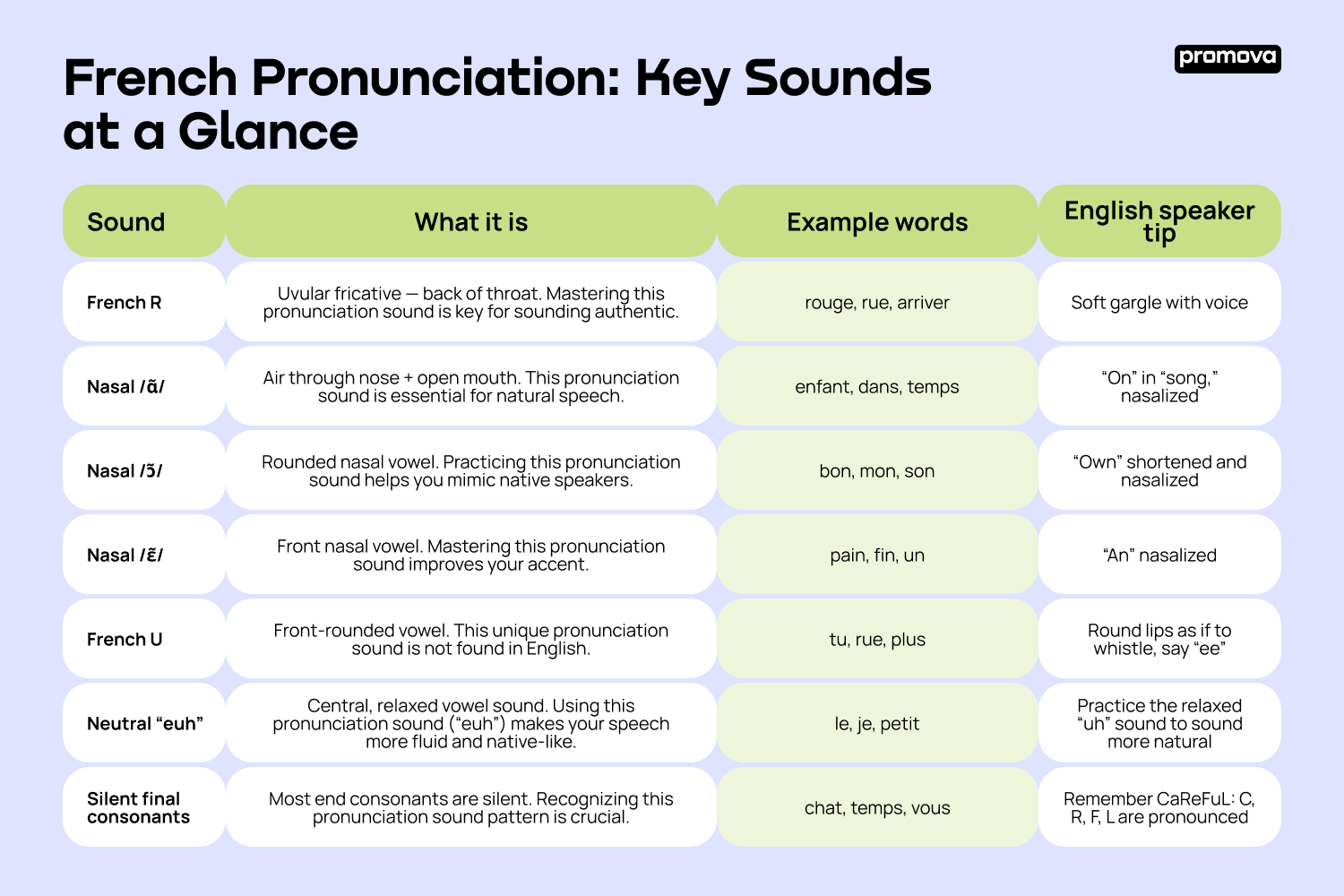
The French R (specifically the standard Parisian R) is a uvular fricative. It's produced at the very back of the throat, not with the tongue tip like English. It’s often described as a soft, voiced gargle, but to sound authentic, you should aim for a natural guttural quality that resonates deeply from the throat. Many learners find this the most physically unfamiliar sound in the language.
How to practice it:
Say the English word “get” out loud. Now repeat the “ge” part, but don’t close the back of your throat to finish the “g.” Hold that throat position and let a little air out while adding your voice. That back-of-throat vibration is approximately where the French R lives. The guttural 'r' in French is produced deeper in the throat and is different from the English 'r'; it requires practice to master, but a softer or trilled 'r' can still be understood by native speakers. Practice with words like rouge (red), rue (street), and arriver (to arrive).
Start slowly. The sound feels strange before it feels natural. Achieving a natural guttural R takes intensive training — dedicated, repeated practice sessions are key to mastering it. Native French speakers accept a range of R pronunciations, so don’t let imperfect Rs stop you from speaking.
I've picked up some French pronunciation tips over the years while helping language schools and tutoring services improve their online visibility through my work at Local SEO Boost. Let me share what I've learned from those educators.
For the French R, the exercise I recommend most is the "gargling" technique. Before you even try to speak, tilt your head back slightly and take a sip of water. Gargle it gently and pay attention to where the vibration happens in your throat. That's roughly where your tongue should be when producing the French R. The sound comes from the back of your throat, not the front like English. Practice without water first by pretending to gargle, then gradually work that sensation into words starting with simple syllables like “ra, re, ri, ro, ru.”
Wayne Lowry, Marketing coordinator, Local SEO Boost
Nasal vowels
French has four nasal vowels, or sounds where air flows through both the mouth and the nose simultaneously. They appear in extremely common words: pain (bread), bon (good), blanc (white), and un (one). Getting them wrong can change the meaning entirely. The fourth nasal sound (in un) is very similar to the first nasal sound (in pain), and mastering it is crucial for authentic French pronunciation. Practice and exaggerate these sounds to help differentiate them from one another.
Nasal vowels trip up a lot of learners. The key is understanding that French has four main ones: "on" (like in "bon"), "an/en" (like in "enfant"), "in/ain" (like in "pain"), and "un" (like in "brun"). I tell students to pay attention to their mouth position. For "on," your lips are rounded.
Wayne Lowry, Marketing coordinator, Local SEO Boost
How to practice them:
The key is directing airflow through your nose while keeping your mouth open. A simple exercise: hum the letter “M” and feel the vibration in your nose. Now open your mouth slightly while maintaining that nasal resonance. The main nasal vowels in French and example words are:
| Sound | Example words | Approximate sound |
| /ɑ̃/ | enfant (child), dans (in), temps (time) | Like “on” in “song” but nasalized |
| /ɔ̃/ | bon (good), mon (my), son (his) | Like “own” but nasalized and shorter |
| /ɛ̃/ | pain (bread), fin (end) | Like “an” but nasalized |
Tip: Try pinching your nose while saying a nasal vowel. If the sound changes noticeably, you’re not sending enough air through your nasal passage. Practice until it sounds the same whether your nose is pinched or not. To truly master nasal vowels, practice listening to native speakers and mimic their pronunciation, focusing on the subtle differences between each nasal sound.
1
Silent letters
French words are often dramatically shorter in speech than in writing. This surprises English speakers, who tend to want to pronounce everything they see.
The general rule worth memorizing is CaReFuL: the consonants C, R, F, and L are usually pronounced at the end of a word. Everything else is typically silent.
Examples:
- chat (cat) → sounds like "sha," not "shat"
- temps (time, weather) → sounds like "tɑ̃," not "tɛmps"
- beaucoup (a lot) → sounds like "bo-koo," not "bow-koop"
- vous parlez (you speak) → sounds like "voo par-lay," not "voo par-lez"
Important! The final "ent" on third-person plural verbs is also always silent: ils parlent (they speak) is pronounced exactly like il parle (he speaks) — /paʁl/.
Liaison
Liaison is the French phenomenon where a normally silent final consonant is pronounced when the next word begins with a vowel. The sound from the preceding word is carried over to the next word, making it sound like one word. This feature gives French its fluid, connected quality — and ignoring it makes your speech sound choppy and unnatural. Mastering liaison not only improves your pronunciation but also enhances your oral comprehension, as it helps you understand spoken French more easily.
Key examples:
- les amis (the friends) → “layz ah-MEE” (the S of les becomes Z)
- vous avez (you have) → “vooz ah-VAY”
- un grand ami (a good friend) → “uN graN-T ah-MEE” (the D becomes T)
- deux enfants (two children) → “duh ZɑN-fɑN” (the X becomes Z)
Liaison is obligatory after articles (les, des, ces), possessives (mes, tes, ses), and pronouns before verbs. Other than that, it’s optional in some contexts and actually forbidden in others. For example, liaison is never used between a singular subject noun and a following verb. In the phrase le garçon attend (the boy waits), you do not link the nasal N sound of the noun to the verb; instead, you keep a clear separation between the two words.
The best methods for improving French pronunciation
1. Shadowing
Shadowing is the most powerful technique for improving accent and rhythm, and it's what professional interpreters use for language work. The method: listen to a short clip of native French audio — 10 to 30 seconds — and repeat it simultaneously, matching rhythm, intonation, and speed as closely as possible.
How to do it: Start with clear, moderately-paced French audio. Good sources include Radio France Internationale (RFI) news segments, TV5Monde clips, or podcasts designed for learners. Listen to the same short segment several times before attempting to shadow it. Aim for 10 minutes daily. Within four to six weeks of consistent shadowing, your French rhythm and connected speech will noticeably improve.
I absolutely recommend shadowing for beginners. The best audio sources are slowed-down French podcasts, children's audiobooks, and specially designed learning materials where the pace is manageable. I've seen language schools we've worked with at localseoboost.co achieve great results using "InnerFrench" podcast episodes and "Coffee Break French" for beginners because they speak clearly and at a measured pace.The trick is starting slow and gradually increasing speed as your mouth gets comfortable with the new movements.
Wayne Lowry, Marketing coordinator, Local SEO Boost
2. Record yourself and compare
This is one of the most underused methods — and one of the most effective. Recording yourself speaking French and listening back reveals pronunciation errors you simply cannot catch in real time, because while you're speaking, your brain hears what it expects to hear rather than what you're actually saying.
How to do it: Record yourself reading a French passage or repeating sentences from audio. Then listen to the original recording and your own version back to back. Note specific sounds where you diverge. Free resources like Forvo let you hear individual words pronounced by native speakers so you can compare precisely.
This works best when you focus on one specific sound per session — the French R one day, nasal vowels the next — rather than trying to fix everything at once.
3. Use tongue twisters (virelangues)
Tongue twisters — called virelangues in French — are excellent for building pronunciation agility and targeting specific French sounds, especially those that are difficult for learners, such as nasal vowels and the French U. Practicing tongue twisters helps you listen to and mimic native pronunciation, making it easier to master these challenging sounds. They’re also genuinely entertaining, which makes practice feel less like drilling.
Try these:
- Les chaussettes de l’archiduchesse, sont-elles sèches? (Are the archduchess’s socks dry?) — targets the “ch,” “ss,” and “è” sounds
- Dans ta tente ta tante t’attend. (In your tent, your aunt is waiting for you.) — targets the “t” and “an” nasal sounds
- Ces cerises sont si sûres qu’on ne sait pas si c’en sont. (The cherries are so sour that one doesn’t know if they are cherries.) — targets the “s,” “c,” and “u” sounds
How to do it: Start slowly, aim for clarity, and increase speed only once each word sounds right. The goal is accurate pronunciation, not record speed.
4. Immerse yourself in authentic French audio and video
Listening to real French (rather than slowed-down learner French) trains your ear to process the language at natural speed. This matters because natural French speech sounds very different from textbook French: liaisons connect words, vowels are reduced, and consonants blend together.
Practical resources to use regularly:
- Podcasts: InnerFrench (intermediate level, authentic pace) and Coffee Break French (structured for learners) are widely recommended by learners and teachers alike.
- TV and film: French-language shows on Netflix — Lupin, Call My Agent (Dix Pour Cent), Marseille — offer natural conversational French with the option to turn on French subtitles.
- News audio: RFI’s Français facile delivers current news read at a slightly reduced pace, which is ideal for intermediate learners.
- French songs and audio material: Listening to French songs and other audio material exposes you to authentic pronunciation and intonation. Try to find material on topics that interest you for continuous listening practice, which is crucial for improving both pronunciation and comprehension.
Remember: The goal of regular listening is not immediate comprehension — it’s ear training. The more you hear natural French, the more your brain begins to map the sounds correctly.
5. Practice the physical position of your mouth
French is spoken with more lip tension and further forward in the mouth than English. English speakers tend to speak with relaxed lips and a somewhat lazy tongue. French requires more muscular precision — rounded, protruded lips for sounds like “ou” and “u,” and a generally more forward tongue position.
Practicing in front of a mirror helps you see whether your lips are forming the shapes they need to be. For the French U (as in tu, rue, plus), round and protrude your lips as if about to whistle, then try to say “ee.” That front-rounded position produces the sound.
6. Practice daily with AI conversation tools
One of the biggest barriers to pronunciation improvement is a lack of speaking time. If you only speak French during a class or with a language partner, you don't get enough repetitions to build the muscle memory that good pronunciation requires.
AI conversation tools allow you to practice speaking at any time, with immediate feedback on pronunciation — no scheduling, no fear of judgment, and no limit on how many times you can repeat a sound. This is especially valuable for the early, awkward stage when you need a high volume of practice before you can build confidence.
Learn French with Promova
Pronunciation improves fastest when you combine understanding the rules with consistent speaking practice — and ideally get feedback on what you're actually producing, not just what you think you're producing.
Promova is a language learning platform designed for busy adults who want to make real progress without a rigid schedule. Our French lessons cover pronunciation from the ground up — nasal vowels, the French R, silent letters, and liaisons are all built into the learning path, not left as an afterthought.
The AI speaking practice gives you a judgment-free space to practice speaking at any hour, with instant feedback so you can hear and correct your pronunciation in real time. No waiting for a class, no embarrassment about mispronouncing something in front of a person; just you, the language, and the chance to get a little better every day.
For more on building a complete French learning practice, visit Promova's guide on how to learn French and see what a structured approach from beginner to fluency looks like.
Conclusion
Improving French pronunciation isn’t about having a natural gift for languages. It’s about understanding what the sounds actually are, practicing them in the right way, and building daily habits that compound over time. Learning pronunciation is a key part of mastering a new language, as it helps you recognize and produce the unique sounds essential for clear communication.
Start with the four big challenges — the R, nasal vowels, silent letters, and liaison. Use shadowing to internalize natural rhythm. Record yourself to catch what you can’t hear in real time. Build a daily practice of 10 to 15 minutes rather than occasional marathon sessions.
French pronunciation is learnable. The sounds that feel impossible in week one start to feel natural by month three — if you practice deliberately and consistently. And once your pronunciation improves, everything else in the language opens up with it: comprehension, speaking confidence, and the pleasure of your words actually sounding like the language you’ve been working so hard to learn, while also connecting more deeply with French culture.
FAQ
Why is French pronunciation so hard for English speakers?
French has several sounds that don’t exist in English — nasal vowels, the uvular R, and the front-rounded “u” — and significant gaps between spelling and pronunciation. One major challenge is that French letters often have pronunciations that differ greatly from their English counterparts, and learning these patterns is essential. French is also syllable-timed rather than stress-timed like English, which means English speakers naturally impose stress patterns that don’t belong. All of these challenges are learnable once you understand the specific rules involved.
What is the best technique to improve French pronunciation?
Shadowing is widely considered the most effective method — listening to short native French audio clips and repeating them simultaneously, matching rhythm and intonation. It trains both your ear and your speech production at the same time. Focusing on each pronunciation sound, such as the neutral French “euh,” helps you mimic native speech and sound more authentic. Recording yourself and comparing to native speakers is equally valuable for catching specific errors you can’t hear while speaking.
How do I pronounce the French R?
The French R is produced at the very back of the throat — a soft, voiced friction sound similar to a gentle gargle. To practice, say “ah” and slowly constrict the back of your throat while keeping your voice on. Practice with words like rouge (red) and rue (street). It feels unnatural at first but becomes habitual with regular practice.
What are nasal vowels in French?
Nasal vowels are sounds where air flows through both the mouth and the nose simultaneously. French has four: /ɑ̃/ as in enfant, /ɔ̃/ as in bon, /ɛ̃/ as in pain, and /œ̃/ as in un. They don’t exist in English, which is why they’re one of the first pronunciation hurdles for English-speaking learners. Practice by humming with an open mouth and directing the air up through your nose.
What is liaison in French?
Liaison is the pronunciation of a normally silent final consonant when the next word begins with a vowel sound. For example, les amis (the friends) is pronounced “layz ah-MEE” — the “s” of les becomes a “z” sound linking into amis. Liaison is mandatory in certain grammatical contexts and gives French its smooth, connected flow. Skipping it makes speech sound unnatural to native ears.
How long does it take to improve French pronunciation?
With consistent daily practice of 10 to 15 minutes — including shadowing and recording yourself — most learners notice meaningful improvement within four to six weeks. Mastering all the key sounds to a near-native level takes longer, but individual sounds like the French R or nasal vowels can feel natural within a few weeks of focused practice. Using tools like Promova helps by building pronunciation into structured daily lessons.



 English


Comments