Easter Vocabulary: Words You Need to Celebrate and Communicate

Contents
Easter is one of the most widely celebrated holidays in the world. Whether you're a Christian observing the religious holiday, someone who loves the spring traditions, or just a language learner who wants to join the conversation, knowing Easter vocabulary helps you understand, connect, and express yourself.
This article gives you the key Easter words you need. For each one, you'll find a clear meaning and a natural example sentence. By the end, you'll be ready to talk about Easter traditions, describe the holiday to someone, or simply understand what people around you are saying.
Core Easter Words
- Easter — A Christian holiday that celebrates the resurrection of Jesus Christ. It falls on a Sunday in March or April. Many non-religious people also celebrate Easter as a spring holiday with eggs, chocolate, and family gatherings. ("We're spending Easter with my grandparents this year — they always make a big lunch.")
- Resurrection — Coming back to life after death. In the Christian faith, Easter celebrates the resurrection of Jesus Christ three days after his crucifixion. ("The resurrection is the central event of the Christian Easter story.")
- Easter Sunday — The main day of Easter celebration. It follows Good Friday and Holy Saturday in the Christian calendar. ("Easter Sunday is usually a time for church services and family meals.")
- Good Friday — The Friday before Easter Sunday. Christians observe this day to mark the crucifixion and death of Jesus Christ. It's considered a solemn, serious day. ("Many shops are closed on Good Friday as a mark of respect.")
- Holy Week — The week leading up to Easter Sunday, starting on Palm Sunday. It's the most important week in the Christian calendar. ("Churches hold special services throughout Holy Week.")
- Lent — A period of 40 days before Easter during which many Christians fast, pray, or give up something as a form of sacrifice and reflection. Lent begins on Ash Wednesday. ("She gave up chocolate for Lent this year — which made the Easter eggs even more enjoyable.")
- Palm Sunday — The Sunday before Easter. It marks Jesus's arrival in Jerusalem, when people waved palm branches to welcome him. ("Palm Sunday marks the beginning of Holy Week.")
- Crucifixion — A method of execution used in ancient times, where a person is nailed or tied to a cross. In Christianity, this refers to the death of Jesus Christ. ("The crucifixion is remembered on Good Friday.")
7
Easter Traditions and Symbols
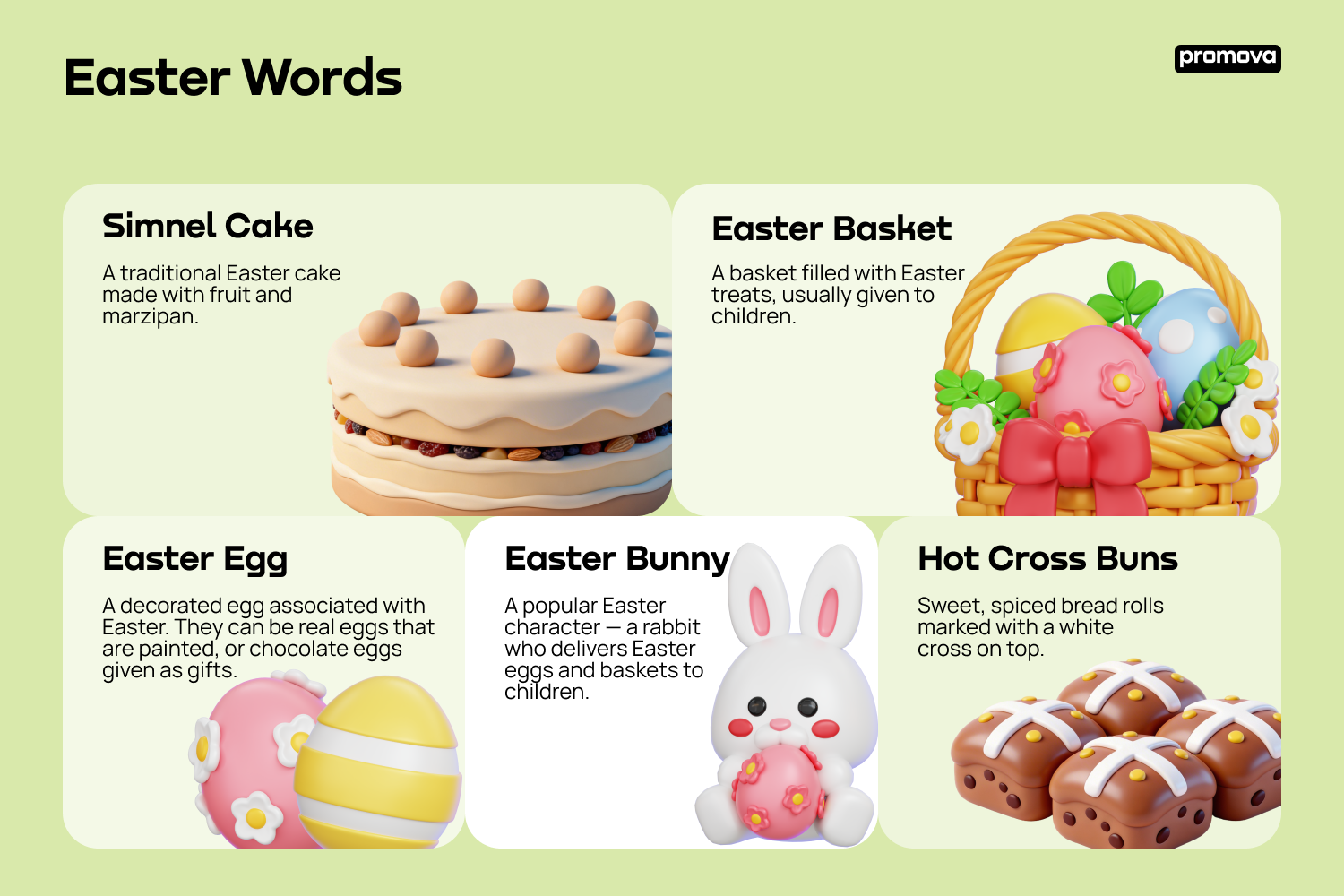
- Easter Egg — A decorated egg associated with Easter. Eggs are a symbol of new life and rebirth. They can be real eggs that are painted, or chocolate eggs given as gifts. ("The kids decorated Easter eggs with paint and stickers — some of them turned out really creative.")
- Easter Egg Hunt — A popular Easter activity, especially for children, where eggs (real or chocolate) are hidden around the house or garden and children search for them. ("We hid 20 chocolate eggs in the garden for the Easter egg hunt — the youngest one found the most.")
- Easter Basket — A basket filled with Easter treats, usually given to children. It often contains chocolate eggs, candy, and small toys. ("Every year, the Easter Bunny leaves a basket of goodies by the front door.")
- Easter Bunny — A popular Easter character — a rabbit who delivers Easter eggs and baskets to children. The Easter Bunny is not a religious symbol but a fun cultural tradition, especially in the United States, United Kingdom, and Australia. ("My nephew still believes the Easter Bunny visits during the night — we're not going to spoil it.")
- Hot Cross Buns — Sweet, spiced bread rolls marked with a white cross on top. They're a traditional Easter food, especially in the UK and Ireland. The cross represents the crucifixion. ("There's nothing like warm hot cross buns with butter on Good Friday morning.")
- Simnel Cake — A traditional Easter cake made with fruit and marzipan. It's especially popular in the UK and Ireland. The 11 marzipan balls on top represent the 11 faithful apostles of Jesus. ("My grandmother makes a simnel cake every Easter — it's become a family tradition.")
- Easter Parade — A public procession or walk that takes place on Easter Sunday. People often wear their best spring clothes and flowers. The Easter Parade on Fifth Avenue in New York City is one of the most famous in the world. ("We watched the Easter Parade on TV — the hats people wore were absolutely incredible.")
- Spring — The season of the year between winter and summer, when plants start to grow and temperatures rise. Easter always falls in spring in the Northern Hemisphere, so the two are strongly connected. ("Easter feels like a real celebration of spring — everything is blooming and the days are getting longer.")
- Rebirth / Renewal — Starting again, or coming back to life. These two words are closely linked to Easter, both in the religious sense and in the natural world — spring brings new life after winter. ("Easter is a time of renewal — people clean their homes, plant flowers, and spend time with family.")
Easter Words for Food and Celebrations
- Chocolate Egg — A hollow or solid chocolate shaped like an egg, given as a gift at Easter. Chocolate eggs are one of the most popular Easter gifts in many English-speaking countries. ("He received five chocolate eggs this Easter — more than he could eat in a week.")
- Feast — A large, special meal with many dishes, usually shared with family or friends. Easter Sunday lunch is often described as a feast. ("The Easter feast included roast lamb, salads, fresh bread, and dessert for 15 people.")
- Lamb — A young sheep. Roast lamb is a traditional Easter meal in many cultures, including Greek, Italian, and British traditions. In Christianity, the lamb is also a symbol of Jesus Christ — known as the "Lamb of God." ("We roasted a whole leg of lamb for Easter Sunday — it took four hours but was completely worth it.")
- Decorate — To make something look attractive by adding color, patterns, or ornaments. At Easter, people decorate eggs, homes, and tables. ("The children spent the whole afternoon decorating eggs with bright colors and glitter.")
Words About Easter Feelings and Themes
- Joy — A strong feeling of happiness and celebration. Easter is associated with joy — especially in the Christian context of resurrection, but also in the cultural context of spring, family, and gifts. ("There was real joy in the room when the kids found all the hidden eggs.")
- Gratitude — The feeling of being thankful. Many people use Easter as a time to reflect and feel grateful for their lives, family, and faith. ("Easter is a good moment to pause and feel gratitude for the people around you.")
- Tradition — A custom or practice passed down from one generation to the next. Easter is full of traditions — some religious, some cultural, and some that are completely unique to individual families. ("In our family, it's a tradition to hide Easter eggs in the garden the night before.")
- Greeting — A polite or friendly expression used when meeting someone or wishing them well. The most common Easter greeting in English is "Happy Easter!" ("She sent Easter cards to all her friends with a simple greeting inside.")
Useful Easter Phrases
Here are a few natural phrases and expressions you can use around Easter:
- "Happy Easter!" — The standard greeting during the Easter holiday.
- "Have a blessed Easter." — A more religious way to wish someone well at Easter.
- "He's risen." / "Christ is risen." — A traditional Christian Easter declaration.
- "The Easter Bunny came!" — Something you might hear children say on Easter morning.
- "We're doing a big Easter lunch." — A common way to describe Easter Sunday plans.
- "Did you give anything up for Lent?" — A common question asked during the weeks before Easter.
Bonus Easter Words Worth Knowing
Ready for a little extra? Here are five more Easter words that come up often in conversations and English-language media.
- Vigil — A period of staying awake or watching, usually at night. The Easter Vigil is a special church service held on the night before Easter Sunday. ("The Easter Vigil service begins after dark and goes until midnight.")
- Procession — A group of people walking together in an organized, ceremonial way. Religious processions are common during Holy Week in many countries. ("Thousands of people joined the procession through the city center on Good Friday.")
- Bonnet — A type of hat, traditionally decorated with flowers and ribbons for spring. Easter bonnets are worn at parades and celebrations. ("She made her daughter an Easter bonnet out of a straw hat and fake flowers.")
- Dye — To change the color of something using a special liquid. Dyeing eggs is one of the most popular Easter crafts. ("We used natural dyes made from beets and onion skins to color the eggs.")
- Blessing — A prayer or ceremony asking for God's protection or favor. Many churches offer a blessing of food baskets on Easter Saturday. ("They brought a basket of bread and eggs to church for the Easter blessing.")
Why Easter Vocabulary Matters
If you're learning English, holidays are a goldmine for vocabulary. They bring together everyday words, cultural expressions, and specific terminology that native speakers use naturally. Easter is no different. It mixes religious language, seasonal words, family traditions, and food vocabulary.
Learning these words doesn't just help you understand movies, conversations, or news articles. It also helps you feel included. When someone mentions an Easter egg hunt or says "Happy Easter," you'll know exactly what they mean — and you'll be able to respond confidently.
Practice Easter Vocabulary with Promova
Reading a word list is a great start. But to really remember vocabulary, you need to use it — out loud, in context, and more than once.
That's exactly what Promova helps you do. With Promova's AI Tutor, you can practice Easter words (and thousands of others) in real conversations. You speak, the AI listens, and you get instant feedback on your pronunciation and grammar. No judgment. No waiting for a teacher to be free. Just you, practicing at your own pace.
You can also explore role-play scenarios that put vocabulary into action — like describing a holiday to a friend, or asking questions about Easter traditions in an English-speaking country.
Promova is available on the web and mobile, so you can practice on your commute, during a lunch break, or right before Easter Sunday when you want to impress someone with your English.
Start for free and see how quickly vocabulary sticks when you actually use it.
Final Thoughts
Easter vocabulary covers a wide range — from religious history to chocolate and family fun. Learning these words helps you understand conversations, read about the holiday, and express yourself naturally in English.
The best way to remember new vocabulary is to use it. Try writing a sentence with five of these words today. Or describe Easter in your own language and then translate it into English using the words above.
Happy Easter — and happy learning!
FAQ
What are the most important Easter vocabulary words in English?
The most important Easter vocabulary words include Easter, resurrection, Good Friday, Holy Week, Lent, Easter egg, Easter egg hunt, Easter Bunny, hot cross buns, and Easter basket. These words cover both the religious meaning of Easter and the cultural traditions that go with it. Knowing these words helps you understand conversations, articles, and media about the holiday.
What is the difference between Good Friday, Holy Saturday, and Easter Sunday?
Good Friday, Holy Saturday, and Easter Sunday are the three final days of Holy Week — the most important period in the Christian calendar. Good Friday marks the crucifixion and death of Jesus Christ. Holy Saturday is a day of quiet reflection between death and resurrection. Easter Sunday is the day Christians celebrate the resurrection of Jesus Christ — it's the main day of the Easter holiday, often marked with church services, family meals, and celebrations.
Why are eggs a symbol of Easter?
Eggs are a symbol of new life and rebirth, which connects naturally to the Easter themes of resurrection and spring. The tradition of decorating eggs at Easter goes back centuries and exists in many different cultures. Today, Easter eggs come in many forms — painted real eggs, chocolate eggs, and plastic eggs filled with candy. They are used in Easter egg hunts, given as gifts, and used as home decorations.
How can I practice Easter vocabulary in English?
The best way to practice Easter vocabulary is to use the words in context — not just read them. Try writing sentences with new words, describing Easter traditions out loud, or explaining the holiday to someone in English. You can also use Promova's AI Tutor to practice speaking these words in real conversations. The AI gives you instant feedback on your pronunciation and grammar, so you can build confidence and remember vocabulary faster.


 English
 Français
 Português
 Español


Comments