The "Greedy Belly" Dictionary: How to Insult People Without Swearing
Contents
Key takeaways
- Oleksandr Usyk uses child-like, creative insults in English that avoid profanity entirely — and they land harder because of it.
- "Greedy belly," "big forehead," and similar phrases are technically simple but emotionally powerful.
- Non-literal, indirect insults are a real feature of English — they show fluency, wit, and emotional control.
- You can learn a lot about English vocabulary, tone, and expression by studying how people communicate under pressure.
- Promova's AI-powered speaking practice helps you build the kind of natural, confident English that works in real conversations — not just textbooks.
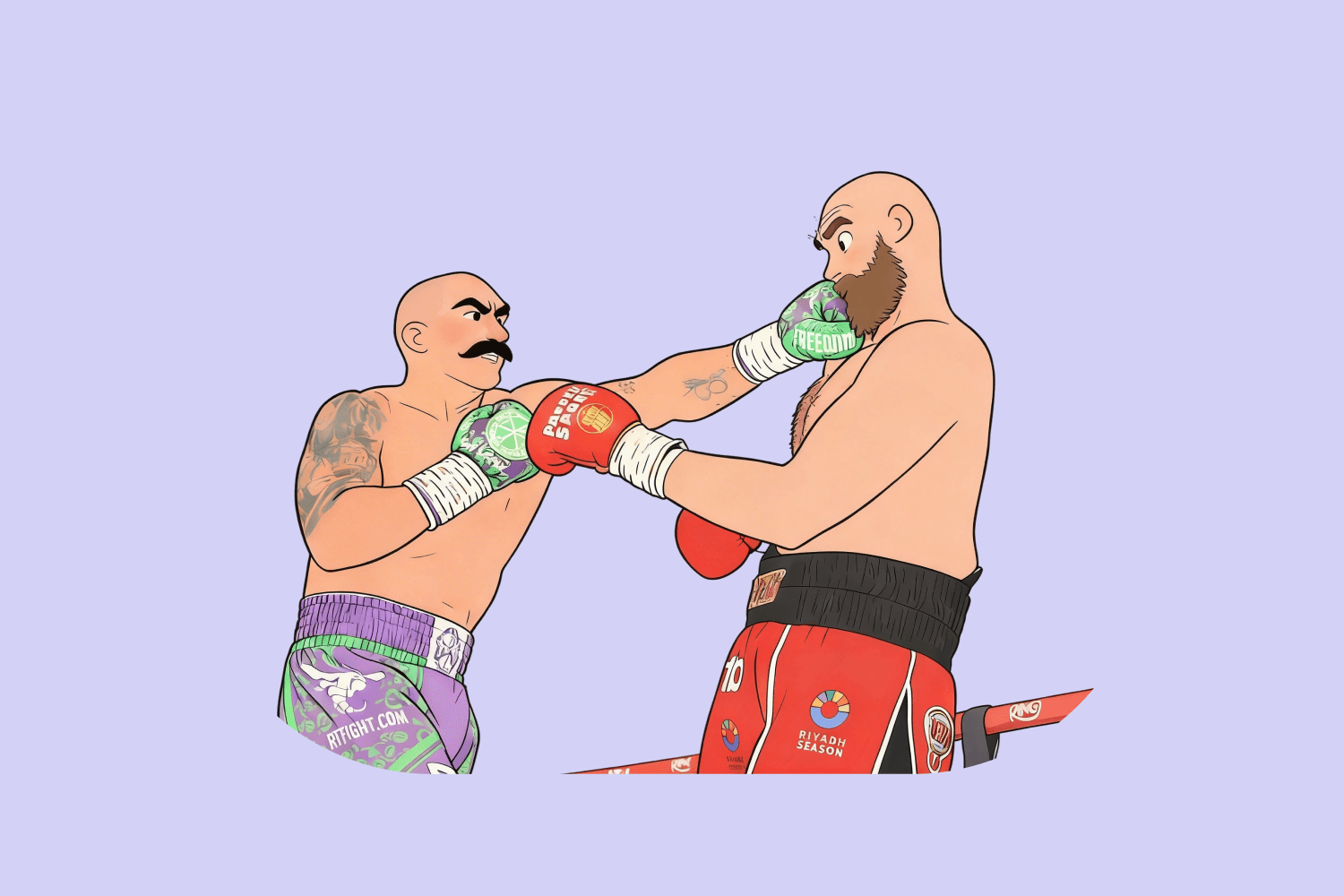
Before Oleksandr Usyk stepped into the ring with Tyson Fury for the undisputed heavyweight championship of the world in May 2024, he did something very unusual for a boxer.
He called Fury a "greedy belly."
Not a monster. Not a coward. Not something you'd hear in a locker room or a late-night movie. A greedy belly. Like something a five-year-old would say to a classmate who took the last piece of cake.
And somehow — it was perfect.
This article is about that. It's about the strange, funny, and surprisingly brilliant way Usyk uses English. It's about what his word choices reveal about language, tone, and the power of saying something unexpected. And yes — it's also a vocabulary lesson. Because if you're learning English, there's a lot to learn from a man who can dismantle a 6'9" opponent with the vocabulary of a primary school student.
Who Is Usyk? A Quick Introduction
Oleksandr Usyk is a Ukrainian professional boxer. He's widely considered one of the greatest heavyweight boxers of all time. In May 2024, he defeated Tyson Fury by split decision in Riyadh, Saudi Arabia, to become the undisputed heavyweight world champion — the first since 1999.
He's known for his footwork, his intelligence in the ring, and his deep Orthodox Christian faith. Outside the ring, he's also known for being deeply, almost philosophically calm — which makes his pre-fight commentary even funnier.
His English is not perfect. He knows it. He doesn't care. He says what he wants to say, and he says it with total confidence.
That's a lesson in itself.
What Does "Greedy Belly" Mean?
Let's start with the phrase that launched a thousand memes.
Before the Fury fight, Usyk referred to his opponent as a "greedy belly." In Ukrainian culture, this phrase (жадібне черево) carries a meaning similar to calling someone selfish, gluttonous, or driven purely by money and appetite. It suggests a person who always wants more — more money, more food, more attention — without thinking about others.
In English, "belly" just means stomach. "Greedy" means wanting more than you need. Put them together and you get an insult that's... technically a description. A very mild, almost nursery-rhyme description.
But the effect? Sharp. Because it reduces a 6'9" world champion to nothing more than a big, hungry stomach. It strips away all the swagger, the tattoos, the "Gypsy King" persona — and leaves just... an appetite.
That's actually very advanced communication. Even if the words are simple.
The Art of the Non-Swearing Insult
In English, the most powerful insults are often not the loudest. They're the most precise.
Calling someone a bad word is easy. Anyone can do it. But finding a phrase that perfectly describes someone's flaw — in plain, simple language — takes real thought. And it tends to stick in people's minds longer.
Here are a few classic examples of English insults that don't use profanity:
- "You have the personality of a damp sock." — The insult isn't the word "sock." It's the image. Wet, limp, slightly unpleasant. Unforgettable.
- "I've met furniture with more energy than you." — Comparing a person to a chair is somehow more devastating than an actual insult.
- "He's not the sharpest tool in the shed." — An English idiom meaning someone is not very smart. Said with a smile. Feels polite. Isn't.
What do these have in common? They use concrete, visual language to create a feeling. They paint a picture instead of attacking directly. And because they're unexpected, they catch people off guard.
Usyk does exactly this — except he does it in his second language, which makes it even more impressive.
Usyk's Greatest Hits: A Pre-Fight Vocabulary Lesson
Let's go through some of Usyk's most memorable pre-fight comments and break them down like the language gems they are.
"You are a big forehead."
Usyk said this to Fury during the pre-fight press conference. A "big forehead" is not a traditional insult in English. It's a physical observation. But the way Usyk delivered it — with complete sincerity, as if he were pointing out a fact on a weather report — made it hilarious and cutting at the same time.
What it tells us about language: Tone matters more than words. The same sentence can be a compliment, a neutral observation, or an insult — depending entirely on how you say it. In English, this is called prosody — the music of speech. Native speakers use it constantly.
"Greedy belly."
As we've established, this one is the crown jewel. In context, Usyk used it to suggest that Fury fights purely for money and not for love of the sport. The phrase works because it's both literal (Fury is a large man) and metaphorical (he's driven by appetite, not principle).
What it tells us about language: Compound nouns — two words joined to make a new meaning — are everywhere in English. "Greedy belly," "couch potato," "cold shoulder," "sweet tooth." These short, two-word phrases can carry enormous meaning. Learning them is one of the fastest ways to sound more natural in English.
"He doesn't want to fight. He wants money."
This one is technically not an insult at all. It's a statement. But the context makes it devastating — because it implies that Fury lacks the warrior spirit, the love of the game, the soul of a true fighter.
What it tells us about language: Sometimes the most powerful thing you can say is something that sounds neutral. This is called implicature in linguistics — when what you imply is stronger than what you say. It's a very advanced communication skill, and it's everywhere in English conversation.
1
Why Simple Language Is Often More Powerful
Here's something that surprises a lot of English learners: using big, complex vocabulary doesn't always make you sound smarter or stronger.
In fact, research from Princeton University found that readers and listeners often trust people who use simpler, clearer language more than those who use complicated words. Simple language suggests confidence. It says: "I know exactly what I mean, and I don't need fancy words to prove it."
Usyk's English is direct, visual, and honest. He says exactly what he sees. And because his words are simple, they're easy to understand — which means they land harder.
This is something native English speakers spend years trying to master. And a Ukrainian boxer is doing it naturally, in a second language, in front of millions of people.
The Vocabulary of Mild Insults: A Mini Dictionary
Let's build your own non-swearing insult vocabulary. These are real English expressions — some common, some a little creative — that you can study (and hopefully never need to use).
Basic insults using body references:
- "Big head" — Someone who thinks too highly of themselves (arrogant)
- "Thick skull" — Someone who is stubborn or slow to understand
- "Hollow chest" — Someone who appears strong but lacks real courage (less common, more poetic)
Animal comparisons:
- "You're a sheep" — You follow others without thinking
- "Stop being a weasel" — Acting in a sneaky, dishonest way
- "Don't be a chicken" — A very common phrase meaning: stop being afraid
Food-based insults (yes, really):
- "Couch potato" — Someone lazy who just sits around all day
- "Small fish" — Someone unimportant or low-level
- "Hot dog" — An old-fashioned term for someone showing off
Object comparisons:
- "A broken record" — Someone who keeps repeating the same thing
- "As useful as a screen door on a submarine" — Someone who isn't helpful at all
- "A wet blanket" — Someone who kills the mood or fun in a group
Notice anything? Most of these use concrete, everyday objects and images. Not abstract words. Not complicated grammar. Just pictures.
That's English wit at its best.
What English Learners Can Take From Usyk's Approach
There's something genuinely inspiring about the way Usyk speaks English in public.
He doesn't apologize for his accent. He doesn't pause and say "how do you say in English?" before every sentence. He just speaks. He finds the words he has, and he uses them with full conviction.
Here's what that looks like in practice — and what you can take from it:
1. Use the vocabulary you have, not the vocabulary you wish you had. Usyk doesn't reach for complicated words. He uses simple ones powerfully. If you're learning English, stop waiting until you know "enough" words before you start speaking. Start with what you have.
2. Tone carries meaning. You can say "that's interesting" in a way that means you find something genuinely fascinating — or in a way that means you think it's completely ridiculous. The words are the same. The tone is everything. Practice this.
3. Concrete images beat abstract statements. "You are a big forehead" is more memorable than "you are not a serious person." Always ask yourself: what does this look like? What image does it create?
4. Confidence is its own kind of fluency. Usyk speaks with total confidence despite making grammatical mistakes. People aren't laughing at him. They're listening to him. Because he believes what he's saying. That kind of energy is contagious — and learnable.
How to Practice This Kind of English
If you want to develop the kind of natural, expressive, confident English that Usyk demonstrates, the best thing you can do is practice speaking — not just studying grammar tables and memorizing word lists.
Real language lives in real conversations. And the fastest way to build confidence in speaking is to practice in a safe environment, where you can make mistakes without judgment.
That's exactly what Promova's AI Tutor is designed for. With voice-based speaking practice and instant feedback, you can rehearse real-life situations — from casual small talk to tense negotiations — without the fear of embarrassing yourself in front of a real person. Over 50 AI role-play scenarios let you explore different tones, situations, and vocabulary in a judgment-free space.
Promova also offers bite-sized lessons designed for busy schedules, so you can build vocabulary and grammar skills in short, focused sessions — and then practice using them with AI-powered conversation tools.
Final Thoughts
Usyk walked into the biggest fight of his career and called his opponent a "greedy belly." He became the undisputed heavyweight champion of the world.
Coincidence? Maybe. But there's a deeper lesson in there for anyone learning English. The goal of language isn't to impress people with complexity. It's to communicate clearly, memorably, and honestly. Simple words, used well, with genuine emotion and conviction — that's more powerful than any thesaurus.
Usyk didn't worry about his English level. He didn't wait until he was "ready." He used what he had, said what he meant, and trusted the listener to understand.
If you're learning English right now, that's the only model you need.
FAQ
What does "greedy belly" mean in English?
"Greedy belly" isn't a standard English phrase — it comes from Ukrainian and roughly means someone driven purely by appetite or money. Usyk used it to call Tyson Fury selfish and motivated only by profit. The phrase works in English because "greedy" (always wanting more) and "belly" (stomach) create a vivid, almost childlike image.
Can you insult someone in English without swearing?
Yes — and often more effectively. English is full of idioms, animal comparisons, and object metaphors that work as mild insults. Phrases like "couch potato," "big head," or "wet blanket" are common everyday expressions. The most memorable insults in English are usually visual and specific, not loud.
What can English learners take from Usyk's speaking style?
Usyk shows that confidence matters more than perfection. He uses simple vocabulary clearly and directly, which is actually an advanced communication skill. For learners, the key takeaways are: use the words you have, focus on tone, and practice speaking rather than waiting until you feel "ready."

 English
 Français
 Português
 Español


Comments