What Is Aegyo? Korean Cuteness in Phrases, Gestures, and Real Life

Contents
Key Takeaways
- Aegyo (애교) is a Korean style of cuteness expressed through voice, gestures, and facial expressions — common in K-pop, K-dramas, and everyday Korean life. It is deeply rooted in Korean society, serving as a social tool to elicit care and protection from others by mimicking childlike behaviors to foster strong interpersonal bonds.
- It’s not just for women or celebrities. Aegyo is used by people of all ages and genders to express affection, soften requests, or just have fun.
- Classic aegyo phrases include “오빠~” (oppa~), “싫어~” (shil-eo~, meaning “I don’t want to~”), and the iconic “보여줄게~” (boyeojulge~) from the “Gwiyomi Song,” a popular aegyo song known for its catchy, cute lyrics and adorable hand gestures.
- Learning aegyo helps you understand Korean social dynamics, pop culture, and informal conversation — not just cute phrases.
- You don’t have to perform aegyo yourself. But recognizing it when you hear it is essential for understanding Korean media and real conversations.
If you’ve watched any K-drama or listened to K-pop, you’ve seen it. The soft, whiny voice. The pouty lip. The little finger hearts. That’s aegyo — and it’s one of the most charming, fascinating, and sometimes hilarious parts of Korean culture.
Whether you want to use it yourself, understand it in context, or just stop feeling confused when your favorite idol does “the gwiyomi song,” this guide has you covered.
What Is Aegyo (애교)?
Aegyo (애교, pronounced eh-gyo) is a Korean word that refers to the cultural concept of behaving cutely. It’s a combination of a high-pitched or whiny tone of voice, exaggerated facial expressions, playful gestures, and specific phrases designed to seem adorable, endearing, or charming.
The word itself comes from two hanja characters: 愛 (ae, meaning love or affection) and 嬌 (gyo, meaning coquettishness or charm). Put them together and you get “lovable charm” — which is exactly what aegyo is. The Asia Pacific Journal describes aegyo as a culturally specific phenomenon connected to hierarchical societal structures and social expectations in Korea.
In Korean society, aegyo is a real social skill. It’s often used as a social lubricant to soften requests and lighten the mood in interpersonal relationships. Aegyo is generally perceived as a feminine quality in South Korea, reflecting traditional gender roles that associate women with appeal and subservience, while men are linked to charisma and authority.
Is Aegyo Only for Women?
Short answer: no.
Aegyo is generally associated with young women in South Korea, reflecting traditional gender roles that link femininity with cuteness and subservience. This association is especially visible in Korean girl groups and female celebrities, where aegyo is used to conform to societal expectations around femininity, youth, and age-specific social roles.
However, aegyo is also used by guys, particularly in romantic relationships. Women often use aegyo to flirt or show affection toward a guy, employing cute gestures and speech styles—such as calling a boyfriend "oppa"—to soften interactions or navigate social expectations. This dynamic highlights how aegyo plays a role in interpersonal and romantic relationships in Korean culture.
What matters isn’t gender — it’s context and relationship. Aegyo between close friends reads as warmth and playfulness. Aegyo from an idol toward fans signals appreciation and connection. Aegyo used badly or in the wrong setting can feel forced or strange.
Like most social tools, aegyo is about knowing when to use it and who you’re using it with.
Common Aegyo Phrases in Korean
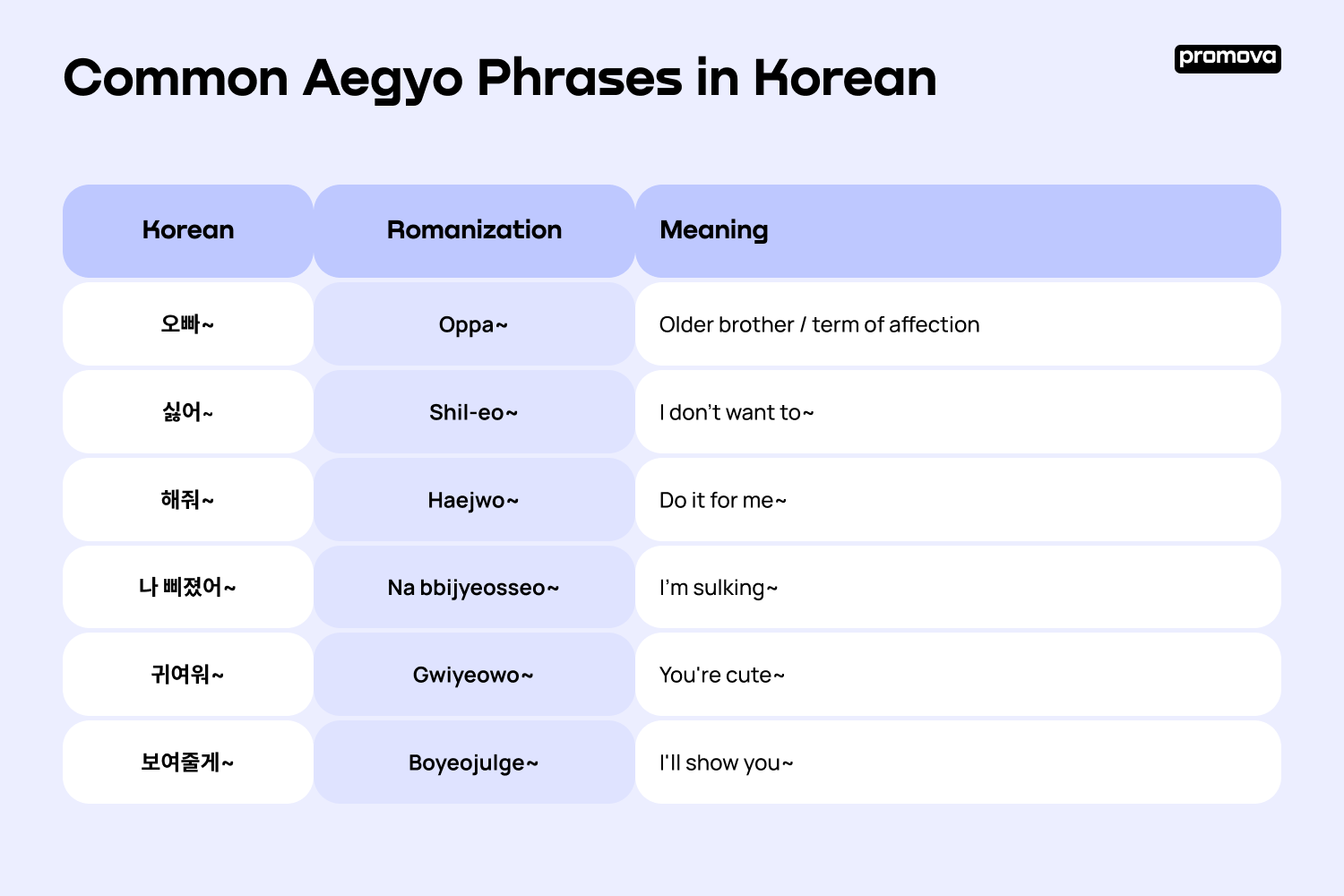
Here are some of the most widely used aegyo expressions, complete with pronunciation, meaning, and context. Aegyo isn’t just about what you say, but how you say it—using specific speech patterns, adjusting your voice to sound cute, and speaking in a way that leaves a playful, charming impression. Performing aegyo often involves high-pitched vocals, pouting, puppy-dog eyes, and gestures like hand hearts. It can also include baby talk and pet-like gestures, deliberately altering normal speech to enhance your charm.
1. 오빠~ (Oppa~)
Pronunciation: Oh-ppa Literally means “older brother” but is used by women to address older male friends, boyfriends, or male celebrities they feel close to. When spoken in a soft, drawn-out tone with a slightly higher pitch, it’s pure aegyo. This speech style is an invitation for attention, affection, or a favor.
2. 언니~ (Unnie~)
Pronunciation: Eon-ni The female equivalent — used by women to address older female friends or celebrities. Use the same soft, stretched delivery and playful speech for the full aegyo effect.
3. 싫어~ (Shil-eo~)
Pronunciation: Shil-eo Literally “I don’t want to” or “I don’t like it.” When said in a whiny, playful tone, it becomes an aegyo classic — a cute protest that’s half-serious, half-charming. Stretching the final vowel and softening the sound creates a childlike impression.
4. 해줘~ (Haejwo~)
Pronunciation: Hey-jwo Means “do it for me~” or “please do it~.” Said softly with big eyes and a light, bouncy rhythm, this phrase is aegyo in action — asking for something in the most disarming way possible.
5. 나 삐졌어~ (Na bbijyeosseo~)
Pronunciation: Na bbij-yeo-sseo Meaning “I’m sulking~” or “I’m pouting~.” This one’s used playfully to signal that you’re (pretend-)upset, usually to get attention or sympathy. Using baby talk and a gentle, high-pitched sound enhances the cute impression.
6. 보여줄게~ (Boyeojulge~)
Pronunciation: Bo-yeo-jul-ge Means “I’ll show you~.” You might recognize this from the famous “Gwiyomi Song” (귀요미 송), where the performer counts from one to seven while doing cute gestures. It went viral globally and introduced millions of people to aegyo for the first time.
7. 귀여워~ (Gwiyeowo~)
Pronunciation: Gwi-yeo-wo Simply means “you’re cute~.” Said with a soft voice, stretched vowels, and a smile, it’s both a compliment and a way of expressing warmth.
Classic Aegyo Gestures and Expressions
Aegyo isn’t just words. The physical performance is just as important — sometimes more so. Aegyo is performed through cute hand gestures and full-body movements, such as playful stomping or exaggerated gestures, which enhance its appeal and are often seen in K-pop performances and dramas.
The Pout (삐침 bbichim) Pushing the lower lip out, turning away slightly, and looking sulky. Often paired with “나 삐졌어~.” It’s the classic “I’m not mad, I’m just a little mad” look.
The Finger Heart (손가락 하트 son-garak hateu) Made by crossing the index finger and thumb to form a tiny heart. This gesture originated in Korean pop culture and spread globally. It signals affection, warmth, and connection — all in one tiny hand movement.
Cheek Squish (볼 꼬집기 bol kkojipgi) Pinching or squishing your own cheeks to look cute and childlike. Sometimes other people do it to you as a sign of affection.
The Head Tilt with Big Eyes Tilting the head to one side while widening the eyes and softening the expression. Smiling is an important part of authentic aegyo, as it conveys warmth, playfulness, and sincerity. This is the visual cornerstone of aegyo — innocent, open, and endearing.
The V Sign (브이 브이) The peace sign held under the chin or beside the face. Simple, cheerful, and almost universally understood in Korean photo culture.
Gwiyomi Number Pose Each number from one to seven corresponds to a specific gesture in the Gwiyomi Song. For example: “one one” = make a small circle with your fingers, “two two” = both hands in a V shape, and so on. These cute hand gestures are part of a broader display of affection or charm, often involving the whole body to maximize appeal. If you’ve seen this, you know exactly how it looks. If you haven’t — search for it. You’ll understand aegyo instantly.
Dressing in a cute way can also enhance the overall effect of aegyo, making the presentation even more adorable and effective.
1
Aegyo in K-Pop and K-Dramas
Aegyo is a key part of Korean popular culture, especially in the world of K-pop, where idols act out charming and cute behaviors to captivate fans. This highly performative element is vital in K-pop, with idols showcasing their adorable side as an act to connect with audiences and express affection.
The global spread of aegyo has been fueled by K-pop and the fantasy-like world created in performances and fan events, where fans and idols alike embrace playful gestures and themed settings. Fan meetings, reality shows, and variety programs regularly include “aegyo challenges” where idols act cute on command — usually to the delight (and sometimes embarrassment) of everyone involved.
In K-dramas, aegyo shows up in romance storylines and comedic moments. A character might pout to get out of trouble, whine to ask for something, or use a soft voice to show they care about someone. It’s shorthand for intimacy and playfulness — and understanding it makes watching Korean content much richer.
Some notable aegyo moments in pop culture include BTS member Jimin’s consistently playful aegyo in fan cams, BLACKPINK’s Lisa doing the Gwiyomi Song, and countless K-drama scenes where the lead character begs for forgiveness with the most dramatic pout imaginable.
When to Use (and Not Use) Aegyo
Aegyo works best when you have a sense of timing and the social ability to read the room. Here’s a quick guide:
Good situations for aegyo:
- With close friends who share the cultural understanding, especially when performed in a playful manner
- In playful, affectionate situations with a romantic partner, using a cute manner of speech or behavior
- When watching or participating in K-pop fan culture, where the manner of aegyo is often exaggerated for fun
- In informal, fun social settings with Koreans who appreciate the humor—generally, aegyo is accepted and even expected in these contexts
Situations to avoid aegyo:
- In professional or formal settings (it will seem very strange, regardless of manner)
- With people you’ve just met or don’t know well, as the manner of aegyo may be misinterpreted
- When the other person isn’t responding positively — some people find excessive aegyo grating or cringey, especially if the manner is over-the-top
Like most cultural tools, reading the room is everything. Successfully using aegyo requires the ability to sense social cues and adapt your manner accordingly. Koreans themselves have a full range of opinions on aegyo — some find it charming, others find it exhausting or cringey in its extreme forms, but it remains a deeply embedded and generally accepted part of social interaction in Korea. Many also find it funny when foreigners attempt it earnestly.
What Aegyo Tells You About Korean Culture
Learning aegyo is about more than memorizing cute phrases. It reveals something deeper about how Koreans express emotion and navigate relationships, evoking qualities seen in babies, such as innocence and vulnerability.
In Korean culture, direct emotional expression — especially vulnerability — can be uncomfortable in formal settings. Aegyo offers an indirect, playful way to express affection, make a request, or lighten a tense moment. It’s emotional communication wrapped in humor, and is esp. prominent in South Korea as a sort considered characteristic of Korean social interaction. Younger generations are actively adopting and adapting aegyo in digital communication to express intimacy, playfulness, and social identity. Aegyo is also a cultural expression used to build intimacy and show warmth in relationships and family dynamics.
It also reflects the importance of age and hierarchy in Korean social structure. Honorifics like oppa, unnie, hyung (형, older brother used by males), and noona (누나, older sister used by males) carry emotional weight. Using them in an aegyo tone softens and sweetens those existing relationships.
Understanding this helps you decode a lot of Korean social interaction — not just in pop culture, but in everyday life.
How to Practice Aegyo Phrases in Korean
If you want to actually learn and use these phrases — not just recognize them — here are a few practical steps.
- Start by listening. Watch K-dramas or variety shows and pay close attention to how native speakers deliver aegyo phrases. The tone, speed, and facial expression all work together.
- Repeat out loud. Pronunciation in Korean is specific, and aegyo phrases depend on the delivery as much as the words. Practice saying them aloud — even if it feels strange at first.
- Learn the context. Don’t just memorize a phrase. Understand when it’s used, who uses it, and what emotional effect it creates. That’s what makes language feel real.
Practicing aegyo phrases is a fun way to learn Korean and improve your language skills. Promova’s language-learning app includes Korean courses that cover real-life vocabulary and conversational expressions like these.
FAQ
What does aegyo mean in Korean?
Aegyo (애교) means lovable charm or cuteness. It refers to a style of expression in Korean culture that combines a sweet tone of voice, specific phrases, and playful gestures to appear endearing or affectionate. It’s widely used in K-pop, K-dramas, and everyday Korean social interactions.
Can non-Koreans use aegyo?
Yes, but with context. Many Koreans find it charming and fun when foreigners try aegyo — especially in K-pop fan settings. That said, it’s better to understand the cultural context before using it, and to read the room. Aegyo works when it’s playful and genuine, not forced or performative.
Is aegyo childish?
Not by Korean cultural standards. While it does mimic childlike behaviors, aegyo in Korean culture is understood as a form of affectionate expression between adults. It becomes childish or inappropriate only when used in the wrong context — such as formal settings or with strangers.
What is the Gwiyomi Song?
The Gwiyomi Song (귀요미 송) is a famous Korean song associated with a specific sequence of cute poses and gestures, counting from one to seven. It went viral internationally around 2013 and became one of the most recognizable examples of aegyo in global pop culture. Many K-pop idols and celebrities have performed their own version.



 English


Comments