Best Language Learning Apps in 2026: Find the Right One for You
Contents
Key takeaways
- What the best language learning app is depends on your goal: building vocabulary, improving grammar, practicing speaking, or all three.
- Top apps in 2026 include Promova, Duolingo, Babbel, Busuu, Rosetta Stone, Pimsleur, PolyChat, and italki — each with a different approach and strength.
- Online language providers split into three delivery models — self-paced apps, live tutoring marketplaces, and corporate training licensed by an employer. Deciding which one you need narrows the field faster than comparing features.
- Most language learning apps are free to start, with premium features available through a subscription.
- Speaking practice is the biggest gap in most apps. Look for platforms that offer AI conversation practice or access to live tutors if speaking is your priority.
- Using three apps — one for grammar, one for reading/listening, and one for speaking practice — can provide a more comprehensive language learning experience.
- Daily lessons are essential for building consistency and making steady progress, no matter which app you choose.
There are dozens of language learning apps out there. Some gamify the whole experience. Some are built around live tutors. Some focus on listening. Some promise fluency in three months (spoiler: that’s a stretch for most learners).
So how do you find the one that actually works for you?
This guide breaks down the top language learning apps available in 2026 and explains what each one does well, who it’s for, and what to consider before you commit.
What to look for in a language learning app
Before comparing specific apps, it helps to know what actually matters in a language learning platform. Here are the key things to evaluate:
Languages offered: Some apps cover 40+ languages, while others focus on a handful. If you’re learning a less common language, your options narrow quickly. Some platforms offer courses tailored for English speakers and support for other languages, catering to diverse linguistic backgrounds.
Learning method: Apps vary widely: some focus on vocabulary drills, grammar explanations, listening exercises, and speaking practice, while others emphasize immersive learning or multimedia resources. You'll find platforms that provide grammatical explanations in English, as well as some that only use your target language. Consider whether the app of your choosing helps you learn grammar, build language skills, and offers courses for different needs, including options for intermediate learners.
Speaking practice: This is the area where most apps fall short. Reading and listening are easier to scale with software. Real conversation practice — especially the kind where you get feedback — is harder. Luckily, many platforms now offer AI-driven practice conversations, real-time grammar and phrasing corrections, and even AI conversation partners to simulate real-world speaking. Look for apps that offer AI-powered speaking tools, speech recognition, or access to human tutors for effective practice conversations and pronunciation feedback.
Structure vs. flexibility: Some learners want a clear path from A1 to B2, while others want to explore topics freely. Effective apps offer a well-organized lesson structure, with core lessons and structured learning plans that build logically from basic to advanced concepts. This logical progression helps learners — especially beginners — avoid feeling overwhelmed and supports steady progress.
Time commitment: If you have 10 minutes a day, you need something different than someone who can study for an hour. Many language learning apps offer short, bite-sized lessons (typically 5–15 minutes) to fit busy schedules and maintain engagement.
Review system and vocabulary reinforcement: A strong review system is essential for reinforcing new vocabulary and concepts. Look for apps that use spaced repetition and adaptive review to help you retain what you’ve learned and progress efficiently.
Price: Most apps have a free tier, but meaningful features often sit behind a paywall. Paid apps typically offer more comprehensive content, advanced features, and better value for serious learners compared to free versions or other learning methods. Always make sure you know what you’re getting before paying.
Apps, tutors, or corporate training — which kind of provider do you need?
Before comparing individual apps, it helps to know that online language providers split into three quite different delivery models. Most comparison articles mix them together, which is why the recommendations you read often contradict each other: the platform that works best for a company rolling out training to 200 employees is rarely the one you would pick to prepare for a two-week holiday.
| Delivery model | How it works | Best for | Examples |
|---|---|---|---|
| Self-paced apps | Structured courses you work through on your own, on a phone or in a browser, usually on a subscription | Building a daily habit, vocabulary and grammar, learning around a full schedule | Promova, Duolingo, Babbel, Busuu, Rosetta Stone |
| Live tutoring marketplaces | You book individual teachers by the hour and pay per lesson; the tutor builds the plan with you | Speaking practice, exam preparation, pronunciation work — anything that needs human feedback | italki, Preply |
| Corporate and team training | Licensed by an employer, with admin dashboards, assigned learning paths and progress reporting | Employee development, onboarding international teams, outcomes HR can actually measure | Promova for Business, Berlitz, Babbel for Business, Preply Business |
The three are not mutually exclusive, and committed learners often pair a self-paced app with occasional tutor sessions. But working out which row your goal sits in narrows the field faster than any feature comparison. If you are choosing on behalf of a team rather than yourself, corporate language training is a different purchase with different criteria — seat management, level testing and reporting matter more than streaks or gamification.
The rest of this guide focuses on the first row: self-paced apps you can start on your own today.
Top language learning apps in 2026
Duolingo
Best for: Complete beginners who want a low-pressure, gamified introduction to a new language.
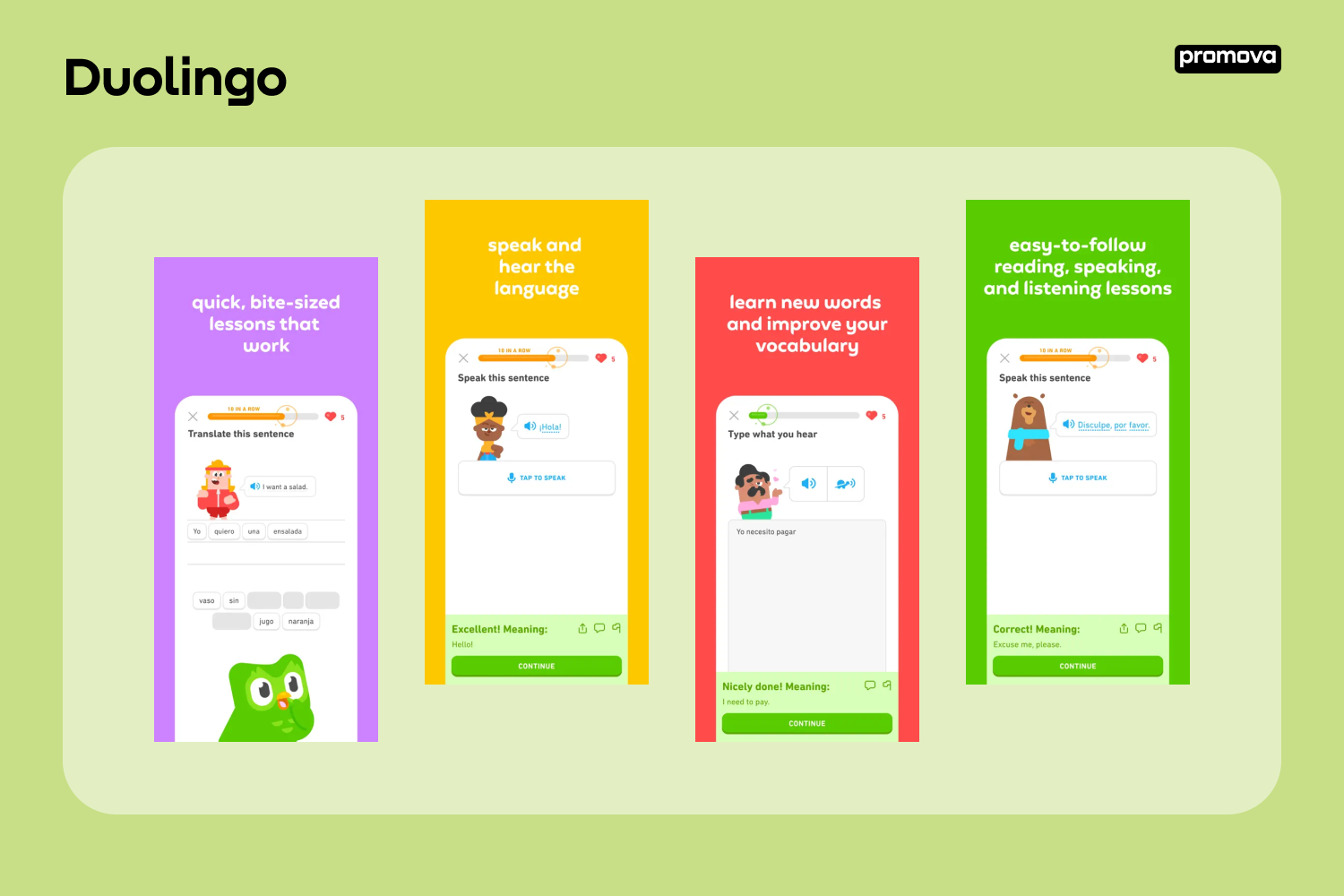
Duolingo is one of the most downloaded language apps in the world — and for good reason. It’s free, fun, and incredibly easy to start. Lessons are short (typically 5–15 minutes), which makes it a great choice for those with a busy schedule. The streak system keeps you coming back, and the gamification makes it feel more like a game than studying.
Duolingo uses a review system based on spaced repetition to reinforce new vocabulary, helping learners retain words and phrases over time. The app provides English explanations for grammar and vocabulary, which can be especially helpful for beginners. However, Duolingo’s speaking exercises are limited compared to other apps, and its speaking practice can feel inconsistent. While it’s excellent for building a basic vocabulary foundation and getting comfortable with a language’s sounds and patterns, it’s less effective for in-depth grammar explanation, nuanced speaking practice, or reaching advanced levels. Many learners use it as a daily habit tool alongside a more structured resource, as other apps may offer more comprehensive speaking exercises or advanced content.
- Languages: 40+ (supports lessons for English speakers as well as other languages)
- Free plan: Yes (with ads and limited hearts)
- Premium: Duolingo Plus (ad-free, unlimited hearts)
- Platforms: iOS, Android, web
- Standout feature: Gamification and daily streaks
Compared to other apps, Duolingo stands out for its accessibility and engaging approach, but it may lack the depth and robust speaking exercises found in more advanced or specialized platforms.
Promova
Best for: Learners who want structured courses, real-life vocabulary, and AI-powered speaking practice in one place.
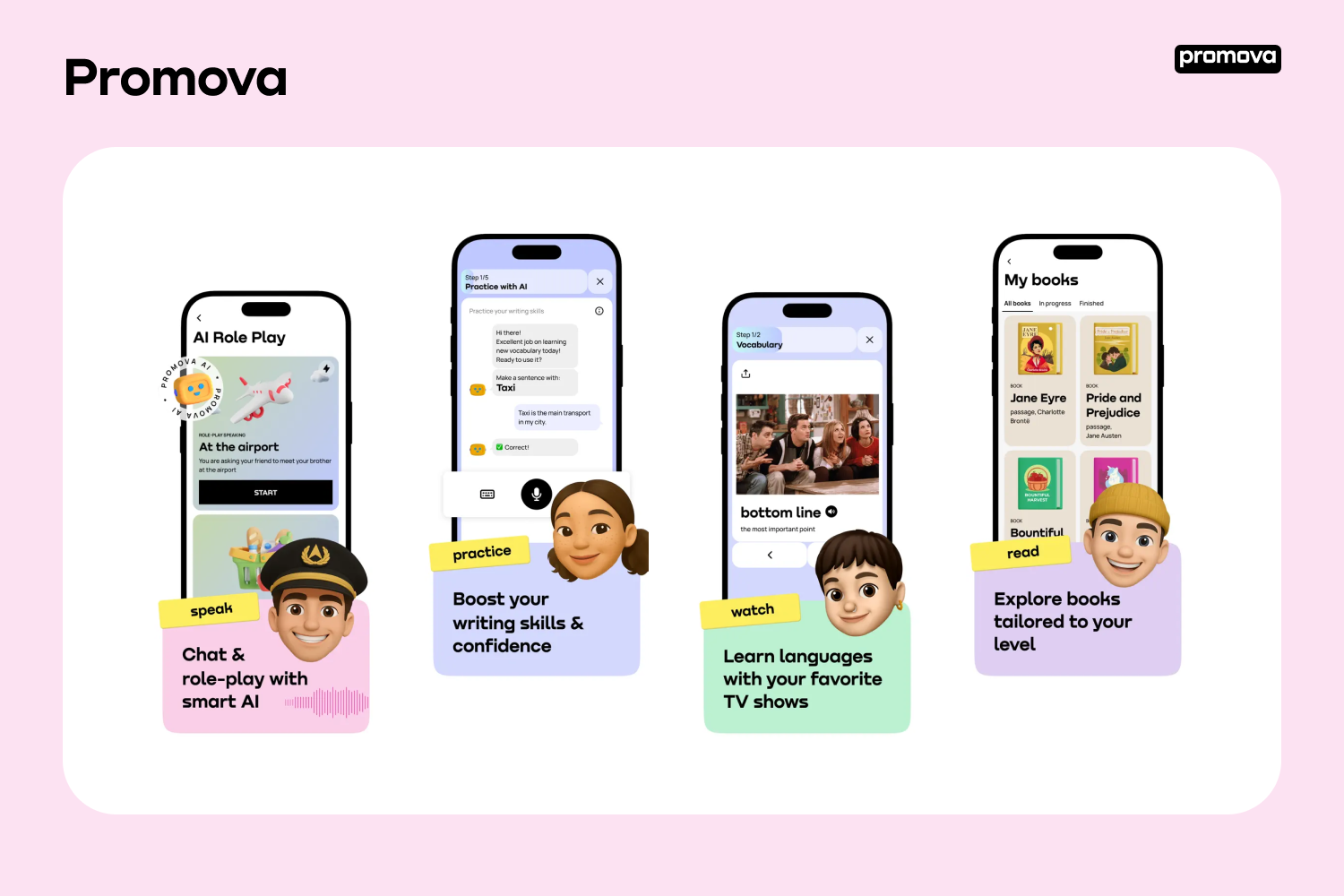
Promova is a language learning platform designed around two core problems: not having enough time and being afraid to speak. It addresses both with bite-sized lessons that fit into a busy day and an AI Tutor that acts as an AI conversation partner, allowing you to practice speaking in real-life scenarios with real-time grammar and phrasing corrections to enhance your learning experience.
Promova offers courses for English speakers and speakers of other languages, with core lessons structured around building vocabulary, grammar, and conversation skills. The platform's review system helps reinforce new words and concepts, supporting better retention and progression. Courses are structured from A1 to C1 and cover practical topics, such as business, travel, small talk, and daily life. The AI role-play feature puts you in real-life conversations, like ordering food, talking to a doctor, or navigating a job interview. You always get feedback at the end, so you know exactly what to improve.
- Languages: 13+, including English, Spanish, French, German, Korean, Japanese, and more
- Free plan: Yes (with limited lessons per day)
- Premium: Promova Premium and Promova Fluent subscriptions available
- Platforms: iOS, Android, web
- Standout feature: AI role-play with end-of-session feedback
2
Babbel
Best for: Adult learners who want structured, practical conversation skills in European languages.
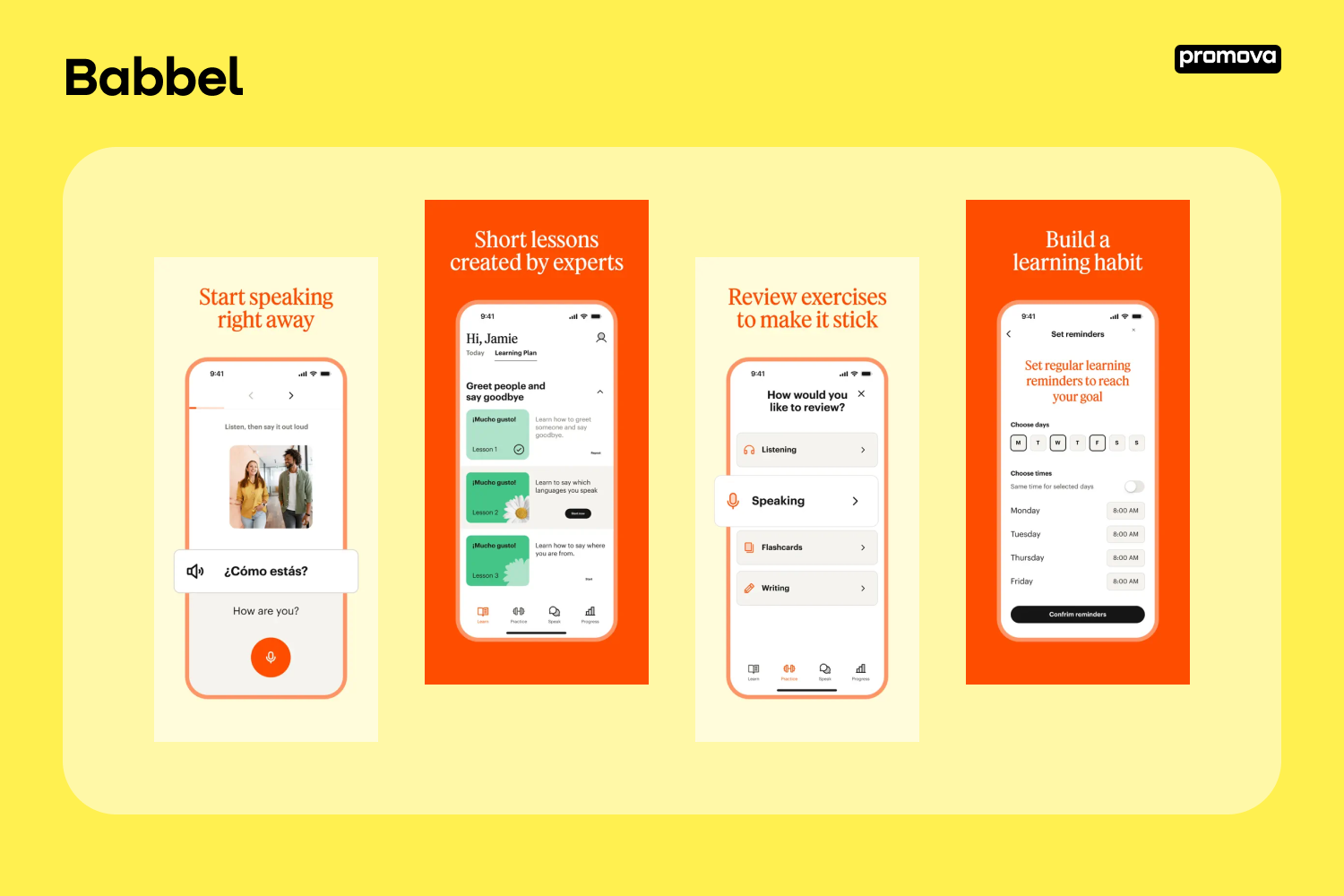
Babbel takes a more academic approach than Duolingo. Its core lessons introduce key vocabulary, grammar, and conversation skills in a structured way, with learning material created by a team of language experts and focused on real-life dialogue — things you’d actually say in a conversation. Babbel is strong in developing conversational skills and provides clear grammatical and English explanations throughout its curriculum. While Babbel focuses on practical dialogue, it offers limited opportunities for extended conversations, which may be a consideration for learners seeking more in-depth speaking practice.
Babbel has courses tailored to different skill levels and needs, ensuring a fit for both beginners and more advanced learners. The app includes a review system to reinforce learning and help with retention. Grammar is explained clearly, not hidden inside exercises.
The app is particularly strong for European languages: Spanish, French, German, Italian, Portuguese, and others. It’s less expansive than Duolingo in terms of language selection, but the quality of its core courses is consistently high. Babbel also offers a money-back guarantee for a limited time, allowing users to try the service risk-free before committing to a subscription.
- Languages: 14 (focused on European languages)
- Free plan: First lesson of each course only
- Premium: Subscription required for full access
- Platforms: iOS, Android, web
- Standout feature: Expert-designed dialogue-based lessons
Busuu
Best for: Learners who want a CEFR-structured course plus written and spoken feedback from native speakers.
Busuu sits between a course platform and a community. Its lessons follow CEFR levels from A1 to C1 and are built around themed conversational scenarios, with vocabulary, grammar, and pronunciation practice in each unit. What sets it apart is the community layer: you submit short written or spoken exercises, and native speakers in the Busuu community correct them — a rare source of human feedback in an otherwise automated category.
Busuu also runs travel-specific mini-courses and, on its top tier, offers official language tests created by McGraw Hill. The trade-offs are worth knowing: the free Basic plan is heavily limited, course depth varies by language (English, Spanish, French, and German reach C1, while most others stop at B2), and AI conversation practice with pronunciation feedback sits behind Premium Plus rather than the standard Premium tier.
- Languages: 14
- Free plan: Yes (Basic — heavily limited)
- Premium: Premium and Premium Plus subscriptions
- Platforms: iOS, Android, web
- Standout feature: Corrections from native speakers in the Busuu community
PolyChat
Best for: learners who want customizable practice, lessons for slang, dating, real-world speech, plus a free tier that doesn't ration your study time.
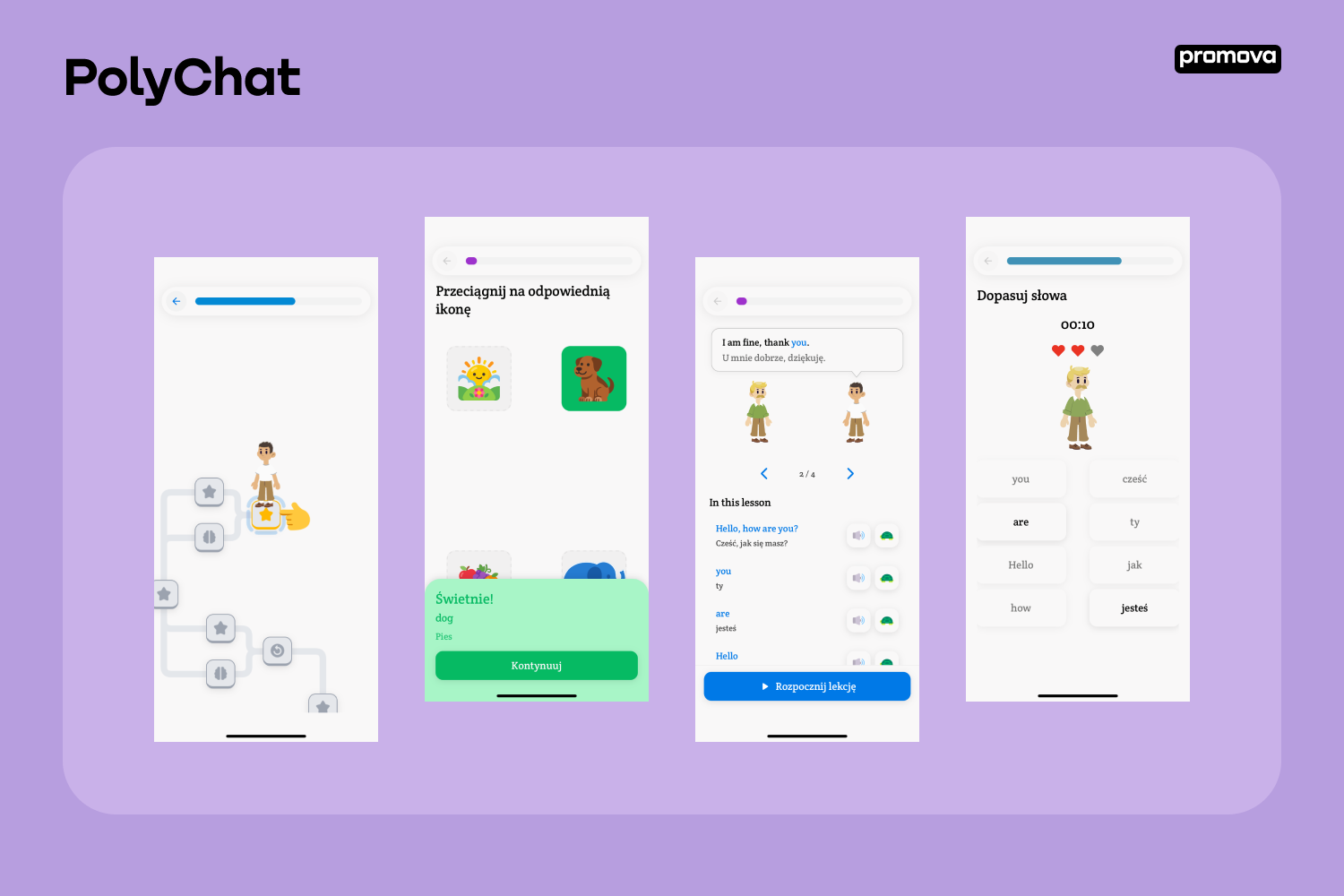
PolyChat's standout tools are a custom lesson creator that generates conversations and exercises on any topic, and Adult Mode for slang, dating, and the real-world speech textbook courses skip. The free tier is generous too: unlimited daily practice with no hearts, energy caps, or mid-session stop signs, across 17 languages and any base-language direction.
If you've outgrown cookie-cutter paths but still want structure you can shape yourself, PolyChat is a strong fit.
- Languages: 17
- Free plan: Yes (unlimited daily practice)
- Premium: Custom lessons, Adult Mode, and advanced features
- Platforms: iOS, Android, web
- Standout feature: Custom lessons + Adult Mode, with unlimited free practice
Rosetta Stone
Best for: Learners who prefer immersive, translation-free learning, especially visual learners.
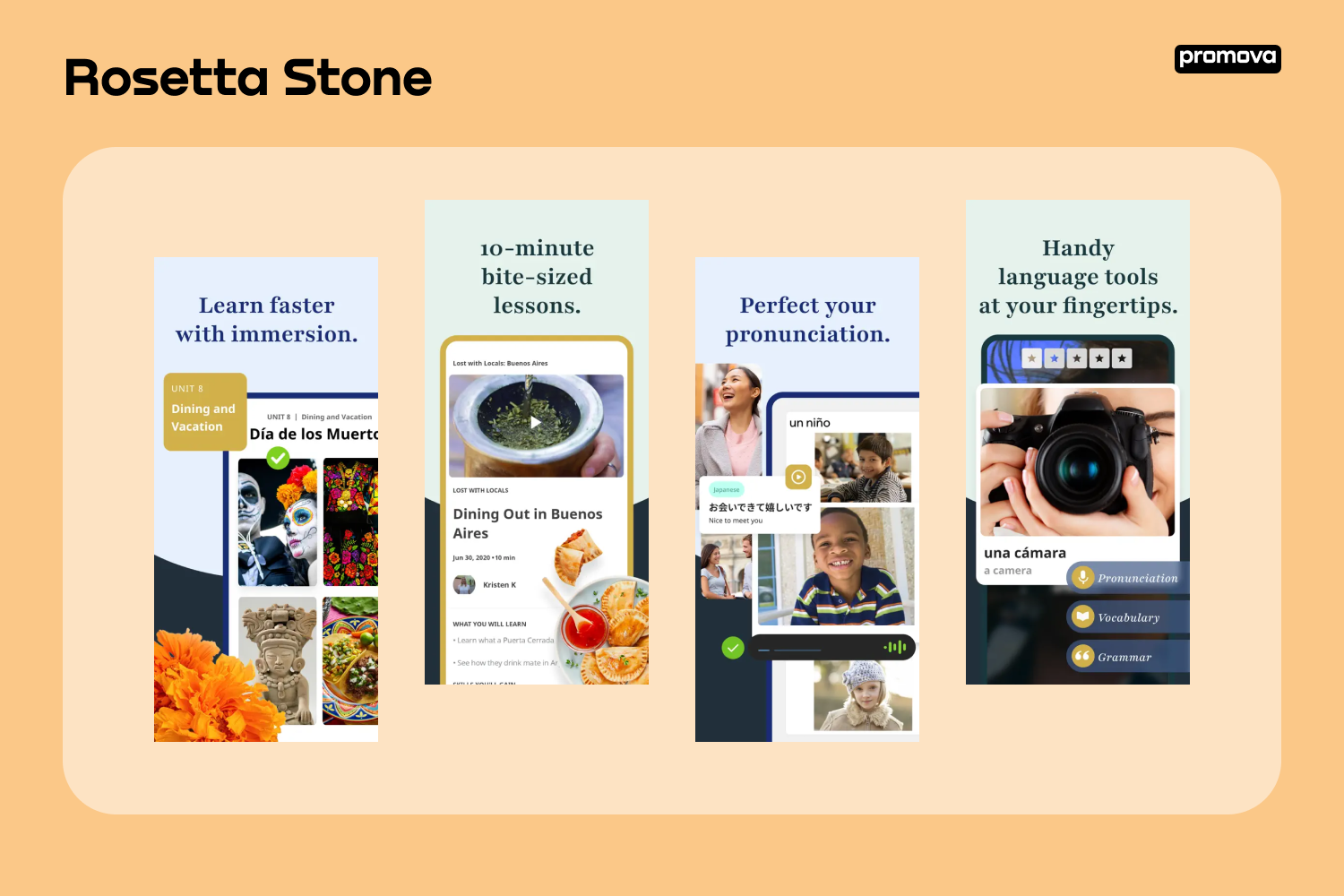
Rosetta Stone is one of the oldest names in language learning, and its method is distinctive: it teaches entirely through images and context, without translating into your native language. This immersion method is especially effective for visual learners, as it relies on recognizing patterns and matching visuals to words. Rosetta Stone avoids English explanations, focusing instead on learning through context and images to build an instinctive understanding of the language, the way children learn their first one.
To deepen understanding of local culture, Rosetta Stone includes cultural insights and may supplement lessons with additional resources such as YouTube videos and on-demand content.
This approach works well for some learners and frustrates others. If you like structured grammar explanations or want to understand why something works the way it does, Rosetta Stone may feel too indirect. But for learners who thrive with immersive, context-heavy learning, it’s a solid option.
- Languages: 25
- Free plan: Trial only
- Premium: Subscription or lifetime access available
- Platforms: iOS, Android, web
- Standout feature: Immersive, translation-free methodology
Pimsleur
Best for: Learners who want to focus on speaking and listening, especially while commuting or exercising.
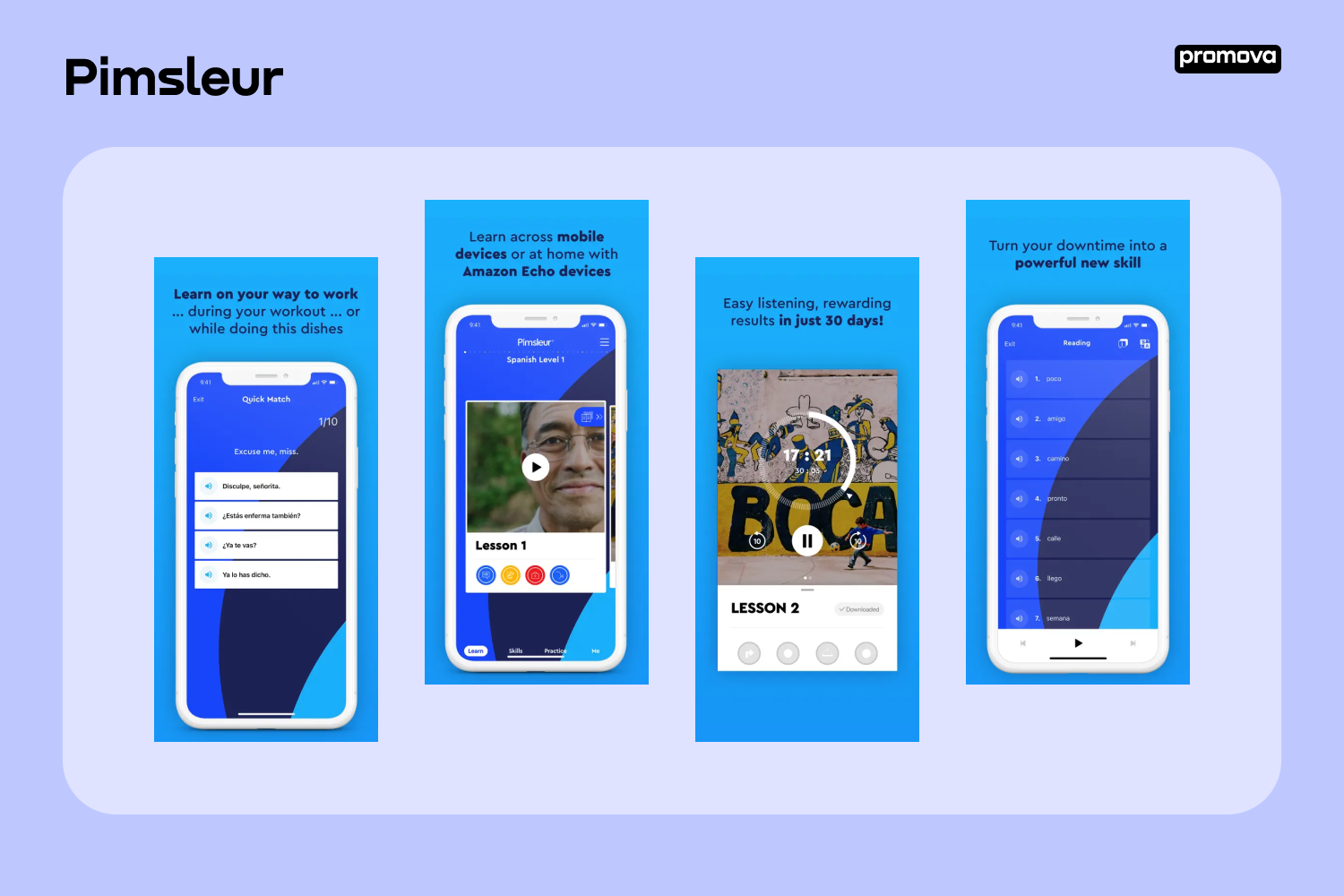
Pimsleur is an audio-first language learning program built around the Pimsleur method, which emphasizes spoken language through full-length, classroom-style audio lessons. Pimsleur's lessons are designed to immerse you in real conversations, helping you practice pronunciation and understand native speakers in real-life situations. Each lesson is 30 minutes long and delivered entirely through listening and speaking — no screen required — which makes it ideal for busy learners who want to improve their pronunciation and listening skills through audio-based conversation. You simply listen to dialogues, repeat phrases, and respond to prompts, focusing on oral language acquisition without relying on transcription or written exercises. It’s one of the few programs that prioritizes speaking from day one.
The method is based on spaced repetition and graduated interval recall — principles with strong backing in memory research. The downside: no reading or writing practice, and it’s one of the pricier options on this list.
- Languages: 50+
- Free plan: First lesson free
- Premium: Subscription required
- Platforms: iOS, Android, web (audio-focused)
- Standout feature: Audio-based, hands-free learning format
Copycat Cafe
Best for: Learners who understand more than they can comfortably say and want structured speaking practice through real conversations.
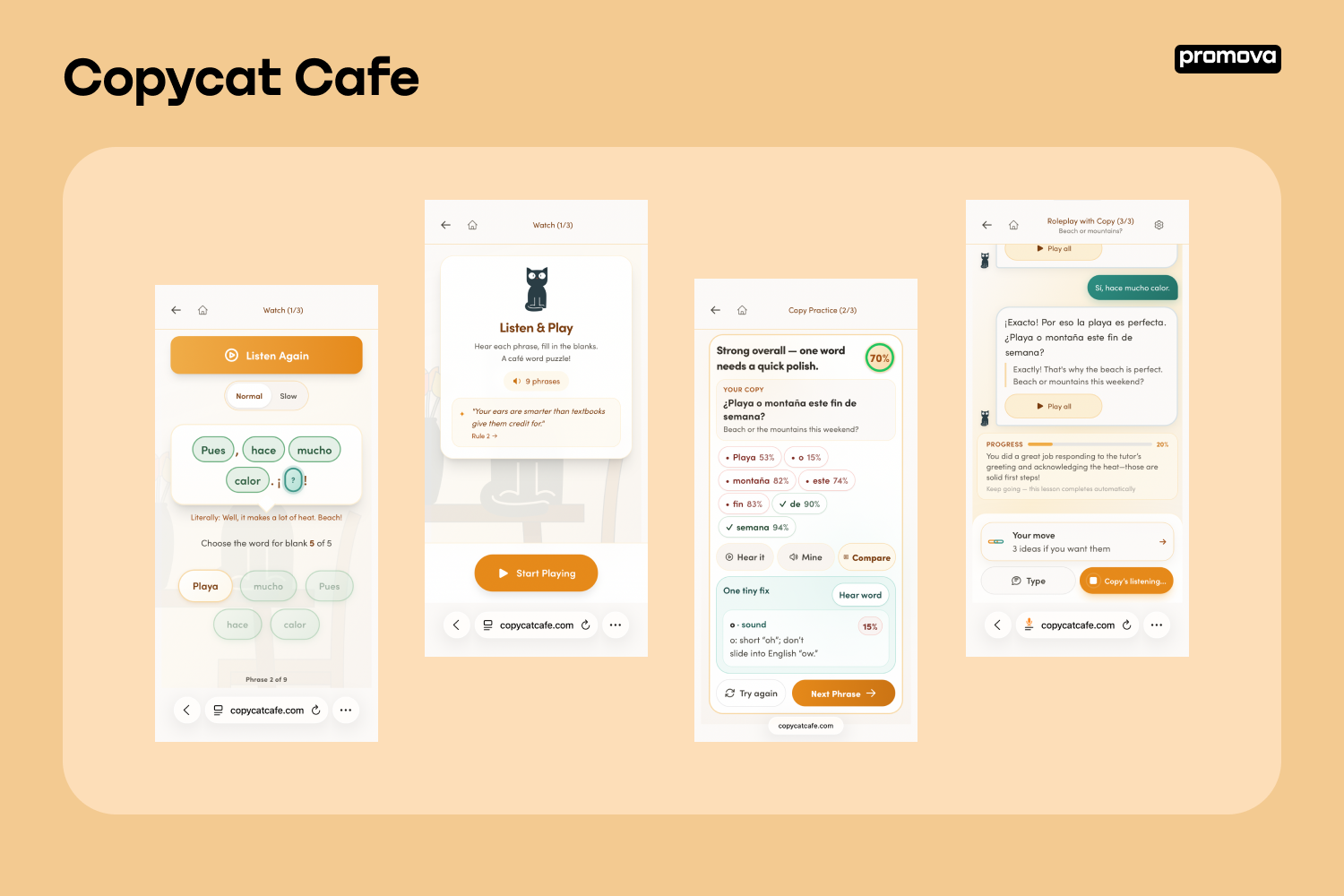
Copycat Cafe is built around a simple idea: people learn to speak by listening and copying before they can produce the language independently. Its Copycat Method follows three steps — Watch, Copy, Chat — designed to move learners from understanding a conversation to saying the words themselves.
Each lesson begins with a real-life dialogue spoken by native voices. Learners listen first, then copy each line aloud and receive a 0–100 pronunciation score with word-level feedback. The lesson ends with a guided conversation with Copy, an AI conversation partner, so learners can use the phrases they have just practiced in context.
Copycat Cafe currently offers French and Spanish. Both courses include 200 structured lessons from A1 to B2, with the same speaking, pronunciation, conversation, grammar-in-context, and spaced-repetition features. German, Italian, Portuguese, and more languages will be added soon.
- Languages: 2 (French and Latin American Spanish; more languages planned)
- Free plan: 7-day free trial
- Premium: One subscription includes every currently available language
- Platforms: Web, iOS coming soon
- Standout feature: The Watch → Copy → Chat method, combining native conversation audio, pronunciation scoring, and guided AI conversation
italki
Best for: Learners who want to practice speaking with real native speakers or certified tutors.
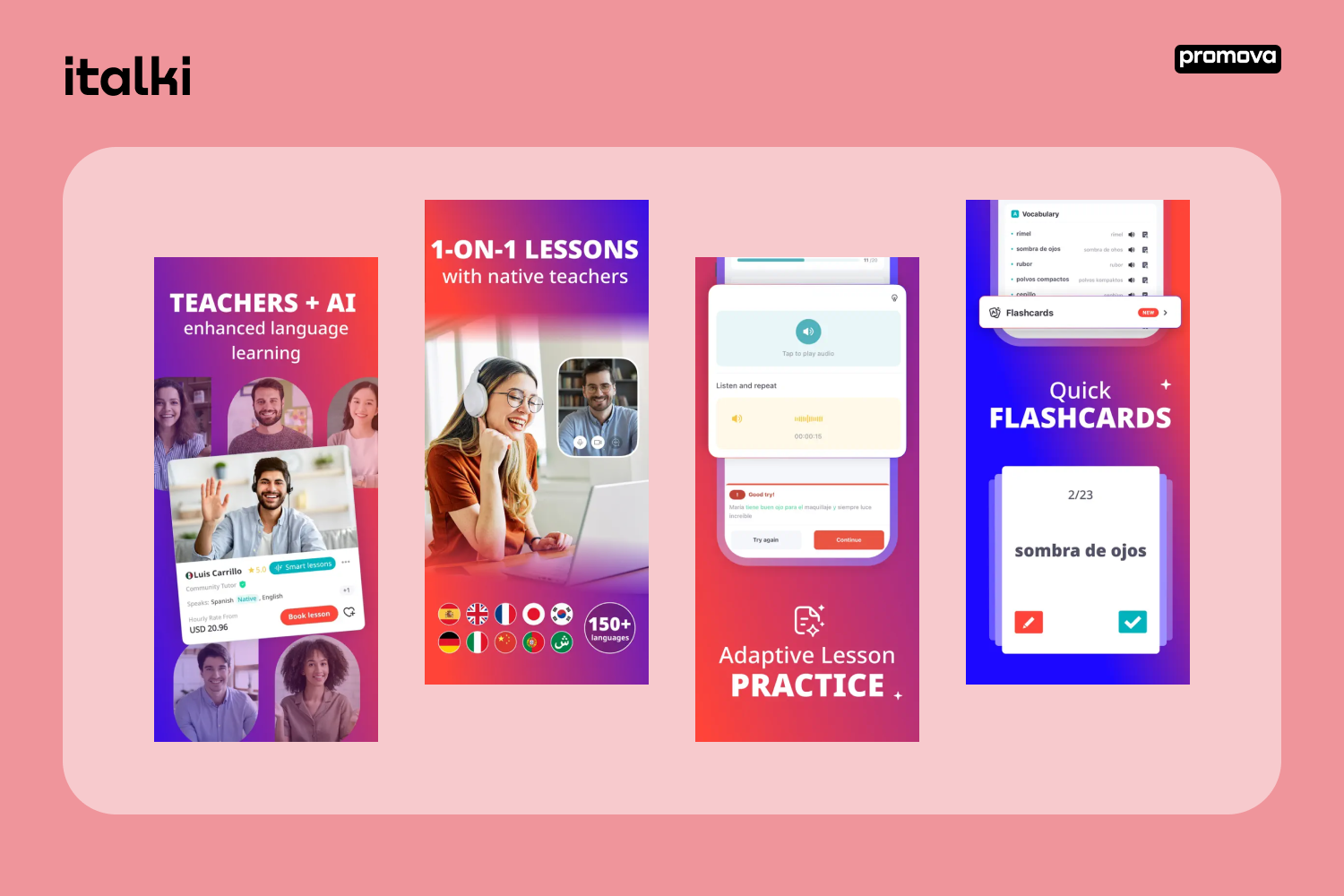
italki is a marketplace rather than a course platform. It connects you with language tutors and conversation partners from around the world, providing opportunities to practice conversations with people speaking your target language. You can book one-on-one video lessons, set your budget, and find a teacher who specializes in what you need — whether that’s exam prep, business language, or casual conversation practice. Tutors often focus on teaching key phrases and practical vocabulary for everyday situations, helping you build essential language skills and develop conversational skills through real-time interaction.
It’s not a standalone learning platform — you won’t find structured courses or vocabulary exercises here. But as a speaking practice tool, it’s unmatched in variety and flexibility. Many learners use italki alongside another app for a complete learning setup.
- Languages: 150+
- Free plan: No (pay per lesson)
- Premium: Varies by tutor
- Platforms: iOS, Android, web
- Standout feature: Access to native-speaker tutors and conversation partners globally
Anki
Best for: Learners who want serious vocabulary building using proven memory science.
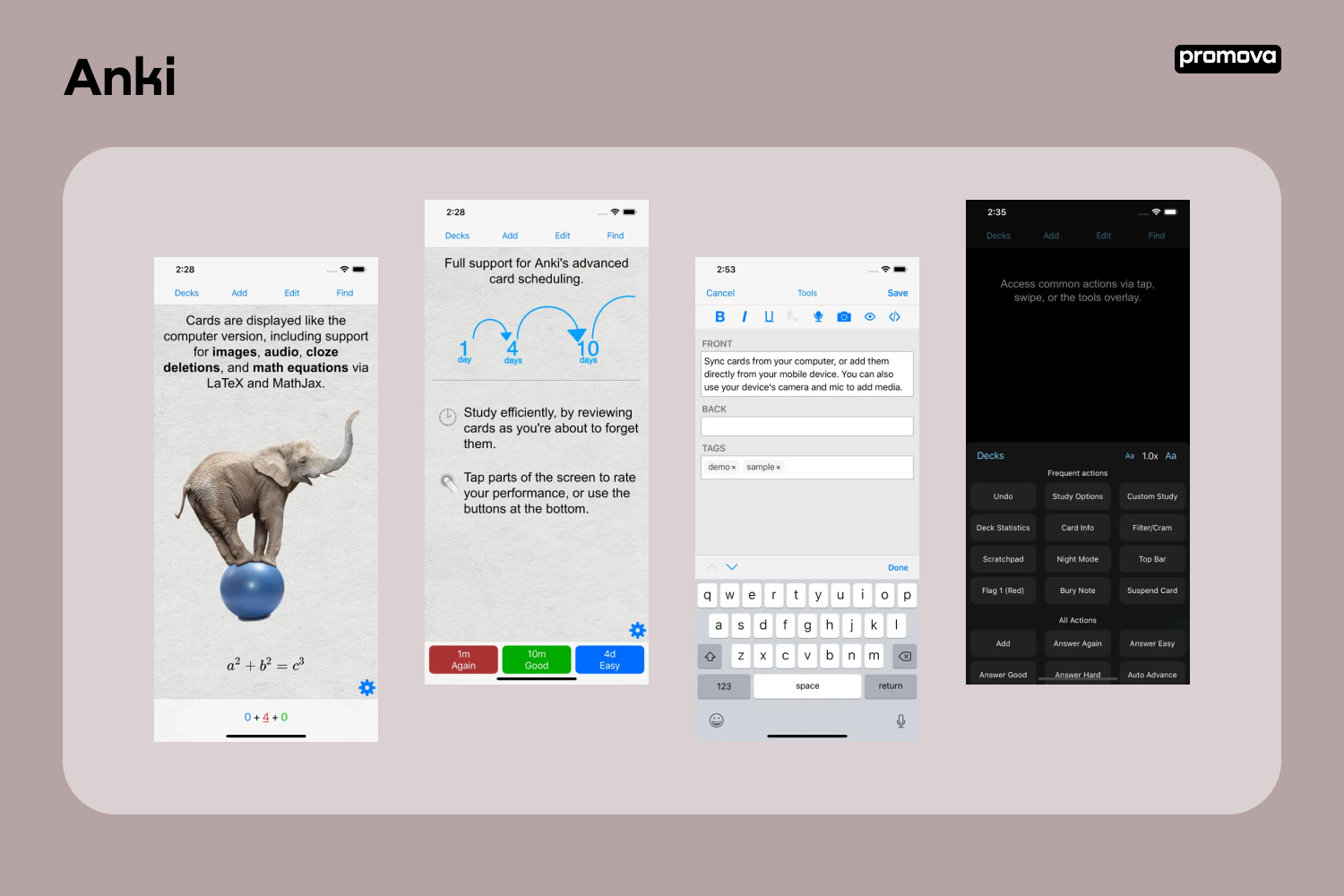
Anki is a flashcard app built on spaced repetition — a method that shows you a word right before you’re about to forget it, which dramatically improves long-term retention. It’s not pretty, and it’s not gamified. But it’s highly effective.
Anki is most powerful when you create your own decks from words you encounter in real content — TV shows, books, conversations — and it also allows you to import your own materials, such as books, podcasts, or videos, for a highly personalized learning experience. The app’s review system is based on spaced repetition, which helps reinforce new vocabulary and ensures you retain what you learn. The community also shares thousands of pre-made decks for all major languages. For an even more comprehensive approach, Anki can be used alongside language transfer audio courses, which teach grammar through logical connections and intuitive learning. It’s a tool for learners who are serious about vocabulary and willing to put in the setup work.
- Languages: Any (user-created content)
- Free plan: Free on desktop; paid on iOS
- Platforms: iOS (paid), Android (free), desktop (free)
- Standout feature: Science-backed spaced repetition system (SRS)
How do these apps compare?
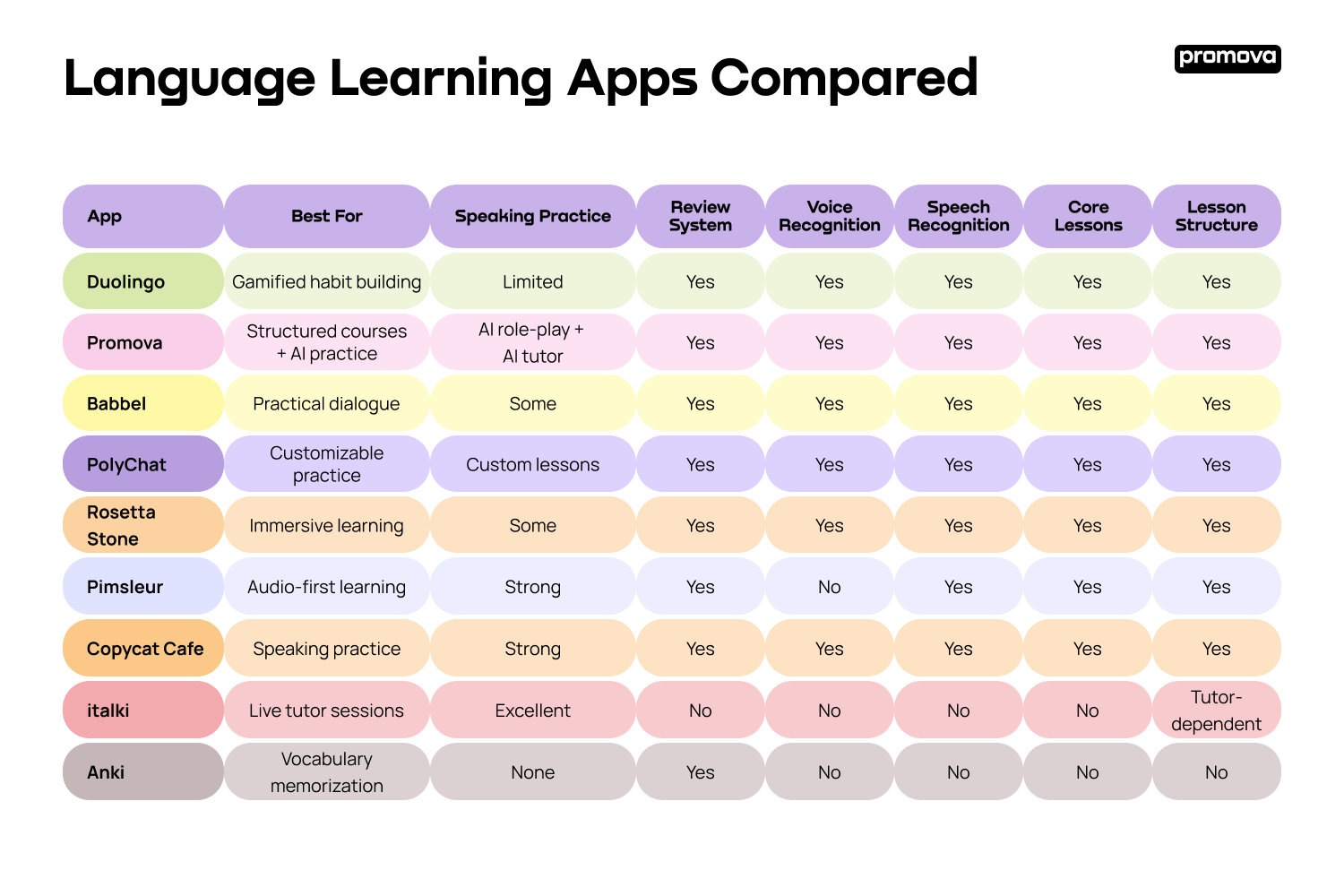
Here’s a quick side-by-side overview to help you decide. Some of the best apps stand out by using advanced voice and speech recognition technologies to provide real-time pronunciation feedback, often powered by AI transcription. These features are especially valuable for speaking practice and help users improve their accent and fluency. Among paid apps, a strong review system, well-structured core lessons, and a clear lesson structure are key differentiators that enhance learning outcomes and retention. The table below highlights which apps are paid, which apps are considered the best for specific needs, and how each of them approaches speaking practice:
| App | Best for | Speaking practice | Free plan | Number of languages | Paid app |
|---|---|---|---|---|---|
| Duolingo | Gamified habit building | Limited (basic voice recognition) | Yes | 40+ | Optional Plus |
| Promova | Structured courses + AI speaking | AI role-play + AI tutors (AI transcription, speech recognition) | Yes | 13+ | Optional Premium |
| Babbel | Practical dialogue, European languages | Some (speech recognition) | First lesson only | 14 | Yes |
| Busuu | CEFR-structured courses + native-speaker feedback | Some (AI Conversations on Premium Plus) | Yes (limited) | 14 | Yes |
| PolyChat | Customizable practice + free unlimited tier | Custom lessons (no built-in speech recognition) | Yes (unlimited) | 17 | Optional Premium |
| Rosetta Stone | Immersive, translation-free learning | Some (voice recognition) | Trial only | 25 | Yes |
| Pimsleur | Audio-first, commute-friendly | Strong (audio, speech recognition) | First lesson | 50+ | Yes |
| Copycat Cafe | Guided speaking practice through real conversations | Strong (pronunciation scoring + AI conversation partner) | 7-day trial | 2 | Yes |
| italki | Live tutor access | Excellent (live feedback) | No | 150+ | Yes (per lesson) |
| Anki | Vocabulary memorization | None | Yes (desktop and Android) | Any | No (or one-time purchase for iOS) |
Which language learning app is right for you?
If you’re a complete beginner and want to build a daily habit without pressure, start with Duolingo or Promova. Both are free, easy to start, and designed for short sessions.
If speaking is your main goal, look at Promova's AI role-play and live tutoring options, Pimsleur for audio-first practice, Copycat Cafe for guided speaking through real conversations, or italki for sessions with real native speakers.
If you want structured, level-based progression, Promova, Babbel, and Busuu all offer clear courses from beginner to advanced. Babbel is stronger for European languages; Busuu follows CEFR levels and adds native-speaker corrections; Promova covers a wider range with AI-powered practice built in.
If you prefer immersive learning without translation, Rosetta Stone is worth trying — especially if you’ve found traditional methods frustrating.
If vocabulary is your weak point, add Anki to whatever else you’re using. It works best as a complement, not a standalone solution.
If you want human conversation practice, italki is the most flexible way to find a tutor or conversation partner at any level.
If you'd rather shape your own lessons and practice without daily limits, PolyChat's custom lesson creator and generous free tier are worth a look too.
The truth is, many serious language learners use two or three apps together when learning a language. For example, combining three apps — one for grammar, one for reading/listening, and one for speaking — can help you develop all your language skills more effectively. This approach is especially useful for intermediate learners who want to refine their abilities across different areas. While free apps are a great starting point, paid apps often provide more comprehensive features and in-depth resources for those committed to learning languages. Ultimately, the best apps are the ones that fit your specific needs, learning style, and goals.
Final thoughts
There’s no single app that does everything perfectly. However, the best apps provide a comprehensive learning experience and help you develop all language skills, from pronunciation and grammar to real-world conversation. Choosing among the best apps depends on your goals and the type of learning experience you prefer. Some learners benefit from immersive, interactive lessons, while others may prioritize vocabulary building or speaking practice.
If you want one platform that combines structured learning, real-life vocabulary, and AI-powered speaking practice, Promova’s language learning app covers a lot of ground in one place. Bite-sized lessons, AI role-play, and optional live tutoring mean you don’t need to piece together three different tools to build a complete routine.
For those committed to learning a language, paid apps may offer advantages over other apps by providing more advanced features, personalized feedback, and a richer overall experience. But whatever you choose, the most important thing is to start and stay consistent. Even 10–15 minutes a day adds up faster than you’d expect.
FAQ
What is the best free language learning app?
Duolingo and Promova both offer strong free plans. Duolingo is great for habit-building with gamified lessons. Promova’s free version includes structured courses and bite-sized lessons in 13+ languages. The best apps stand out for their well-designed review systems, clear lesson structure, and comprehensive core lessons that build foundational language skills. The best choice depends on whether you want gamification or more structured, level-based learning.
Which app is better for learning to speak a language?
For AI-powered speaking practice, Promova’s role-play feature and Pimsleur’s audio method are both strong options. These apps use voice recognition and speech recognition technology to help you practice pronunciation and engage in practice conversations, providing feedback to improve your spoken language skills. For live conversation with real people, italki connects you with native-speaker tutors and conversation partners across 150+ languages.
Can you become fluent using only a language learning app?
Apps are excellent tools, but fluency typically requires more than any single platform. The most effective learning experience comes from developing all language skills—listening, speaking, reading, and writing—while also focusing on conversational skills and practical usage. Combine an app for structured learning with regular speaking practice, listening to native content, and reading in your target language. Apps significantly accelerate the process when used consistently as part of a broader approach.
Which language learning app works for less common languages?
Pimsleur covers 50+ languages including several less common ones. italki is the most flexible for rare languages since it connects you with individual native-speaking tutors globally. Duolingo has also been expanding its language library over the years. Many apps offer courses for both English speakers and speakers of other languages, tailoring lessons to different backgrounds and needs.


 English
 Français
 Português
 Español


Comments