Best Spanish Podcasts for Learning in 2026: Beginner to Advanced

Contents
Key takeaways
- Podcasts are one of the most effective tools for building Spanish listening comprehension, especially when combined with transcripts and active repetition.
- The best Spanish learning podcasts for beginners use slow, clear speech and bilingual explanations; intermediate podcasts gradually shift to more Spanish-only content; advanced podcasts use fully native-speed speech on real-world topics.
- Coffee Break Spanish and Dreaming Spanish are consistently recommended across all experience levels as starting points.
- Transcripts are the single most important feature to look for in a learning podcast — being able to read what you hear connects sounds to words far faster than listening alone.
- Daily listening sessions of 15–20 minutes are more effective for building comprehension than occasional long sessions.
- Native-speaker podcasts like Radio Ambulante and El Washington Post are excellent for upper-intermediate and advanced learners who want authentic Latin American content.
Podcasts might be the most underrated tool in language learning. You can listen to them on a commute, during a walk, or while doing dishes. And if you choose the right one for your level, every session will actually move your Spanish forward.
The challenge is knowing which podcast to pick. There are dozens of Spanish learning shows out there, and the difference between one that's too hard, one that's too easy, and one that's exactly right for you matters a lot. A podcast you can't follow yet is just frustrating. A podcast you already understand completely isn't helping you grow.
This guide covers the best Spanish podcasts by level and explains what each one offers, who it's best for, and what to actually do while you listen to get the most out of it.
What makes a Spanish podcast worth your time?
Before diving into specific recommendations, it’s worth knowing what separates a useful learning podcast from one that just plays in the background. What makes podcasts effective for language learning is their ability to provide authentic listening practice, exposure to native speech, and the convenience of learning anytime, anywhere.
The best Spanish podcasts for learners share a few traits. First, they match your level. Content that’s just slightly beyond your current ability forces your brain to work in the right way. Too easy, and you cruise through it. Too hard, and comprehension collapses.
Second, they provide transcripts. Being able to read along while you listen — or check afterward what you missed — dramatically accelerates vocabulary acquisition. When you hear something unfamiliar, a transcript lets you find it instantly instead of guessing or just skipping past it.
Third, they use clear, deliberate speech. Many of the best podcasts feature native speakers and include real-life conversations, which are key for language learners. While native-speed conversational Spanish is great for advanced learners, it can be discouraging early on. Podcasts designed for learners typically enunciate more carefully, avoid heavy regional slang, and often repeat key phrases — all of which help you actually follow along.
Finally, the content itself has to be engaging. Language learning doesn’t benefit from suffering through boring material. The best podcasts cover topics you’d choose to listen to anyway.
Best Spanish podcasts for beginners
Coffee Break Spanish
Coffee Break Spanish is one of the most widely recommended Spanish podcasts for beginners, and it's earned that reputation. The format pairs host Mark (who was a complete beginner when the show started) with a native Spanish speaker, so you're learning alongside someone at a similar level rather than being talked at by an expert.
Episodes are structured and built systematically — lesson one covers greetings, and each episode adds vocabulary and grammar concepts in a logical progression. Explanations happen in English, which is genuinely helpful when you're trying to understand why Spanish grammar works the way it does. Transcripts and lesson notes are available for premium members.
Best for: True beginners who want a structured curriculum in podcast form.
Notes in Spanish — Inspired Beginners
Notes in Spanish has been running since 2005 and divides its content into three levels: Inspired Beginners, Intermediate, and Advanced. The beginner series features relaxed, real conversations between Ben (a native English speaker) and Marina (his Spanish wife), covering everyday life in Spain. The pace is deliberate, the language is natural, and the cultural content — tapas, the Spanish royal family, regional life — makes episodes worth returning to.
The website also offers additional paid resources, phrasebooks, and a blog for extra practice.
Best for: Beginners who want natural-sounding Spanish with cultural content rather than simple grammar drills.
Dreaming Spanish (Beginner level)
Dreaming Spanish is built around comprehensible input — the idea that you acquire language most naturally by hearing it in context at just above your current level. The channel produces content across five levels, from Super Beginner to Advanced, and the beginner videos use simple vocabulary, visual support, and slow, clear speech to make content genuinely understandable from the start.
What makes Dreaming Spanish particularly effective is the volume of content available (hundreds of hours across levels) and the fact that it's almost entirely in Spanish from day one. There's no code-switching to English. This trains your brain to process Spanish directly rather than translating every sentence.
Best for: Learners who prefer Spanish-immersion content even at beginner level and want a large library to work through.
1
Best Spanish podcasts for intermediate learners
News in Slow Spanish
Exactly what it sounds like — current news stories read at a reduced pace with clear enunciation. The vocabulary is genuinely adult (real news, real issues), but the slower delivery gives you time to process what you're hearing. There are over 600 episodes, labeled for beginner, intermediate, and advanced learners, and you can choose between Latin American or European Spanish hosts depending on your preference.
Episodes are short — just a few minutes each — which makes News in Slow Spanish practical for daily listening without carving out a big block of time.
Best for: Intermediate learners who want to build listening comprehension with real-world vocabulary without getting overwhelmed by native speech speed.
Intermediate Spanish Podcast (Spanish Language Coach)
César Rodríguez’s podcast is designed specifically for intermediate learners and is one of the more thoughtfully constructed shows in this category. Episodes are conducted entirely in Spanish, which pushes you to think in the language rather than mentally translating everything. The topics range from housing costs in Spain to gender roles and psychology — they're substantive enough to hold your attention and covered in language that’s accessible without being dumbed down. The podcast also goes over essential grammar points and explains grammar concepts in a way that's accessible for intermediate learners, helping you understand the rules behind Spanish sentence structure and verb conjugations.
Every episode comes with a free transcript, vocabulary flashcards, and exercises on the accompanying website. That combination — audio plus structured follow-up resources — is what separates a genuinely useful learning tool from background noise.
Best for: Intermediate learners who are ready for Spanish-only content and want structured vocabulary and comprehension exercises alongside each episode.
Españolistos
Españolistos is hosted by Andrea, a Colombian Spanish teacher, and Nate, her American husband, who learned Spanish as an adult. That dynamic — a native speaker and a fluent non-native speaker — is very useful for learners, because Nate occasionally makes mistakes that Andrea corrects in context. It's a naturalistic model of how real language learning works.
With 400+ episodes averaging around 30 minutes each, episodes cover everything from online dating to Venezuela's economic crisis and Latin American slang. The show is Spanish-only, which means it's best for learners who can already follow a conversation with some effort. Transcripts are available via donation.
Best for: Intermediate to upper-intermediate learners interested in Latin American culture, natural conversation, and regional vocabulary.
Duolingo Spanish Podcast
Despite the brand association, the Duolingo Spanish Podcast is genuinely well-made. Each episode tells a real person's story in clear Spanish, with an English narrator providing context and translations for key phrases. The Spanish portions move at a natural-but-accessible pace; they're fast enough to feel authentic, but also slow enough for intermediate learners to follow.
Stories cover topics like a woman who discovered her family's secret history, a man who became a tango dancer, and other compelling personal narratives. Free transcripts are available on the website. Episodes run 20–30 minutes, making them a good length for focused listening.
Best for: Intermediate learners who want story-based content in accessible Spanish with English scaffolding.
Best Spanish podcasts for advanced learners
Radio Ambulante
Radio Ambulante is a narrative journalism podcast from NPR that tells true stories from across Latin America. Hosts and contributors come from different Spanish-speaking countries, which means you're exposed to a genuine variety of accents — Mexican, Colombian, Chilean, Dominican, Argentinian — in the context of real, compelling stories.
The content is fully native-speed and covers serious topics, such as immigration, indigenous communities, political upheaval, crime, and culture. This isn't simplified Spanish — it's the kind of journalism you'd read in The New Yorker, produced in Spanish. Transcripts are available for most episodes, which makes it workable even for upper-intermediate learners willing to pause and look things up.
Best for: Advanced learners who want authentic Latin American content and exposure to diverse regional accents.
El Washington Post
The Washington Post's Spanish-language podcast covers current news stories with hosts and guests from various Spanish-speaking countries, giving you multicultural exposure alongside real journalistic content. Episodes run about 15–20 minutes and typically cover three to four stories per episode.
What's particularly useful for advanced learners is the vocabulary density. You'll encounter formal, precise language used in media and public discourse, which is harder to find in learner-focused content. Cultural and political context deepens alongside language comprehension.
Best for: Advanced learners who are news-oriented and want to build vocabulary in formal journalistic Spanish.
Unlimited Spanish
Óscar Pellus's podcast takes a different angle from news or storytelling. Each episode covers aspects of the Spanish language itself — colloquial expressions from Spain, regional quirks, cultural observations, and personal stories. It's educational without being dry, and Óscar speaks clearly and at a measured pace even though the content is aimed at advanced learners.
Every episode comes with a free transcript. Episodes end with a real-life story told in natural Spanish, which ties the vocabulary and concepts from the episode into an authentic listening context.
Best for: Advanced learners focused on European Spanish who want to deepen their understanding of the language itself rather than just building general comprehension.
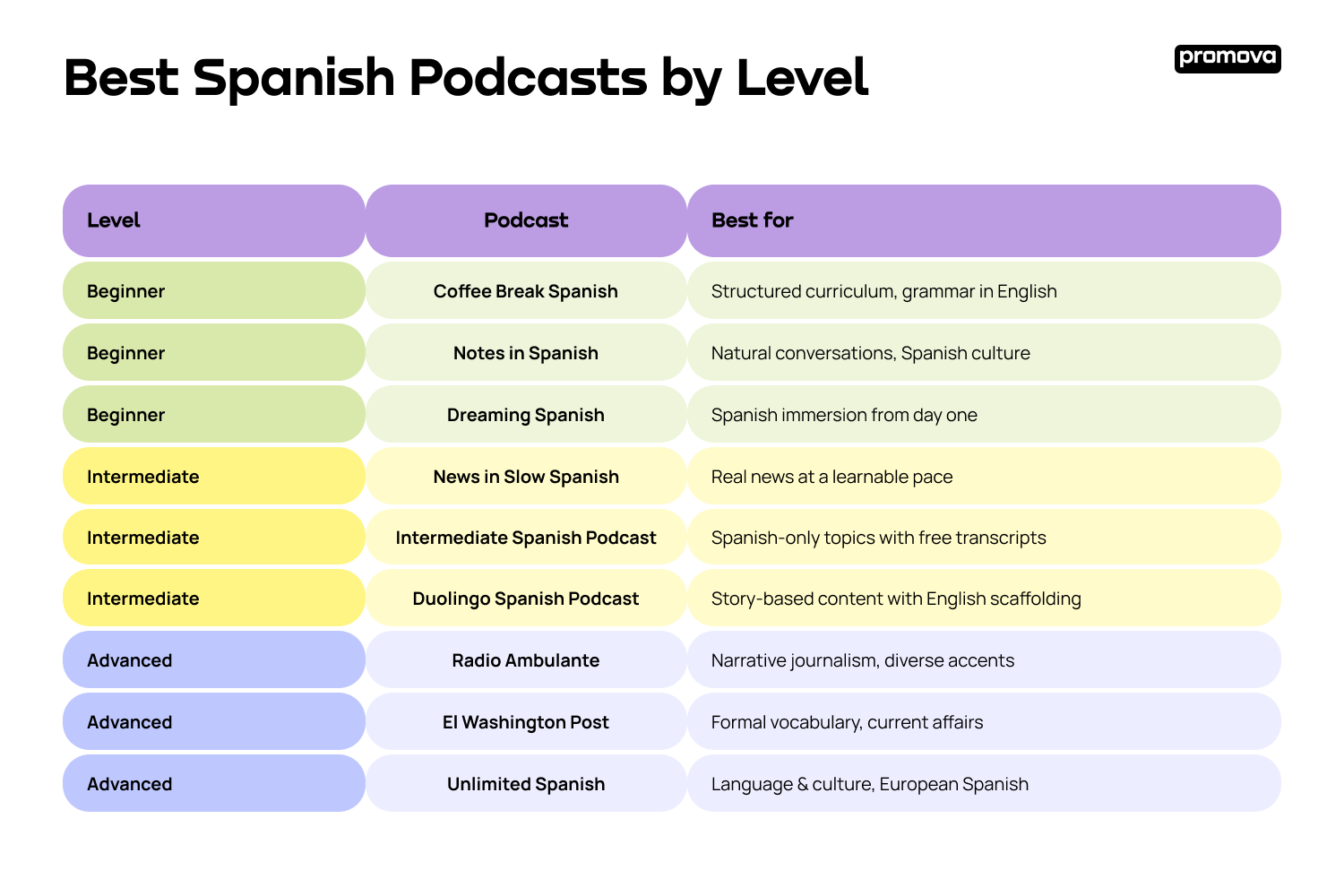
Best Spanish podcasts by level — quick reference table
Here’s a quick reference table of some of the best audio podcasts for learning Spanish. These podcasts are available on major platforms such as Apple Podcasts, Spotify, and Google Podcasts.
| Podcast | Level | Language | Transcripts | Focus |
| Coffee Break Spanish | Beginner | English + Spanish | Premium | Structured curriculum |
| Notes in Spanish (Beginners) | Beginner | English + Spanish | Free | Daily life, culture |
| Dreaming Spanish | Beginner–Advanced | Spanish only | No | Comprehensible input |
| News in Slow Spanish | Beginner–Advanced | Spanish | Free (with Premium) | Current events |
| Intermediate Spanish Podcast | Intermediate | Spanish only | Free | Cultural topics |
| Españolistos | Intermediate–Advanced | Spanish only | Donation | Latin America, culture |
| Duolingo Spanish Podcast | Intermediate | Spanish + English | Free | Personal stories |
| Radio Ambulante | Advanced | Spanish only | Free | Narrative journalism |
| El Washington Post | Advanced | Spanish only | No | Current news |
| Unlimited Spanish | Advanced | Spanish only | Free | Language and culture |
Conclusion
Spanish podcasts are one of the best tools available for language learners. They are low-friction, genuinely engaging when you choose the right one, and easy to fit into a daily routine. The key is matching the podcast to your current level, using transcripts actively, and combining listening with speaking practice so comprehension translates into real conversation.
Start with one podcast from the beginner section. Listen to the same episode two or three times. Use the transcript. Then, as your comprehension builds, work your way up the levels. Within a few months, you'll notice that native-speed Spanish — which once felt like an impenetrable blur of sounds — starts to slow down and make sense.
That's the moment you'll know that the podcasts are working. Keep going.
FAQ
What is the best Spanish podcast for absolute beginners?
Coffee Break Spanish is the most consistently recommended for absolute beginners. Episodes are structured, build systematically, include English explanations, and are easy to follow even with zero Spanish background. Dreaming Spanish’s Super Beginner series is also excellent for those who prefer Spanish-only immersion from day one.
How often should I listen to Spanish podcasts?
Daily listening of 15–20 minutes is more effective than occasional long sessions. Consistency matters more than duration — your brain builds listening comprehension through repeated exposure, not cramming. Even commute-length sessions add up significantly over weeks and months.
Do I need to understand every word to benefit from Spanish podcasts?
No. A common recommendation from language acquisition researchers is to aim for roughly 70–80% comprehension. The words you don’t know but hear repeatedly in context are exactly the vocabulary your brain is in the process of acquiring. Transcripts help you identify those words and look them up.
Can Spanish podcasts replace a Spanish course?
Spanish shows and podcasts cover a huge range of interesting topics and help learners engage with Spanish speakers from around the world. However, while podcasts are excellent for building listening comprehension and vocabulary in context, they don’t replace structured grammar study or speaking practice. They work best as a complement to a course or app. Using Promova alongside a podcast habit covers both the structured and immersive sides of language learning effectively.


 English


Comments