Noun Modifiers
Contents

The flexibility and richness of English allow various ways to express ideas. One such method is using modifiers to convey messages more effectively. In general, you might get used to modifying nouns with adjectives. However, a noun can be a modifier for another noun. In this article, you will learn how to use modifier nouns correctly.
What is a modifier noun?
A modifier noun is a noun that adjusts or clarifies the meaning of another one. They can provide such information as the type, purpose, or characteristic of the noun they modify. For example, in the phrase “chicken soup,” both words are nouns. However, “soup” is a subject, and “chicken” is a modifier, specifying the type of soup.
Types of modifier nouns
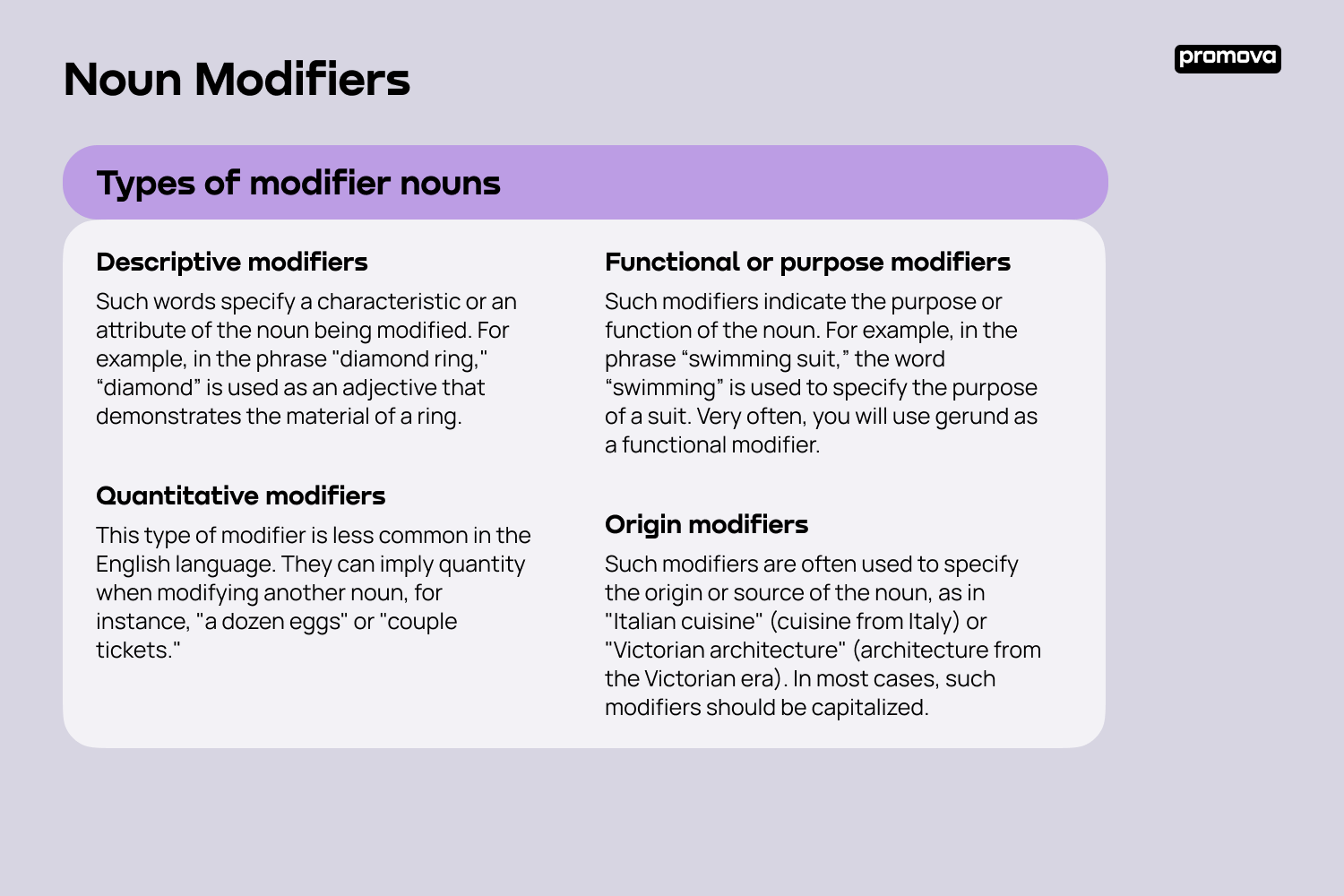
There are several types of modifier nouns, each serving a specific purpose:
- Descriptive modifiers. Such words specify a characteristic or an attribute of the noun being modified. For example, in the phrase "diamond ring," “diamond” is used as an adjective that demonstrates the material of a ring.
- Functional or purpose modifiers. Such modifiers indicate the purpose or function of the noun. For example, in the phrase “swimming suit,” the word “swimming” is used to specify the purpose of a suit. Very often, you will use gerund as a functional modifier.
- Quantitative modifiers. This type of modifier is less common in the English language. They can imply quantity when modifying another noun, for instance, "a dozen eggs" or "couple tickets."
- Origin modifiers. Such modifiers are often used to specify the origin or source of the noun, as in "Italian cuisine" (cuisine from Italy) or "Victorian architecture" (architecture from the Victorian era). In most cases, such modifiers should be capitalized.
Understanding the various types of modifier nouns enriches the ability to communicate with precision and clarity in English. By mastering them, you can enhance the expressiveness and specificity of your language, making communication more effective and nuanced.
How to use noun modifiers?
For some language learners, it might be confusing that one noun modifies another. We understand this challenge since every language is unique, and the differences between two languages can be significant. Thus, it might affect the perception of new knowledge. So, here are the rules for using noun modifiers:
- Placement. The modifying noun usually precedes the noun it modifies, as seen in "school bus" or "computer science."
- Singular and plural form. The modifying noun can be both in singular and plural forms. Here are some examples: "arms race," "sports car," “football game.”
- No possessive form. When nouns are used as modifiers, they do not take the possessive form unless the meaning demands it, e.g., "writers’ conference" (a conference of writers) vs. "writer workshop" (a workshop for writers).
Some English speakers tend to overcomplicate by stacking too many noun modifiers. It makes sentences confusing and difficult to read. So avoid complex constructions like “government employee benefits services office” in your speaking and writing.
3
Practice and Application
The best way to master using nouns to modify other nouns is through practice and exposure. Read widely to see how skilled writers employ this technique, and write regularly, experimenting with and refining your use of noun modifiers. Feedback from others can also be invaluable, providing insights into how your writing is interpreted and where you might improve.
Conclusion
Using nouns to modify other nouns is a powerful tool in the English language, allowing for precision, nuance, and creativity in expression. By understanding the rules, being aware of common mistakes, and applying practical tips, you can enhance your writing, making it clearer, more engaging, and more effective.
FAQ
What are "noun modifiers"?
How do noun modifiers affect sentence structure?
Can you provide examples of noun modifiers?
What is the difference between restrictive and non-restrictive noun modifiers?
Make your next step to fluency with Promova

 English
 Français
 Português
 Español


Comments