200 Irregular Verbs in English (V1–V2–V3): Complete List with Examples and Learning Tips
Contents
Key Takeaways:
- Irregular verbs don't follow the -ed rule, so each verb must be learned with its past and past participle forms (V1–V2–V3).
- This guide includes over 200 of the most common irregular verbs in English, based on Merriam-Webster and Longman dictionaries, making it a reliable reference for learners.
- There are patterns: many irregular verbs follow similar vowel changes or form groups (e.g., sing – sang – sung or build – built – built), which makes memorization easier.
- Irregular verbs are essential for real communication, as they are used in past tenses, perfect tenses, and passive voice.
- Regular practice is key: using examples, grouping verbs, flashcards, and repetition helps you remember verb forms and use them naturally when learning English online.
If you've ever said "I goed to the store" and immediately cringed — you already know why irregular verbs matter. Unlike regular verbs that simply take -ed in the past, irregular verbs play by their own rules. There are over 200 of them in everyday English, and the most common ones — go, be, have, do, get — come up in almost every sentence. This guide breaks them all down, explains the patterns, and gives you practical ways to actually remember them.
What Is an Irregular Verb?
An irregular verb is a verb that does not form its simple past or past participle by adding -ed or -d to the base form.
Regular verbs follow a predictable pattern:
- escape → escaped
- enjoy → enjoyed
- try → tried
Irregular verbs don't follow this pattern. Instead, they change in unpredictable ways — or sometimes don't change at all:
- go → went → gone
- cut → cut → cut
- drink → drank → drunk
Why are they irregular? English irregular verbs evolved from Proto-Indo-European, which relied on internal vowel changes rather than suffixes. Many of the most common verbs in the language preserved these ancient forms — which is exactly why be, go, have and do are all irregular. The more frequently a verb is used, the more likely it is to keep its old, irregular form.
They change their forms in the passive voice and in the past and perfect tenses. That's why you can't simply memorize one rule and follow it — you need to learn each word and its forms separately.
Understanding Irregular Verb Conjugation
Mastering irregular verb conjugation is basically your golden ticket to English fluency. While regular verbs are fairly straightforward — just add "-ed" or "-d" — irregular verbs have their own unique forms that you'll need to learn one by one. But here's the thing: having a solid list of English verbs at your fingertips completely changes the game in your language learning journey.
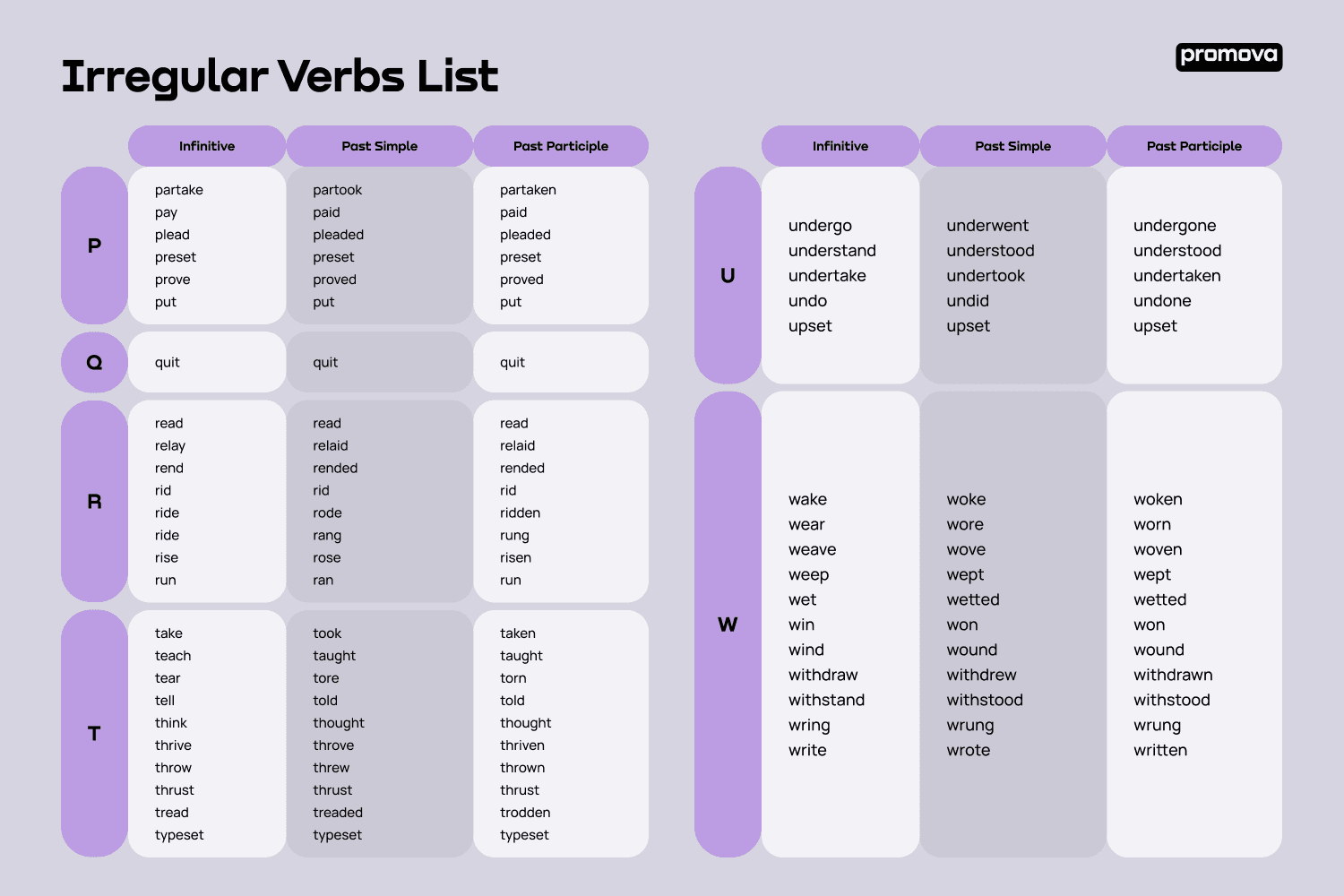
Full List: 200 Irregular Verbs (V1 – V2 – V3)
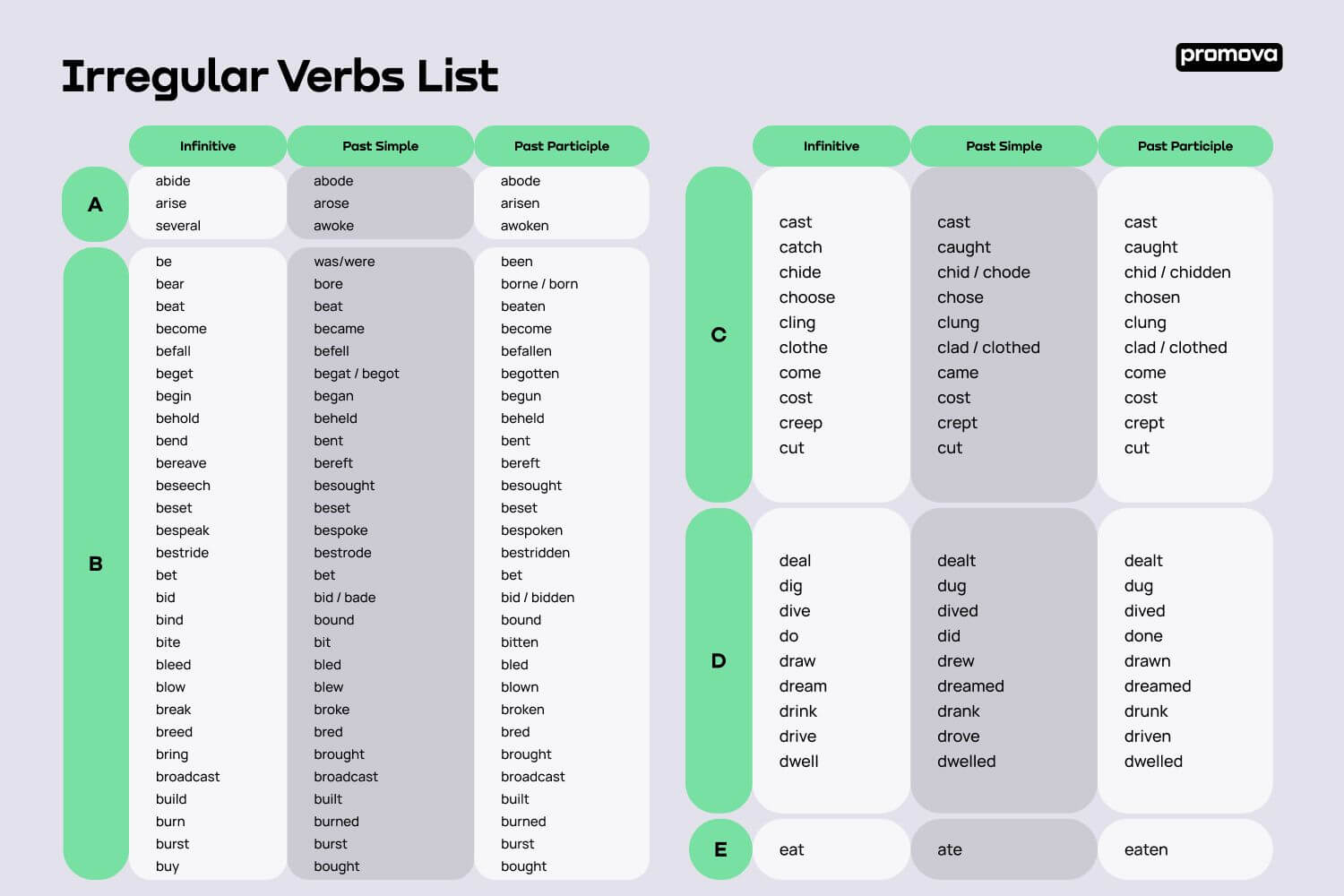
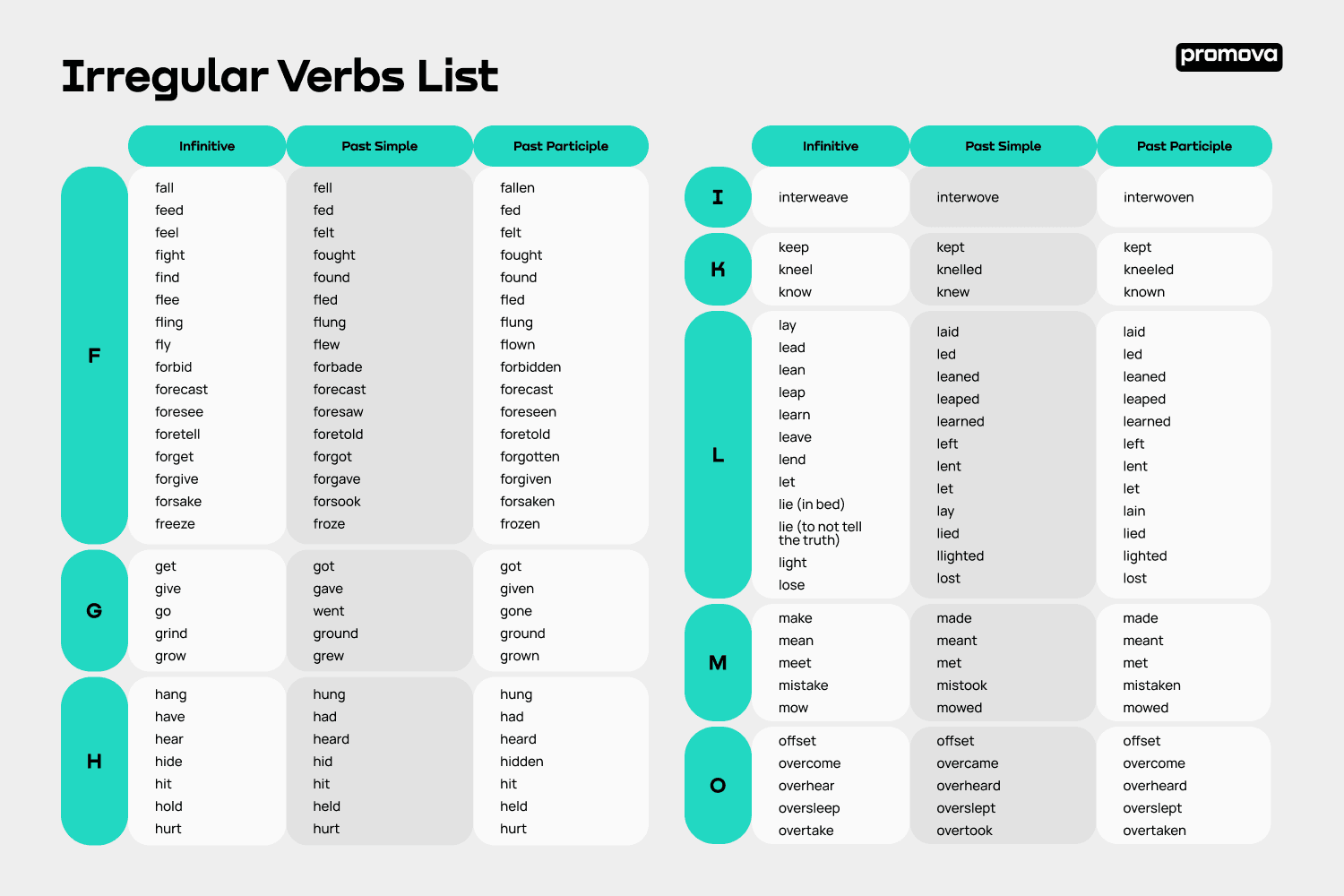
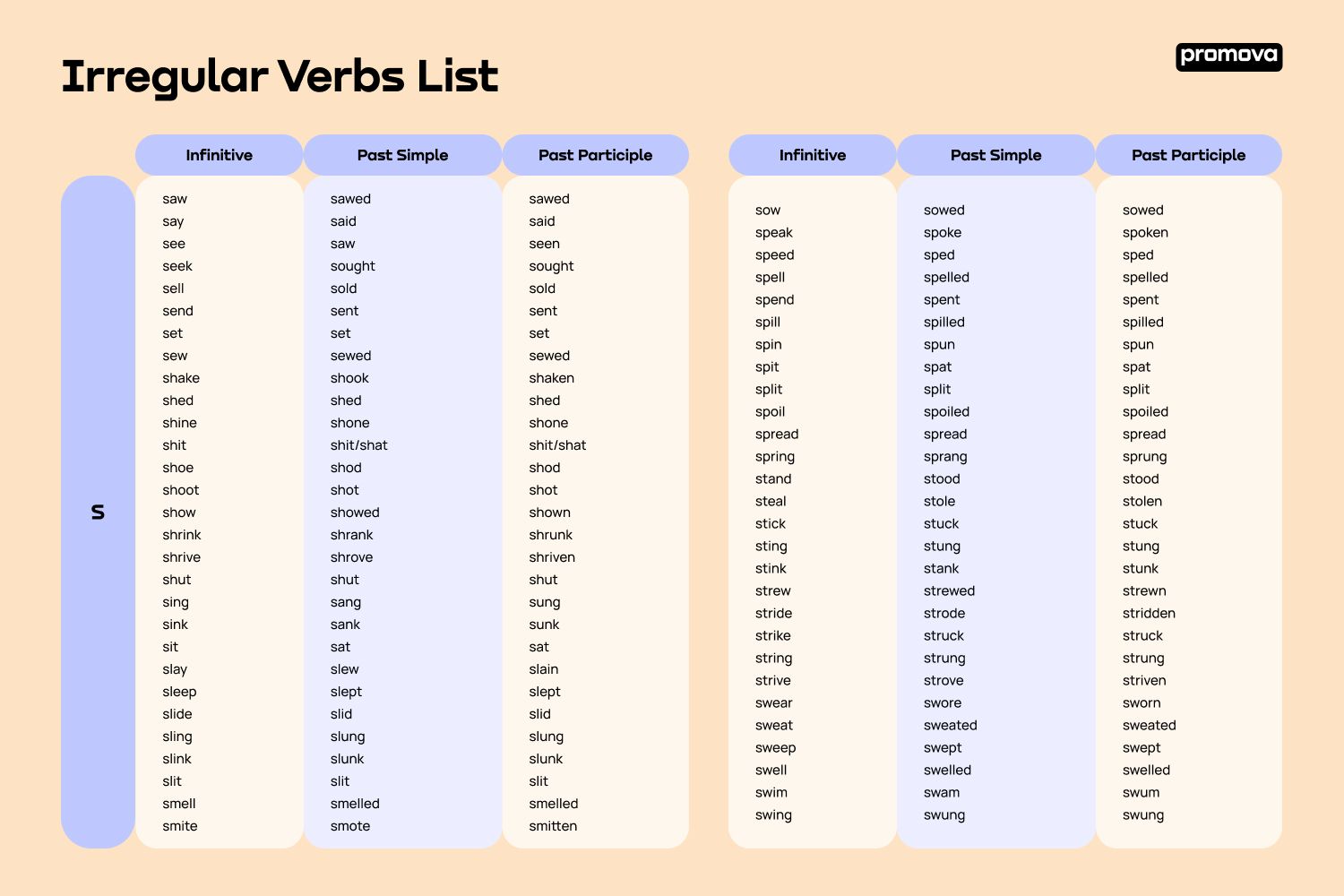
The table below contains over 200 irregular verbs with all three forms: base form (V1), simple past (V2), and past participle (V3). This list was created according to Merriam-Webster and the Longman Learner's Dictionary of American English.
| Infinitive | Simple Past | Past Participle |
|---|---|---|
| A | ||
| abide | abode | abode |
| arise | arose | arisen |
| awake | awoke | awoken |
| B | ||
| be | was/were | been |
| bear | bore | borne/born |
| beat | beat | beaten |
| become | became | become |
| befall | befell | befallen |
| beget | begat/begot | begotten |
| begin | began | begun |
| behold | beheld | beheld |
| bend | bent | bent |
| bereave | bereft | bereft |
| beseech | besought | besought |
| beset | beset | beset |
| bespeak | bespoke | bespoken |
| bestride | bestrode | bestridden |
| bet | bet | bet |
| bid | bid/bade | bid/bidden |
| bind | bound | bound |
| bite | bit | bitten |
| bleed | bled | bled |
| blow | blew | blown |
| break | broke | broken |
| breed | bred | bred |
| bring | brought | brought |
| broadcast | broadcast | broadcast |
| build | built | built |
| burn | burned | burned |
| burst | burst | burst |
| buy | bought | bought |
| C | ||
| cast | cast | cast |
| catch | caught | caught |
| chide | chid | chid/chidden |
| choose | chose | chosen |
| cling | clung | clung |
| clothe | clad/clothed | clad/clothed |
| come | came | come |
| cost | cost | cost |
| creep | crept | crept |
| cut | cut | cut |
| D | ||
| deal | dealt | dealt |
| dig | dug | dug |
| dive | dived | dived |
| do | did | done |
| draw | drew | drawn |
| dream | dreamed | dreamed |
| drink | drank | drunk |
| drive | drove | driven |
| dwell | dwelled | dwelled |
| E | ||
| eat | ate | eaten |
| F | ||
| fall | fell | fallen |
| feed | fed | fed |
| feel | felt | felt |
| fight | fought | fought |
| find | found | found |
| flee | fled | fled |
| fling | flung | flung |
| fly | flew | flown |
| forbid | forbade | forbidden |
| forecast | forecast | forecast |
| foresee | foresaw | foreseen |
| foretell | foretold | foretold |
| forget | forgot | forgotten |
| forgive | forgave | forgiven |
| forsake | forsook | forsaken |
| freeze | froze | frozen |
| G | ||
| get | got | got |
| give | gave | given |
| go | went | gone |
| grind | ground | ground |
| grow | grew | grown |
| H | ||
| hang | hung | hung |
| have | had | had |
| hear | heard | heard |
| hide | hid | hidden |
| hit | hit | hit |
| hold | held | held |
| hurt | hurt | hurt |
| I | ||
| interweave | interwove | interwoven |
| K | ||
| keep | kept | kept |
| kneel | knelled | kneeled |
| know | knew | known |
| L | ||
| lay | laid | laid |
| lead | led | led |
| lean | leaned | leaned |
| leap | leaped | leaped |
| learn | learned | learned |
| leave | left | left |
| lend | lent | lent |
| let | let | let |
| lie (in bed) | lay | lain |
| lie (to not tell the truth) | lied | lied |
| light | lighted/lit | lighted/lit |
| lose | lost | lost |
| M | ||
| make | made | made |
| mean | meant | meant |
| meet | met | met |
| mistake | mistook | mistaken |
| mow | mowed | mowed |
| O | ||
| offset | offset | offset |
| overcome | overcame | overcome |
| overhear | overheard | overheard |
| oversleep | overslept | overslept |
| overtake | overtook | overtaken |
| P | ||
| partake | partook | partaken |
| pay | paid | paid |
| plead | pleaded | pleaded |
| preset | preset | preset |
| prove | proved | proved |
| put | put | put |
| Q | ||
| quit | quit | quit |
| R | ||
| read | read | read |
| relay | relaid | relaid |
| rend | rended | rent/rended |
| rid | rid | rid |
| ride | rode | ridden |
| ring | rang | rung |
| rise | rose | risen |
| run | ran | run |
| S | ||
| saw | sawed | sawed |
| say | said | said |
| see | saw | seen |
| seek | sought | sought |
| sell | sold | sold |
| send | sent | sent |
| set | set | set |
| sew | sewed | sewed |
| shake | shook | shaken |
| shed | shed | shed |
| shine | shone | shone |
| shoe | shod | shod |
| shoot | shot | shot |
| show | showed | shown |
| shrink | shrank | shrunk |
| shut | shut | shut |
| sing | sang | sung |
| sink | sank | sunk |
| sit | sat | sat |
| slay | slew | slain |
| sleep | slept | slept |
| slide | slid | slid |
| sling | slung | slung |
| slink | slunk | slunk |
| slit | slit | slit |
| smell | smelled | smelled |
| smite | smote | smitten |
| sow | sowed | sowed |
| speak | spoke | spoken |
| speed | sped | sped |
| spell | spelled | spelled |
| spend | spent | spent |
| spill | spilled | spilled |
| spin | spun | spun |
| spit | spat | spat |
| split | split | split |
| spoil | spoiled | spoiled |
| spread | spread | spread |
| spring | sprang | sprung |
| stand | stood | stood |
| steal | stole | stolen |
| stick | stuck | stuck |
| sting | stung | stung |
| stink | stank | stunk |
| strew | strewed | strewn |
| stride | strode | stridden |
| strike | struck | struck |
| string | strung | strung |
| strive | strove | striven |
| swear | swore | sworn |
| sweat | sweat/sweated | sweat/sweated |
| sweep | swept | swept |
| swell | swelled | swelled |
| swim | swam | swum |
| swing | swung | swung |
| T | ||
| take | took | taken |
| teach | taught | taught |
| tear | tore | torn |
| tell | told | told |
| think | thought | thought |
| thrive | throve/thrived | thriven/thrived |
| throw | threw | thrown |
| thrust | thrust | thrust |
| tread | trod | trodden |
| typeset | typeset | typeset |
| U | ||
| undergo | underwent | undergone |
| understand | understood | understood |
| undertake | undertook | undertaken |
| undo | undid | undone |
| upset | upset | upset |
| W | ||
| wake | woke | woken |
| wear | wore | worn |
| weave | wove | woven |
| weep | wept | wept |
| wet | wetted | wetted |
| win | won | won |
| wind | wound | wound |
| withdraw | withdrew | withdrawn |
| withstand | withstood | withstood |
| wring | wrung | wrung |
| write | wrote | written |
How to Read the Table
The table has three columns, and each one does a different job in English grammar.
V1 — Base form is the verb in its default state. Use it for present simple, infinitives, and after modal verbs: I go, she doesn't know, you must think.
V2 — Simple past is the form you use to talk about completed actions in the past:
- I went to the stadium yesterday.
- He always drove carefully.
- She knew a lot about irregular verbs.
V3 — Past participle is used in perfect tenses and passive constructions:
- The novel has been written by a celebrated author.
- The window was broken by a stray ball.
- They have seen the latest exhibit at the gallery.
5
How to Learn Irregular Verbs
200 verb forms at once sounds like a lot. It doesn't have to be. Here are three approaches that actually work.
Learn in Groups
Many of the most common irregular verbs in English can be grouped by similar patterns, such as vowel changes (e.g., sing – sang – sung) or suffix-based changes (e.g., build – built – built). Recognizing these patterns helps make learning the 200 irregular verbs more manageable.
All three forms the same: cut – cut – cut / put – put – put / quit – quit – quit / hit – hit – hit / set – set – set / spread – spread – spread / shut – shut – shut
Second and third forms the same: bind – bound – bound / find – found – found / build – built – built / sell – sold – sold / send – sent – sent / teach – taught – taught / think – thought – thought
First and third forms the same: come – came – come / become – became – become / run – ran – run / overcome – overcame – overcome
The i–a–u pattern: sing – sang – sung / drink – drank – drunk / stink – stank – stunk / spring – sprang – sprung
Did you know? The most frequently used verbs in English — be, have, do, go, get — are all irregular. That's actually good news: learning just these five gives you an instant boost in everyday communication.
Save Our Flashcards
The best way to learn irregular verbs is to keep them visible throughout your day. Here's a simple system:
- Use our flashcards — base form on one side, V2 + V3 on the other
- Save them to your phone — screenshot the ones you keep forgetting
- Set them as your wallpaper — every time you unlock your phone, you review a verb
You don't need to sit down for a study session. A few seconds of exposure throughout the day adds up faster than you'd think.
Practice with a Quiz
The best way to know if something has actually stuck is to test yourself. Try the quiz below — it covers the most common irregular verbs from this list and takes under two minutes.
Take Your English Further with Promova
Learning irregular verbs is a real milestone — but it's just one piece of the puzzle. If you want to keep making progress with a clear structure, Promova has everything in one place: flashcard decks, bite-sized lessons, and a personal study plan built around your level and schedule. Learn English online at your own pace — download the Promova app or sign up on the website to get started.
10 questions · ~5 min
1
FAQ
What are "200 irregular verbs"?
Why is it important to learn "200 irregular verbs"?
How can one effectively memorize the "200 irregular verbs"?
Are there any resources available for studying the "200 irregular verbs"?
Make your next step to fluency with Promova

Other articles on this topic
How to Use the Verb "To Be" in EnglishVerbs ending in -ingAction Verbs in EnglishPhrasal Verbs English
 Español
 Français
 Português


Comments