How to Say My Love in French: Romantic Words and Phrases

Contents
Key takeaways
- “My love” in French is mon amour — one of the most recognized romantic expressions in the world. But French has dozens of warmer, more creative alternatives.
- French terms of endearment change based on gender: mon is used before masculine nouns, ma before feminine ones. Knowing this one rule helps you use any nickname correctly.
- French speakers use animal nicknames — mon lapin (my rabbit), mon caneton (my duckling) — more than almost any other language. It’s affectionate, not weird.
- Many French nicknames are cute and can be used for both romantic partners and family or friends, such as mon poussin (my chick).
- The right term of endearment depends on who you’re talking to: partners, children, and friends each have their own vocabulary in French.
- Learning these expressions is a great entry point into spoken French — they’re short, emotionally meaningful, and used constantly in everyday life.
Saying “I love you” in any language is powerful. But in French, the whole vocabulary around love — the nicknames, the pet names, the little words people reach for when they want to sound tender — is a world of its own.
French is consistently ranked among the most romantic languages, and it’s not just because of how it sounds. It’s because French speakers have spent centuries finding creative, specific, and sometimes wonderfully bizarre ways to tell people they care.
This guide covers the full picture: romantic terms for partners, sweet expressions for children, casual endearments for close friends, and why any of this matters for your language learning. You’ll also find pronunciation tips and a short grammar note so you can actually use these phrases — not just read them.
How French terms of endearment work
Before diving into the lists, one rule is worth knowing. In French, every noun has a gender — masculine or feminine — and the possessive adjective changes to match:
- Mon is used before masculine nouns: mon amour, mon cœur, mon ange
- Ma is used before feminine nouns: ma chérie, ma belle, ma douce
- Mon is also used before feminine nouns that start with a vowel (for easier pronunciation): mon amie instead of ma amie
Some terms, like mon amour, have the same meaning and form regardless of whether you are speaking to a man or a woman. The phrase remains mon amour for both genders.
That’s it. Once you know this, you can use any expression on this page correctly.
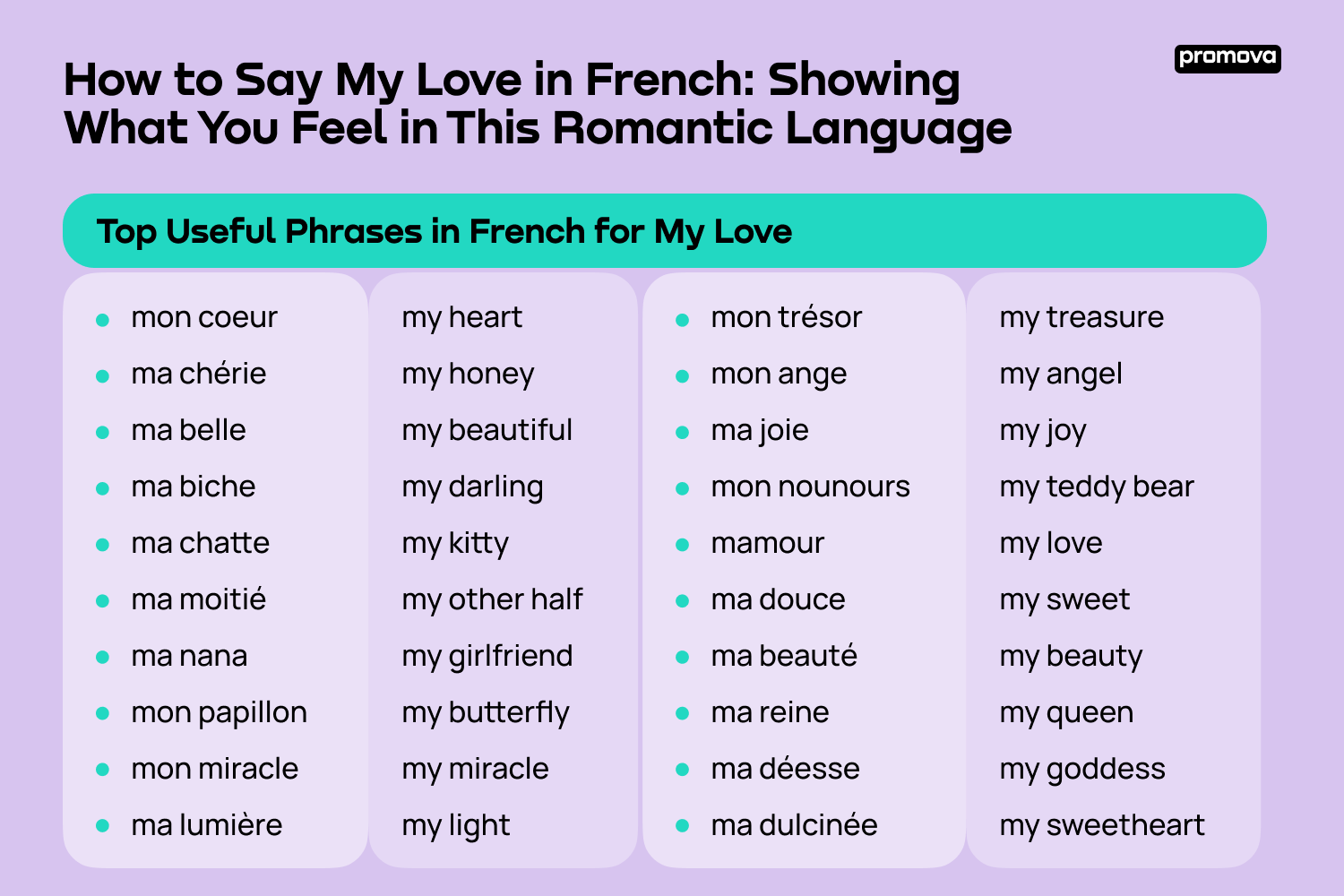
How to say my love in French: romantic phrases for partners
The most famous expression is mon amour — “my love.” But French speakers rarely stop there. The language has a rich tradition of creative, affectionate nicknames that go far beyond the obvious, reflecting deep feelings, romance, and the idea of emotional connection. French terms for 'lover' and 'woman' are also commonly used in romantic contexts, with specific words and phrases to refer to a girlfriend, boyfriend, or significant other. Many of these expressions can refer to a partner, family member, or close friend, depending on the context, and often carry the same meaning regardless of gender.
For her:
| French | Meaning |
| Mon amour | My love |
| Ma chérie | My darling / my honey |
| Mon cœur | My heart |
| Ma belle | My beautiful |
| Ma biche | My darling (literally “my doe”) |
| Ma moitié | My other half / better half (commonly used to signify a deep emotional connection in romantic relationships) |
| Ma lumière | My light |
| Mon ange | My angel |
| Ma reine | My queen |
| Ma déesse | My goddess |
| Ma douce | My sweet |
| Ma joie | My joy |
| Mon trésor | My treasure |
| Ma dulcinée | My sweetheart |
| Ma pomme d’amour | My love apple |
| Mon arc-en-ciel | My rainbow |
| Ma perfection | My perfection |
| Ma beauté | My beauty |
| Ma petite femme | My little wife |
| Mamour | My love (a softer, blended form of mon amour) |
| Ma puce | My flea (a playful and affectionate term, especially for women or loved ones) |
For him:
| French | Meaning |
| Mon chéri | My darling / my honey |
| Mon beau | My handsome |
| Mon chat | My cat |
| Mon chou | My favorite (literally “my cabbage” — yes, really) |
| Mon roi | My king |
| Mon roc | My rock |
| Mon Roméo | My Romeo |
| Mon homme | My man |
| Mon mec | My boyfriend |
| Mon Valentin | My Valentine |
| Mon prince charmant | My charming prince |
| Ma raison de vivre | My reason for living |
| Mon autre | My other half |
| Mon doux | My sweet (used to affectionately address a male partner) |
| Ma copine | My girlfriend (informal, used to refer to a girlfriend in casual contexts) |
One expression that deserves its own note: mon loulou. It doesn’t have a direct English translation. It likely comes from loup (wolf), but over time it evolved into something closer to “my sweetie” or “my little one.” French speakers use it across all ages and relationships — it’s one of those expressions that just sounds warm, no matter the context.
And yes, mon chou (my cabbage) is genuinely one of the most common terms of endearment in France. If it sounds odd, know that English has “honey,” “sugar,” and “pumpkin” — French just went with cabbage. Every language makes its own choices.
Learn possessive adjectives in French for affection phrases.
When expressing love in French, the most common way is je t'aime, which translates directly to "I love you" in English. This phrase is central to French romance and is used to convey deep feelings to a lover, partner, or even family. Other romantic phrases include je t'aime passionnément ("I love you passionately") and je t'aime pour toujours ("I love you forever"), each expressing different levels of emotional intensity and commitment.
For even deeper declarations, je suis amoureux/amoureuse de toi means "I am in love with you" (masculine/feminine) and is typically reserved for romantic partners. If you want to express overwhelming passion, you can say je suis fou/folle de toi ("I am crazy about you"), with "crazy" here emphasizing intense, mad feelings of love.
French also has a beautiful phrase for love at first sight: coup de foudre, which literally means "bolt of lightning" and refers to the idea of falling in love at first sight—an immediate, spontaneous romantic connection.
Pronouns like je ("I") and tu ("you") are essential in these expressions, as in Je t'aime de tout mon cœur ("I love you with all my heart") or Tu es mon âme sœur ("You are my soulmate"), where "soul" highlights the depth of the bond. Another soulful phrase is de toute mon âme ("with all my soul"), emphasizing profound emotional intimacy.
Some terms, such as mon amour, have the same meaning regardless of gender and can refer to a lover, partner, or even a close family member or friend, depending on the context. French endearments often reflect the desire to spend time with a loved one, as in phrases like Où es-tu, mon amour ? ("Where are you, my love?"), which expresses longing and affection.
Terms of endearment in French for children
French parents are famously tender with their children, and the language reflects that. Many of the most beloved expressions involve animals and nature — small, soft, endearing things that match how French speakers feel about their little ones. Some terms, like 'mon doudou', can refer to a beloved stuffed animal or comfort object, highlighting the importance of emotional comfort in French childhood. Similarly, 'mon chaton' means 'my kitten' or 'kitty', and is often used affectionately for children.
| French | Meaning |
| Mon petit amour | My little love |
| Mon doudou | My love / my comfort (a warm, very affectionate term; also means stuffed animal or comfort object) |
| Mon bébé | My baby |
| Mon caneton | My duckling |
| Mon poussin | My baby chick (used for romantic partners, friends, or family) |
| Mon lapin | My rabbit |
| Mon chaton | My kitten / kitty (affectionate for children) |
| Mon ours | My bear |
| Mon nounours | My teddy bear |
| Ma coccinelle | My ladybug |
| Ma grenouille | My frog |
| Mon lutine | My elf |
| Mon biquet / ma biquette | My little lamb |
| Mon rayon de soleil | My ray of sunshine |
| Mon étoile | My star |
| Mon petit trésor | My little treasure |
| Ma petite puce | My little flea (used affectionately — think “my little one”) |
| Ma princesse | My princess |
| Ma fille | My little girl |
| Ma choupinette | My cutie |
| Ma marmotte | My groundhog (oddly sweet in context) |
| Ma poupette | My little doll |
| Mon sucre d’orge | My candy cane |
| Mon bijou | My precious |
| Mon papillon | My butterfly |
| Mon miracle | My miracle |
The animal theme is worth noticing. French parents reach for creatures naturally — it reflects tenderness without being overly sentimental. If your child has a favorite animal, you can often build a nickname around it and it’ll land perfectly in French.
Master French present subjunctive for romantic phrases.
French terms of endearment for friends
Close friendships in French culture have their own vocabulary — warmer than acquaintances, more playful than romantic partnerships. Many of these affectionate terms can be used to refer to both friends and family, highlighting the closeness and intimacy of these relationships. The most heartfelt option is mon ami bien-aimé (“my beloved friend”) or simply ami de mon cœur (“friend of my heart”).
But French friends also use humor to show affection. These expressions are informal, absurd, and only appropriate with people you actually know well — whether you want to refer to a close friend or even a family member in a playful way:
| French | Meaning |
| Mon monstre | My monster |
| Ma truffe | My truffle |
| Mon ver de terre | My earthworm |
| Ma cocotte | My little pot (warm, grandmother-ish energy) |
| Ma loutre | My otter |
| Mon bouchon | My bottle cork |
| Ma vieille branche | My old branch |
Ma vieille branche is a particular favorite — it’s what you call a friend you’ve known forever, someone so familiar they’re like part of the furniture. Use these only when you’re certain the other person will take it in the spirit it’s intended. French humor is dry and affectionate at the same time, and these expressions walk that line.
9
Why it matters to express love out loud
You might already know how you feel about the people in your life. But saying it — in any language — does something that staying quiet doesn’t. Expressing your feelings out loud can be both fun and rewarding, especially when learning a new language.
Research in relationship psychology consistently shows that verbal expressions of affection strengthen emotional bonds, increase relationship satisfaction, and improve overall wellbeing for both the speaker and the listener. This applies to romantic relationships, parent-child relationships, and close friendships.
For children especially, words matter. Studies in developmental psychology show that verbal affirmations from caregivers contribute to a child’s sense of security and self-worth — even in infancy, before a child can speak back. Telling your child mon rayon de soleil isn’t just sweet. It’s doing something.
And for you, as a language learner — these expressions are some of the best vocabulary to start with. They’re short, emotionally resonant, and used constantly in everyday French conversation. Once you know mon cœur and ma belle, you’ll hear them everywhere.
How to pronounce French terms of endearment
French pronunciation can feel intimidating, but for these expressions, a few general rules help a lot:
- Mon sounds like “mohn” (nasal vowel — the “n” isn’t fully pronounced)
- Ma sounds like “mah”
- Amour sounds like “ah-MOOR”
- Cœur sounds like “ker” (the œ sound doesn’t exist in English — aim for something between “e” and “u”)
- Chérie / chéri sounds like “sheh-REE”
- Ange sounds like “ahnzh”
The best way to internalize these sounds is to hear them spoken by native speakers. Practicing speaking French and focusing on pronunciation with native speakers is key to mastering these romantic terms. French films, podcasts, and music are full of these expressions — once you start listening for them, you’ll notice them constantly.
Learn French expressions of love with Promova
Reading a list of expressions is a starting point. Actually remembering them, pronouncing them correctly, and using them in real conversation is a different skill — and that’s what Promova’s French course is built for. Mastering these phrases can help you impress native French speakers or loved ones, making your conversations more memorable and meaningful.
With Promova, you get:
- Bite-sized lessons that fit into your day — ten or fifteen minutes is enough to make real progress.
- Guided French courses developed by language professionals, available for all levels from absolute beginner to advanced.
- AI role-play practice with over 50 real-life scenarios — so you practice using French in actual conversations, not just recognition exercises.
Whether you’re learning French for travel, for a relationship, for a move to Paris, or just because you’ve always wanted to — Promova meets you where you are and helps you go further.
Summary
French has one of the richest vocabularies for expressing love and affection of any language — for partners, for children, and for close friends. The romance of the French language shines through in its heartfelt expressions, capturing the emotional and sentimental aspects of relationships. From the classic mon amour to the wonderfully absurd mon chou, these expressions carry centuries of warmth and cultural meaning.
Knowing them makes you a more expressive French speaker. Using them — actually saying them out loud to people you care about — makes you a better communicator in any language.
Start with the ones that feel natural to you. Say them. And let the French language do what it does best.
FAQ
How do you say “my love” in French?
The most common way is mon amour. Other popular options include mon cœur (my heart), ma chérie / mon chéri (my darling), and mon ange (my angel). The right choice depends on the gender of the person you’re addressing — mon for masculine nouns, ma for feminine.
Why do French people use animal nicknames?
French has a long tradition of animal-based endearments — mon lapin (my rabbit), mon caneton (my duckling), mon chaton (my kitten). It’s not considered strange; it’s considered tender. The small, soft associations of these animals make them feel affectionate rather than odd.
How do you translate “hugs and kisses” in French?
Directly translating “hugs and kisses” can lead to misunderstandings, as French culture expresses affection differently. For “kisses,” the word bisous is commonly used, especially in greetings and farewells. For “hugs,” the verb embrasser is used, but note that embrasser can mean both “to hug” and “to kiss” depending on context. There isn’t a direct equivalent for “hugs and kisses” as a phrase; instead, French speakers might say “gros bisous” (big kisses) or use embrasser to convey affection.
Can you use the same French endearments for friends as for partners?
Some overlap — mon cœur and mon ange can be used for close friends. But French also has a separate set of playful, humorous expressions for friendships, like ma vieille branche (my old branch) or ma cocotte, which wouldn’t typically be used with a romantic partner.



 English
 Français
 Português
 Español


Comments