Passive Voice
Contents

Passive voice is a term that you may have come across when studying English. It is a grammatical structure that is used to describe an action in which the subject is acted upon by the verb. In this reference, we will explore what passive voice is, why it is used, how to identify it, and when to use it.
What is the passive voice?
Passive voice is a grammatical structure where the subject of your sentence is acted upon by the verb. So, in the sentence
"The cake was eaten by the dog,"
the subject (the cake) is not performing the action (being eaten), but is being acted upon by the verb (was eaten).
In contrast, the active voice is a grammatical structure where the subject of your sentence performs the action. For example, in the sentence "The dog ate the cake," the subject (the dog) is performing the action (eating the cake).
Why use the passive voice?
The passive voice is used for a variety of reasons, including when the focus is on the action or the object being acted upon rather than the subject performing the action. It can also be used to emphasize the object or to avoid assigning blame or responsibility.
For example, in a scientific report, the passive voice may be used to emphasize the results rather than the researcher who conducted the experiment. In legal writing, the passive voice may be used to avoid assigning blame or responsibility.
Examples of passive voice in different tenses
Passive voice can come up in different tenses, including the present, past, and future.
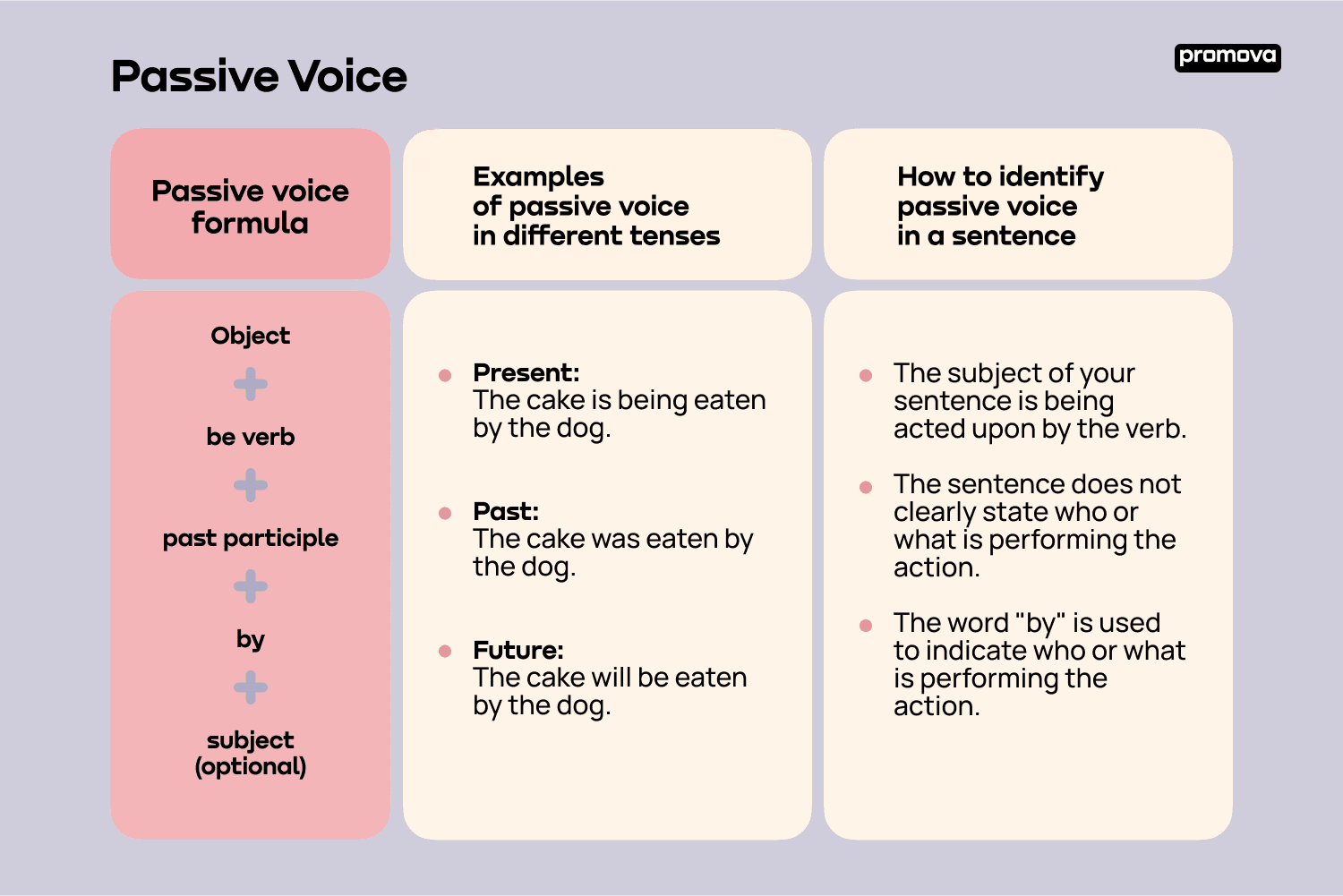
Present: The cake is being eaten by the dog.
Past: The cake was eaten by the dog.
Future: The cake will be eaten by the dog.
8
How to identify passive voice in a sentence
To identify passive voice in a sentence, look for the following:
- The subject of your sentence is being acted upon by the verb.
- The sentence does not clearly state who or what is performing the action.
- The word "by" is used to indicate who or what is performing the action.
For example, in the sentence "The ball was caught by the player," the subject (the ball) is being acted upon by the verb (was caught), and the word "by" is used to indicate who performed the action.
Passive voice formula and structure
The basic formula for passive voice is:
[Object] + [be verb] + [past participle] + [by] + [subject (optional)]
When to use the passive voice and when to avoid it
Passive voice is appropriate in certain situations, such as when the focus is on the action or the object being acted upon rather than the subject performing the action. It can also be used to avoid assigning blame or responsibility.
However, passive voice can also make a sentence less clear and can be overused, making writing sound awkward or impersonal.
Consider the context and purpose of your writing when deciding whether to use passive voice. If clarity and directness are important, active voice may be more appropriate.
Common mistakes
One common mistake when using passive voice is failing to include the subject that performed the action. This can make the sentence unclear or confusing.
For example, in the sentence "The cake was eaten," it is unclear who or what ate the cake.
Another mistake is overusing passive voice, which can make writing sound stifled and unnatural.
Summary
Passive voice is a common English grammatical construct. We use it for a variety of reasons, including when the focus is on the action or the object being acted upon, so it's not the subject acting. While it may make for dry and often boring writing, passive voice isn't the devil grammar checkers make it out to be - try using it yourself when it makes sense!
FAQ
What is "Passive Voice"?
How does "Passive Voice" differ from "Active Voice"?
When should "Passive Voice" be used?
What are some examples of "Passive Voice"?
Make your next step to fluency with Promova

 English
 Français
 Português
 Español


Comments